English Classroom Language for Students
Practise useful English classroom language for students. Ask for help, check instructions, work with a partner and explain what you do not understand.
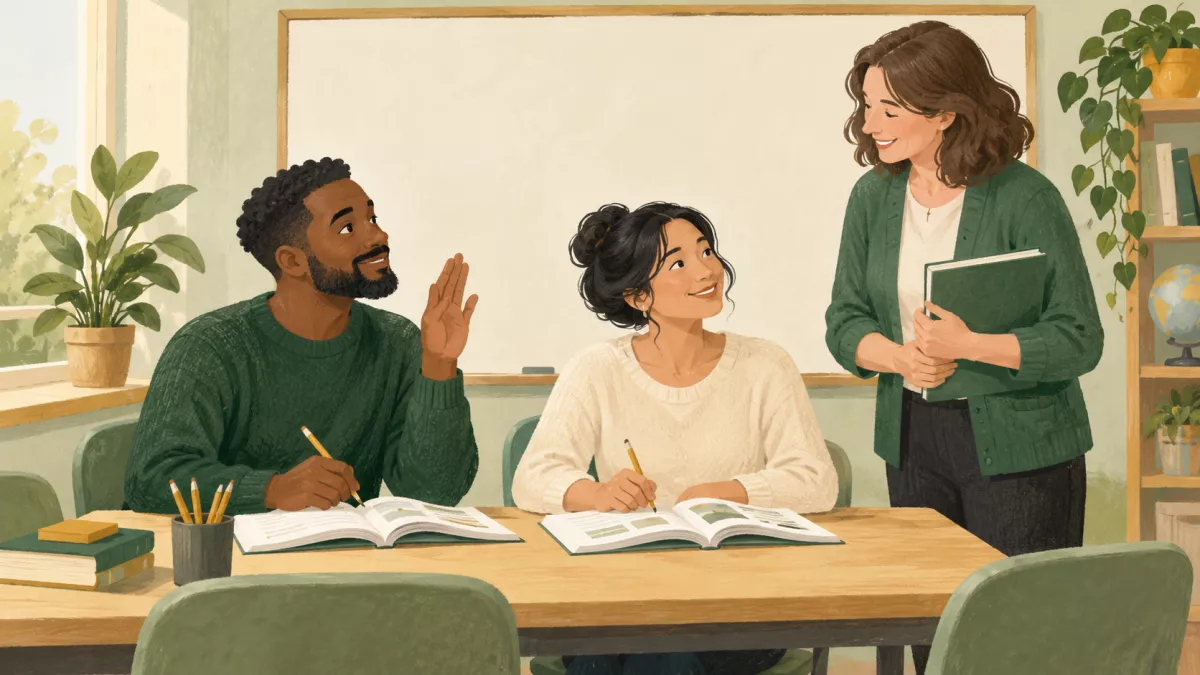
You understand part of a lesson, but the next instruction is unclear. “Could you explain the last step again?” helps you keep learning. Classroom English is useful because it gives you a way to participate before you know every word in the lesson.
These phrases work for many ages and settings, from a small language class to a study group. Choose a few you need most, say them aloud and practise responding to them. Your goal is to keep a real classroom exchange moving.
Ask for the kind of help you need
Situation | Useful student phrase |
|---|---|
You did not hear | Could you say that again, please? |
The pace is difficult | Could you speak a little more slowly? |
A word is unfamiliar | What does this word mean? |
You need its spelling | How do you spell that? |
You need pronunciation help | How do you pronounce this word? |
A task is unclear | Could you show us an example? |
You want to check a rule | Why do we use this form here? |
Scroll sideways to see all columns.
“I don’t understand” is a useful beginning. Add one detail when you can: “I understand the question, but I don’t understand this word.” That tells the teacher where to focus. If the problem is hearing, asking for repetition may help more than asking for a new explanation.
Could you is a common polite request, and can you is also widely used. A natural tone and a clear question matter more than making every request very long. “Could you repeat the page number, please?” is specific and easy to answer.
Understand common task words
Match means connect things that belong together, such as a word and its definition. Underline means draw a line below something; circle means draw a circle around it. Complete often means fill the missing part. Compare means look for similarities or differences, while explain asks you to give the reason or meaning.
Work in pairs usually means work with one other person. Take turns means let one person do something, then the other. Check your answers means review what you wrote; it does not always mean the teacher is asking for a spoken answer immediately.
When a task has several stages, listen for first, then and finally. You can check the order: “Do we read the dialogue first and answer the questions afterwards?” Practise this skill with simple English instructions so the sequence becomes easier to follow.
Use permission and borrowing phrases
“Can I use a dictionary?” asks permission. “Can you lend me a pencil?” asks another person to provide something. “Can I borrow your pencil?” asks to receive it temporarily. Add please when appropriate, and return borrowed items with a short thank-you.
Other useful phrases include “May I ask a question?”, “Could I move closer to the board?” and “Can I join this group?” A teacher may answer with a classroom rule: “You can discuss the first task, but you must write the final answer yourself.” Review must, have to and should when you want to distinguish a requirement from advice.
Check the rule rather than guessing. “Are we allowed to work together on this part?” is helpful when some tasks are collaborative and others are individual. The answer depends on that lesson’s instructions.
Make partner work a conversation
Try this short exchange. Learner A: “Shall we take turns reading?” Learner B: “Yes. Would you like to start?” Learner A: “Okay. Could you help me with this word?” Learner B: “Let’s ask the teacher so we can check it.”
You can also compare answers without demanding agreement: “I chose B because the speaker says she is leaving. What did you choose?” If your partner has a different answer, return to the sentence or recording together. “Can you show me the part that helped you?” turns disagreement into a useful check.
When giving feedback, name one feature: “I could follow the order clearly” or “Could you repeat the last date?” Specific feedback gives your partner something to keep or improve. You do not need to correct every detail at once.
Build a small classroom phrase routine
Choose three phrases: one for clarification, one for partner work and one for checking instructions.
Write a short situation for each phrase.
Practise the question with a partner and give a realistic reply.
Try using one phrase during your next lesson or study session.
For children beginning with letters, keep the spoken routine short: “Which letter is it?”, “Can I try again?” and “Your turn.” An activity such as Letter Learning can provide a setting for these exchanges. Add the classroom phrases around the activity at a comfortable pace, rather than expecting a child to memorise the whole table.
For older learners, keep a small personal list of phrases you actually used. After a lesson, note which one helped you get an explanation or complete a task. Reuse that phrase in another situation, then add one new expression when you need it.
Your turn · self-review
Choose a helpful classroom phrase
Write your answer first. Reveal the models, compare the reasons and try a fresh example.
Practice only. Your writing stays on this page; it is not submitted or saved.
-
Model answer and explanation
After we read the paragraph, do we answer the questions on our own or discuss them with a partner? This asks about the unclear stage rather than requesting the entire lesson again.
-
Model answer and explanation
I chose C because of the final sentence. Which answer did you choose? — I chose B. — Let’s read that part together and compare the evidence.