English Home Vocabulary: Rooms, Furniture and Chores
Learn English home vocabulary for rooms, furniture and everyday chores. Practise describing a room, locating objects and sharing household tasks.
Where do you keep your keys? What needs cleaning before a visitor arrives? English home vocabulary helps you answer these everyday questions. Room names give you a starting point, but furniture words, location phrases and chores let you describe what actually happens there.
Practise with your own home, a picture or an imaginary flat. You do not need to share personal details. A small, familiar space is enough for a useful lesson in naming objects, finding things and agreeing on a few household tasks.
Connect rooms with their everyday uses
Room or area | Objects you may find | Useful action |
|---|---|---|
kitchen | sink, fridge, cupboard | wash the dishes |
bedroom | bed, wardrobe, bedside table | make the bed |
living room | sofa, armchair, coffee table | tidy the room |
bathroom | shower, basin, mirror | clean the basin |
hallway | coat hooks, shoe rack | put away shoes |
study or workspace | desk, chair, bookshelf | organise papers |
Scroll sideways to see all columns.
These are examples, not rules about what every home contains. A living room may also be a sleeping space, and a workspace may be a small table in another room. Describe the arrangement you mean rather than assuming every home has the same rooms.
Home is the place where someone lives or feels they belong; house describes a type of building. A flat can be your home. In American English, apartment is a common word for flat, and closet often describes a built-in storage space. Wardrobe can mean a separate piece of furniture for clothes.
Talk about furniture and individual items
Furniture is normally uncountable. Say “There is some furniture in the room”, not “There are three furnitures.” To count, name the items: “There are two chairs and a table.” You can also use a piece of furniture when the item’s exact name is not important.
A shelf becomes shelves in the plural. A cupboard is a storage unit, often with doors; a drawer slides in and out of a desk or other unit. Learning these differences helps when you give directions: “The scissors are in the top drawer” is more precise than “The scissors are in the furniture.”
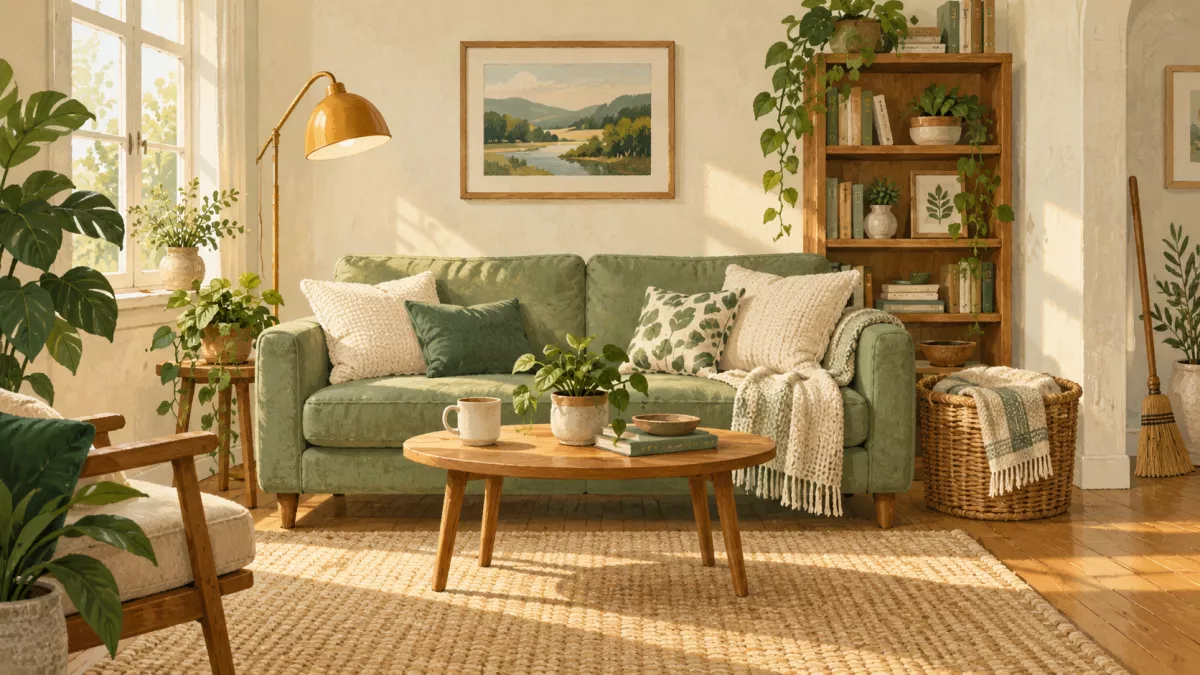
Use there is and there are to introduce a room: “There is a lamp beside the sofa. There are two cushions on it.” Once the object is known, you can say “The lamp is next to the sofa.”
Locate objects with a clear reference point
Useful phrases include on the table, in the cupboard, under the bed, beside the chair and between the windows. Choose a reference point the listener can identify. “It is over there” may work face to face, but “It is on the small table beside the door” helps someone who is looking on their own.
Compare “The keys are on the cupboard” with “The keys are in the cupboard.” The first places them on its top surface; the second places them inside. Review in, on and at for place and then add one new location phrase at a time.
A simple finding game works well with a room picture. One person describes an object’s location without naming it. The other identifies it and repeats the full sentence. Check the picture together if there are two possible answers.
Learn chores as complete phrases
A chore is a regular practical task. Useful combinations include do the laundry, wash the dishes, sweep the floor, vacuum the carpet, wipe the table, take out the rubbish and water the plants. In American English, take out the trash is common. Learn the verb with its object rather than memorising a noun alone.
Make the bed means arrange the bedding neatly. It does not mean build a bed. Tidy the room usually means put things in order, while clean the room focuses on removing dirt. Housework is normally uncountable: “We share the housework” or “I have some housework to do.”
When sharing tasks, name the job and check the timing: “Could you wipe the table after lunch? I’ll wash the dishes.” For a longer task, use simple instructions in English to put the steps in order. A specific request is easier to follow than “Do the kitchen.”
Describe a room and plan one small task
Choose a real or imaginary room and list five useful objects.
Write two there is/there are sentences to introduce it.
Describe where two smaller objects are.
Name one chore and say who will do it and when.
For example: “There is a desk near the window. The notebook is in the top drawer. I’ll organise the papers after dinner.” These sentences combine vocabulary with a clear purpose. On your next practice day, move one object in the imaginary room and explain the change without reading your original notes.
Your turn · self-review
Find the object and name the chore
Write your answer first. Reveal the models, compare the reasons and try a fresh example.
Practice only. Your writing stays on this page; it is not submitted or saved.
-
Model answer and explanation
There are two pieces of furniture in the room. You could also name them: There is a sofa and an armchair. Furniture itself is normally uncountable.
-
Model answer and explanation
The keys are in the small bowl beside the door. Could you take out the rubbish after dinner? The first sentence identifies a reference point; the second gives a specific task and time.