
In, On and At for Place: Everyday Examples
Use in, on and at for place with everyday examples for rooms, surfaces, meeting points and transport. Compare meanings and practise clear descriptions.
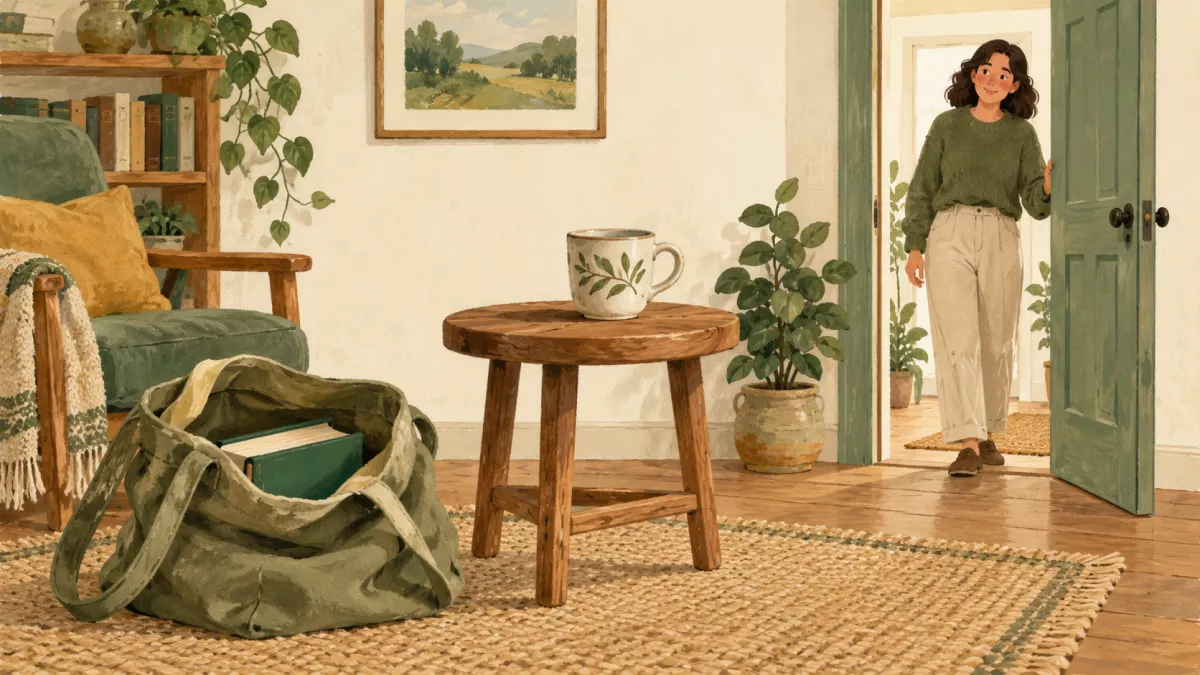
For place, in often presents something as inside an area or space, on describes a position on a surface, and at treats a location as a point or place of activity. Say “in my bag”, “on the table” and “at the entrance”. These are useful starting patterns, not rules that explain every expression.
The choice sometimes depends on how you present the place. You can be at a museum for a visit and in the museum when describing your physical position inside it. Context helps you decide what your listener needs to know.
Use in for an area or enclosed space
Try “The keys are in the drawer,” “She lives in a village,” and “We're in the kitchen.” A space can be small or large: in a box, in a room, in a city, in a country. You are presenting the person or object as within that space.
For a clear room description, combine this with the earlier there is and there are lesson: “There are two chairs in the kitchen.” The first part introduces the chairs; the final phrase places them.
Use on for surfaces and floors
Say “The notebook is on the desk,” “There's a picture on the wall,” and “The office is on the second floor.” A surface does not have to be horizontal. A notice can be on a door, and a mark can be on a ceiling.
Some phrases use on in other ways, such as “on the coast”. Learn a useful phrase in a sentence rather than forcing every example into one picture. The central surface idea will help with many ordinary object descriptions.
Use at for points and activities
Phrase | How the place is presented | Example |
|---|---|---|
at the door | A particular point | I'll wait at the door. |
at the bus stop | A meeting or waiting point | Meet me at the bus stop. |
at work | A place or situation of activity | She's at work until five. |
at a concert | An event | We met at a concert. |
Scroll sideways to see all columns.
At does not necessarily mean outside. “I'm at the library” does not specify whether you are just outside it or inside using it. If that detail matters, add it: “I'm inside the library, near the front desk.” For meeting arrangements, a more precise description often helps.
Compare place with movement and transport
“I'm in the office” describes a position. “I'm going to the office” describes movement towards a destination. Do not replace every to with at just because the destination is a place. Our directions guide gives useful movement phrases.
Common transport patterns include on a bus, on a train, in a car and in a taxi. These are established expressions, so learn them as phrases. “I go by train” describes the travel method; “I'm on the train” describes where you are now.
The same words also describe time, with different patterns. Keep the in, on and at for time guide as a separate reference rather than applying place examples directly to dates and hours.
Practise choosing the intended picture
Your turn · self-review
Locate people and objects
Complete the sentences and explain the meaning before checking the models.
Practice only. Your writing stays on this page; it is not submitted or saved.
-
Model answer and explanation
The phone is in my bag. My bag is on the chair. I'll meet you at the entrance. The phrases describe an inside space, a surface and a meeting point.
-
Model answer and explanation
I'm in the station is more specific about being inside the station space. I'm at the station identifies the station as your location without necessarily specifying inside or outside.
Check a phrase in context
Choose three objects near you and describe their positions. Then describe a meeting place with enough detail for another person to find you. If two choices seem possible, ask whether you mean an inside space, a surface or a general location.
For expressions that still feel uncertain, use a learner's dictionary example rather than guessing from size alone. The earlier dictionary guide shows how to check sentence patterns. A complete phrase is easier to reuse than a preposition on its own.





