
Asking for Directions in English: Useful Phrases and Dialogues
Ask for directions in English, understand turns and landmarks, and check the route with practical dialogues, a phrase table and answered exercises.
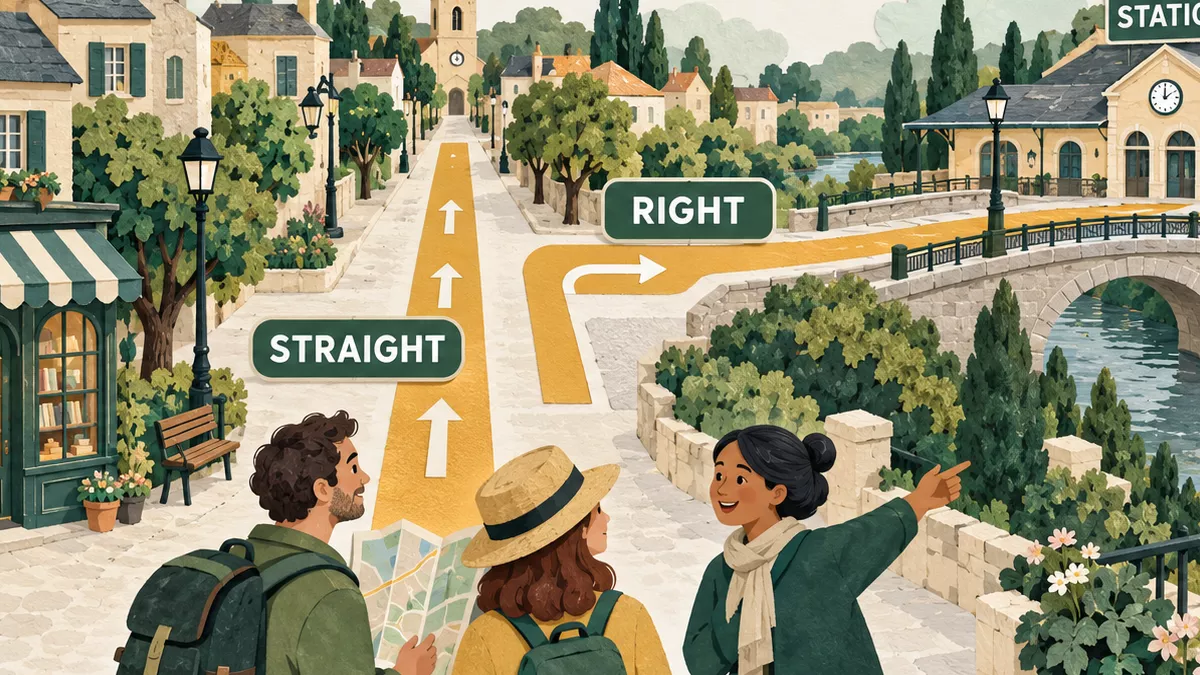
To ask for directions in English, start with “Excuse me”, name the place you need, and ask how to get there. Then listen for turns and landmarks. Before you leave, repeat the important part of the route so the other person can correct any misunderstanding.
You do not need a long question or a perfect accent. “Excuse me, where is the station?” is enough to begin. This lesson uses an imaginary town, so you can practise asking, following and checking directions without needing a real map.
Choose a question that fits the situation
What you need | A useful question |
|---|---|
Find a named place | Excuse me, how do I get to the station? |
Find the closest option | Is there a pharmacy near here? |
Ask more politely | Could you tell me how to get to the museum? |
Check the distance | Is it far from here? |
Check whether you can walk | Can I walk there? |
Scroll sideways to see all columns.
“How do I get to…?” asks about the route. “Where is…?” asks about the location; the reply may include directions too. If a name is difficult to pronounce, show the written name and say, “I’m looking for this place.” Give the person a moment to look before asking your next question.
Listen for actions, then landmarks
Directions often contain a small action followed by a place: “Turn left at the traffic lights.” The action tells you what to do. The landmark tells you when to do it. Listen for both; remembering only “left” may leave you unsure which street to take.
Phrase | Meaning in the route |
|---|---|
Go straight on. | Continue in the same direction. |
Turn right at the corner. | Change direction where the streets meet. |
Take the second left. | Pass the first left-hand street; turn at the next one. |
Go past the bookshop. | Continue beyond the bookshop. |
Cross the bridge. | Go from one side of the bridge to the other. |
It is opposite the park. | The place faces the park across the street. |
Scroll sideways to see all columns.
“On your right” describes where something is as you move. It does not always mean “turn right”. Also, “next to” means beside a place, while “opposite” means across from it. Those small differences can change the destination.
A complete station dialogue
Traveller: Excuse me, could you tell me how to get to the station?
Local: Yes. Go straight on past the bookshop. Turn right at the town hall and cross the bridge. The station is on your left.
Traveller: So, straight past the bookshop, right at the town hall, and then across the bridge?
Local: That’s right.
Traveller: About how long does it take to walk there?
Local: Around ten minutes.
Traveller: Great. Thank you for your help.
The traveller checks three steps rather than repeating every word. Notice the final location: the station is on the left after the bridge. The earlier right turn and the later left-hand location refer to different points in the journey.
If directions move too quickly, use the listening learning path to explore listening practice. During a conversation, ask for the part you missed: “Sorry, after the town hall, where do I go?”
Practise with a tiny town guide
Imagine you are standing outside the town hall. Use this guide to answer the questions. These routes are invented for the exercise; the cover illustration introduces the general idea of a route, rather than providing a map for this table.
Destination | Route from the town hall |
|---|---|
Station | Turn right, cross the bridge, then look on your left. |
Café | Turn left. The café is next to the post office. |
Library | Go straight on. The library is opposite the park. |
Scroll sideways to see all columns.
Your turn · self-review
Write, then compare
Answer in your own words, then compare the meaning and evidence with the models. Other clear answers may also be correct.
Practice only. Your writing stays on this page; it is not submitted or saved.
-
Model answer and explanation
The station: its route includes crossing the bridge.
-
Model answer and explanation
The café: “next to” tells you it is beside the post office.
-
Model answer and explanation
No. Go straight on; the right turn leads towards the station.
-
Model answer and explanation
Opposite: the library faces the park across the street.
Turn the phrases into a short role-play
Choose two familiar places near your home. One person asks for the first place; the other gives no more than three steps. The listener checks the route and asks about the distance. Swap roles, then change one landmark so you must listen again instead of memorising the reply.
You can find conversation practice in AI Conversations. Pick a relevant available scenario and focus on asking a clear question and confirming the answer; do not worry about making a long speech.
If the other person does not know, respond with “No problem, thank you anyway.” If you miss a turn in the explanation, ask about that specific step. Guessing silently gives the speaker no chance to help.
For your next session, explore the speaking learning path and practise one question, one three-step answer and one checking sentence aloud. Your goal is a route that both people understand.





