
How to Understand Fast Spoken English
Understand fast spoken English by noticing linked sounds, weak forms and sentence stress, then practise with a clear three-pass listening method.
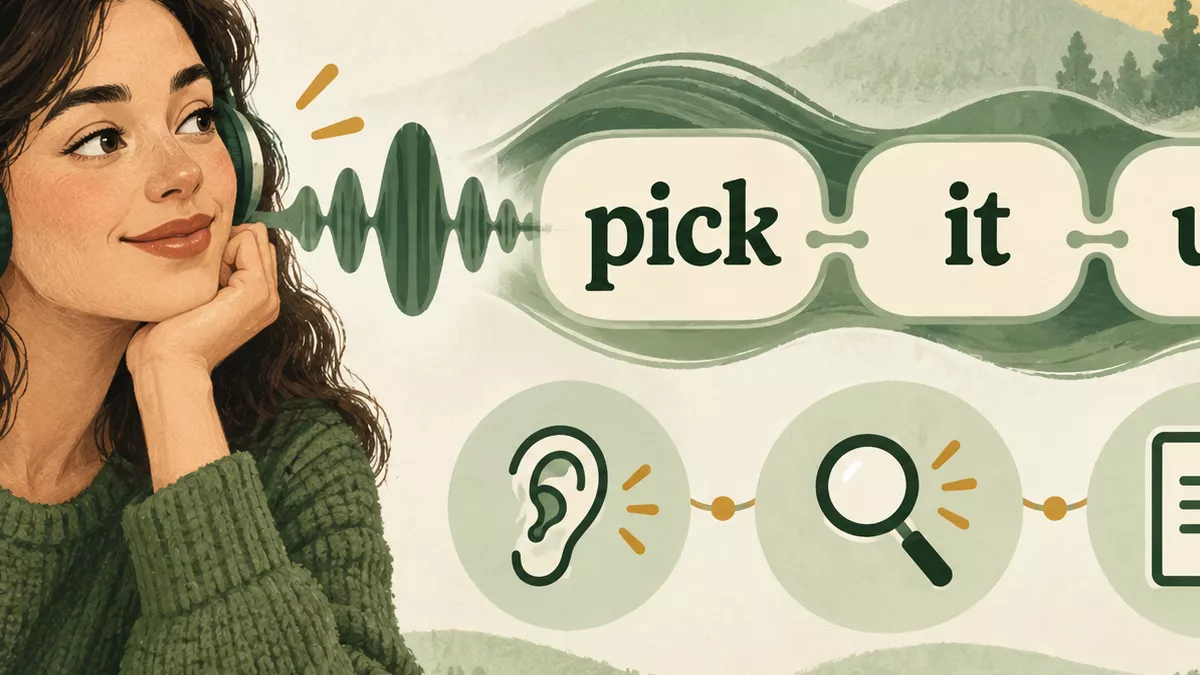
To understand fast spoken English, practise hearing groups of words rather than expecting every word to sound separate. Listen first for the message, return for important details, then compare the sounds with a reliable transcript. This helps you discover whether the difficulty is speed, unfamiliar language or a word that sounds different in a sentence.
You do not need to catch every small word to understand a conversation. Your aim is to follow the speaker’s meaning and notice the sounds that carry useful information.
Why familiar words can be hard to hear
Written English has spaces between words. Speech does not provide equally clear gaps. A word you recognise immediately on a page may be shorter, less prominent or joined to a neighbour when someone says it.
Connected speech varies with the speaker, accent, situation and emphasis. Treat the examples below as patterns to notice, not exact rules for every recording. Clear communication matters more than copying one particular accent.
Words can link together
In a phrase such as “pick it up”, the final consonant of one word can link smoothly into the vowel at the start of the next. The phrase may feel like one continuous sound group. Read the normal spelling, then say the phrase smoothly without adding a pause after each word.
Use “pick_it_up” as a visual reminder of linking. The underscores show connections; they are not a pronunciation transcription or a new way to spell the phrase.
Small words can have weaker forms
Words such as “to”, “and” and “can” often receive less emphasis when they are not important to the message. Their vowels may become shorter or weaker. If the speaker emphasises one of these words, its sound may become stronger again.
In “I can meet you on Friday”, the day may be the most important information. In “I CAN meet you”, the speaker may be correcting the idea that they cannot. Listen to the whole message before deciding which words matter most.
Stress gives you a guide
Sentence stress means some words stand out more than others. Important nouns, main verbs and other key information often help you follow the meaning. Small grammatical words still matter, particularly for details such as a negative, but they do not always have equal volume or length.
Written phrase | What to notice | Useful meaning |
|---|---|---|
Pick it up, please. | Smooth links across pick / it / up. | Someone asks you to lift something. |
We can meet on Friday. | The day may receive the strongest stress. | A possible meeting day. |
I wanted the blue one. | Blue may stand out when colour matters. | A contrast with another colour. |
Scroll sideways to see all columns.
Choose a manageable recording
Start with a short recording on a familiar topic and a trustworthy transcript. A small section you can replay is more useful for detailed practice than a long programme that loses you immediately. The listening path is a good place to find structured practice.
If you cannot understand the transcript either, some of the difficulty is vocabulary or grammar. Study the essential language, or choose an easier recording, before expecting repeated listening to solve everything.
Use the three-pass listening method
Pass 1: catch the main message
Listen without reading. Ask who is speaking, what the situation is and what the person wants. Write one short sentence about the overall message. Keep listening after an unclear word; the next sentence may explain it.
Pass 2: look for chosen details
Choose two questions before you replay. For a meeting arrangement, these might be “When?” and “Where?” For a request, ask “What does the speaker need?” and “What should happen next?” Listen for these details instead of trying to write every sound.
Pass 3: connect sound and text
Read the transcript and mark one phrase you missed. Replay that section while looking at the words. Then put the text away and listen again. Notice a link, a weak form or a stressed word that helps you recognise the phrase.
These three passes are a practice structure. You may need extra replays, and that is fine. Keep the focus on finding a specific difficulty rather than repeating the whole recording without a question.
Work through a sample message
The following is an original practice script, not an embedded audio recording. Read it aloud, ask a study partner to say it, or use it as a model when choosing a similar listening lesson.
We can meet outside the library on Friday. I finish work at four, so half past four would be better. Bring your notebook, but you don’t need your laptop.
Before checking the answers, decide:
Your turn · self-review
Write, then compare
Answer in your own words, then compare the meaning and evidence with the models. Other clear answers may also be correct.
Practice only. Your writing stays on this page; it is not submitted or saved.
-
Model answer and explanation
To arrange a meeting.
-
Model answer and explanation
Outside the library.
-
Model answer and explanation
Half past four (4:30). The speaker finishes work at four, but prefers to meet later.
-
Model answer and explanation
The laptop. Bring the notebook; you do not need your laptop.
Words such as “so” explain a reason or result, while “but” signals a contrast. The phrase “don’t need” changes the instruction. Listening for these details helps you avoid choosing the first time or object you hear.
Review one difficult phrase
Write a small note with the phrase, what you first thought you heard, and what helped you recognise it. Later, replay the phrase without the transcript. For closer sound-to-word practice, use Dictation Trainer. To repeat phrases and notice rhythm, try Shadowing Practice.
The British Council’s introduction to connected speech gives further background on why words can sound different together.
Choose one manageable recording today. After your three passes, keep just one phrase you can now recognise more clearly. That specific discovery gives your next listening session a useful starting point.





