
How to Practise Speaking English Alone
Practise speaking English alone with a seven-day recording challenge, useful prompts and a simple way to review your speech without overcorrecting.
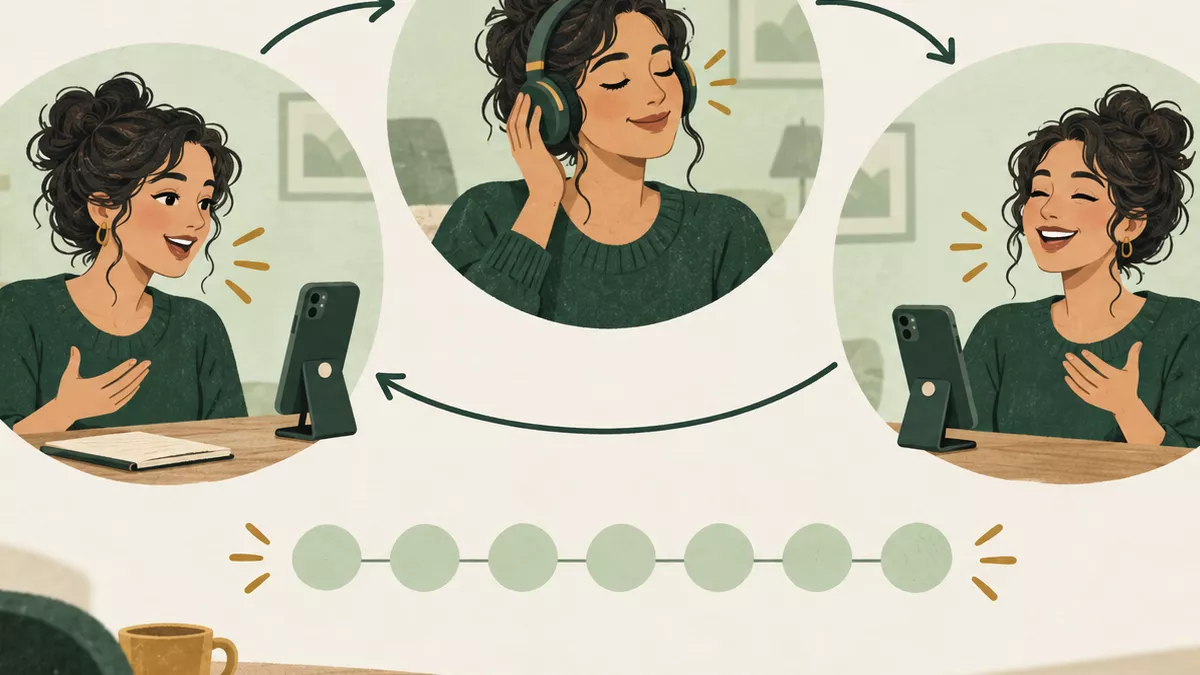
You can practise speaking English alone by choosing a small topic, speaking out loud, recording yourself, and trying again after one useful correction. You do not need to prepare a long speech. A clear thirty-second answer is a good starting point.
The important part is the review. Speaking once gives you practice; listening back helps you notice where your message becomes unclear. This seven-day challenge gives you a different speaking task each day while keeping the same simple practice loop.
Set up a small speaking space
Choose a quiet place and use a phone or another device that can record and play back your voice. You can keep these recordings for your own review. A notebook is useful for three or four prompt words, but avoid writing every sentence before you speak.
Start with a topic you know: your room, your breakfast, your work, or a place you like. If you have to research the topic first, you are making the speaking task harder than it needs to be.
Use the record, review, repeat loop
Choose one question. For example: What do you usually do after work?
Write three prompt words. Try dinner, walk, book. These support your memory without becoming a script.
Record your answer. Aim for thirty to sixty seconds. Pause when you need to think, then continue.
Listen for one problem. Perhaps a word is difficult to hear, a sentence is unfinished, or the order of your ideas is confusing.
Record a second version. Keep the same message and improve that one point. Stop after the second or third attempt.
You can use Pronunciation Coach for focused word practice when one word needs attention. For your longer answer, listen to the whole recording yourself: a word-level practice task and a complete spoken message serve different purposes.
See how one answer develops
Question: What do you usually do after work?
First version: After work, dinner. Then I walking. I like books, I reading before sleep.
The message is understandable, but several actions need complete verb phrases. Choose that single focus rather than changing everything at once.
Second version: After work, I make dinner. Then I go for a walk. I usually read a book before bed because it helps me relax.
The second answer has a simple order and a reason. It does not need advanced words. Notice the useful phrases: make dinner, go for a walk, and before bed. Say them as small groups of words instead of stopping after each word.
Your seven-day speaking challenge
Your turn · self-review
Plan, speak, then review
Try one task each day. Say your answer aloud and, if you wish, record it with your own device. Use the boxes for optional planning or review notes, then compare with the examples. These boxes do not record or assess speech. Use invented personal details if you prefer.
Practice only. Your writing stays on this page; it is not submitted or saved.
-
Model answer and explanation
One possible introduction: “Hi, I’m Ana. I work in a shop. In my free time, I enjoy drawing.” Include the three requested details and finish each thought. Your name, activity and interest can be different.
-
Model answer and explanation
For example: “There is a desk by the window. A chair is beside the desk, and a lamp is on it.” Move from one object to the next so the listener can follow your description. Use objects from your own room.
-
Model answer and explanation
For example: “I usually get up at seven. I have breakfast, then I walk to work.” Notice the complete phrases get up, have breakfast and walk to work. Adapt the routine to your own situation.
-
Model answer and explanation
For example: “Yesterday, I went to the market. I bought some fruit and met a friend on the way home.” Yesterday establishes the time; went, bought and met describe completed events. Your story may be different.
-
Model answer and explanation
For example: “Go straight along this street. Turn left at the crossing. The shop is on your right.” Put the steps in travel order and use clear landmarks. Check the directions against the place you actually chose.
-
Model answer and explanation
For example: “It was quiet. I visited my cousin on Saturday, and we watched a film together.” The extra detail gives your partner something to ask about. Describe another weekend if you prefer.
-
Model answer and explanation
An example review note: “I said my daily activity without looking at my prompts. I still want to make enjoy drawing clearer.” Compare your own two attempts and choose one concrete improvement. This is a reflection, not a fluency score.
Treat the plan as a set of practice tasks, not a promise of fluency in a week. If one task is difficult, shorten it to three sentences. If it feels comfortable, add a reason or an example.
Review your speech without judging every sound
Ask three practical questions when you listen back:
Message: Could someone understand what happened or what I want?
Clarity: Which word or phrase would I ask the speaker to repeat?
Flow: Where did I stop because I could not find the next idea?
Write one note such as “Finish the sentence before adding another idea.” A note like “My English is bad” does not tell you what to practise. Compare your own attempts instead of measuring yourself against a polished presenter.
Pronunciation can be clearer without removing your accent. If you struggle with a phrase, listen to a short model in Shadowing Practice, repeat it slowly, and then return to your own message.
Avoid three common traps
Reading a full script every time: Try one prepared version if you need it, then turn the script over and use prompt words. Reading aloud and finding your own words are different tasks.
Restarting after every mistake: Finish your thought first. In a real conversation, the other person usually needs the message more than a perfect restart.
Practising only monologues: Solo recording cannot teach you every part of listening and turn-taking. When you are ready, try a suitable scenario in AI Conversations and respond to what your partner actually says.
Make your first recording today
Choose the day-one task and write only three prompts: name, routine, interest. Record a short answer, listen once, and improve one point. Save both versions with a clear date so you can compare them after the week. For a structured next step, explore the speaking learning path and choose a foundation lesson that matches the difficulty you noticed.





