How to Describe a Lost Item in English
Describe a lost item in English with useful details about colour, size and location. Practise asking for help and answering follow-up questions.
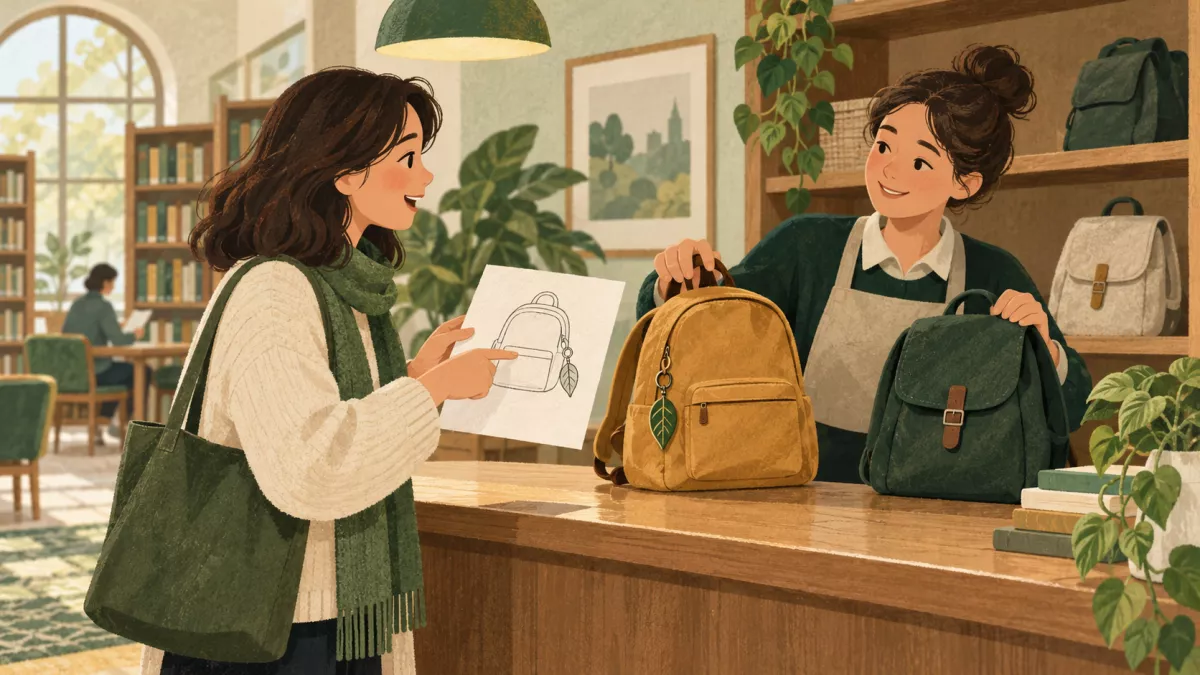
“I've lost my bag” tells someone the problem, but it does not identify the bag. When you describe a lost item in English, add the details that distinguish it from similar objects. A clear description and a careful account of where you last saw it help the listener ask useful follow-up questions.
Start with the item and the request
Useful openings are “Excuse me, I've lost my…” and “Has anyone handed in a…?” You can ask, “Do you have a lost-property desk?” The exact service depends on the place, so begin by asking the right person where to get help.
If you know you left an object somewhere, say “I left my notebook in the classroom.” If you do not know where it is, “I've lost my notebook” fits. “I think I left it…” keeps the uncertainty clear. You do not need to present a guess as a fact.
Give a few distinctive details
Detail | Useful phrase | Example |
|---|---|---|
Type | a small backpack | It's a small backpack. |
Colour | dark blue | It's dark blue. |
Material or appearance | made of canvas | It's made of canvas. |
Distinctive feature | a leaf-shaped keyring | It has a leaf-shaped keyring. |
Condition | a mark on the front | There's a white mark on the front. |
Scroll sideways to see all columns.
Choose details a listener can recognise. A small dark-blue backpack with a white mark is easier to distinguish than “a nice bag.” The description lesson helps you choose precise adjectives and arrange them naturally.
If the object is difficult to name, explain its use: “It's a small case for my glasses.” You can sketch the shape in person. Keep the first description brief enough for the listener to remember, then add another detail if they need it.
Explain where and when you last saw it
Say “I last saw it beside the window at about four.” About shows that the time is approximate. Include a useful sequence if it helps: “I had it in the reading room, then I went to the café.” Avoid telling every detail of your whole day unless it becomes relevant.
The listener may ask “Where were you sitting?”, “What time did you leave?” or “Was anything inside?” Answer what you know and say when you are unsure: “I don't remember the exact table, but it was near the door.”
A relative clause can add a specific feature: “It's the bag that has a broken zip.” Review who, which and that for a way to add information without a long series of separate sentences. For objects, which or that is useful in this kind of description.
Check whether a found item is yours
“Is this your bag?” “Yes, that's mine.” My needs a noun in “my bag,” while mine stands on its own. “That looks like mine, but mine has a green strap” is useful when the object is similar but not the same. The pronouns and possessives lesson explains these forms.
Do not agree just because an item has the right general colour. Use your distinctive details to check it. If it is different, say “Thank you, but mine is smaller” or “That isn't the one; mine has two pockets.” The language keeps the correction clear and polite.
Practise a short lost-item exchange
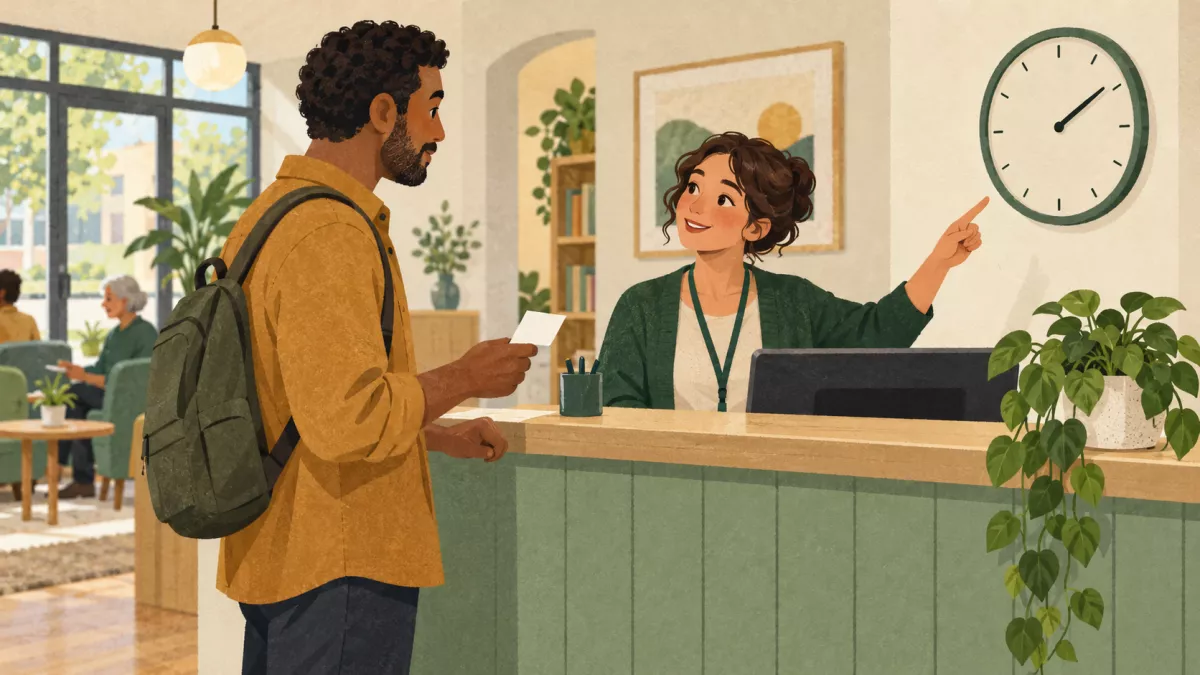
Visitor: “Excuse me, has anyone handed in a blue notebook?” Assistant: “What size is it?” Visitor: “About this big. It has a yellow elastic band.” Assistant: “Where did you last see it?” Visitor: “On a table near the reading-room window, at about four.”
The assistant asks for one detail at a time. The visitor answers directly and signals an approximate time. For a partner task, choose an ordinary object and write four identifying details. Let the partner ask questions without seeing your note.
Swap roles with a different object, such as an umbrella or a pencil case. Finish by checking whether your partner can repeat the two most distinctive features. If they remember only “a bag,” shorten the background story and make the identifying details clearer.
Your turn · self-review
Make the item identifiable
Write your answer first. Reveal the models, compare the reasons and try a fresh example.
Practice only. Your writing stays on this page; it is not submitted or saved.
-
Model answer and explanation
“Excuse me, has anyone handed in a small green umbrella? It has a wooden handle and a yellow strap.” The size, colour and features identify it more clearly than nice.
-
Model answer and explanation
“Thank you, but that isn't mine. Mine has a red strap.” Mine replaces my bag, and the distinctive feature explains the difference.