
English Word Stress: How to Make Your Speech Clearer
Understand English word stress with clearly marked syllables, everyday examples and a short listening-and-speaking routine you can practise today.
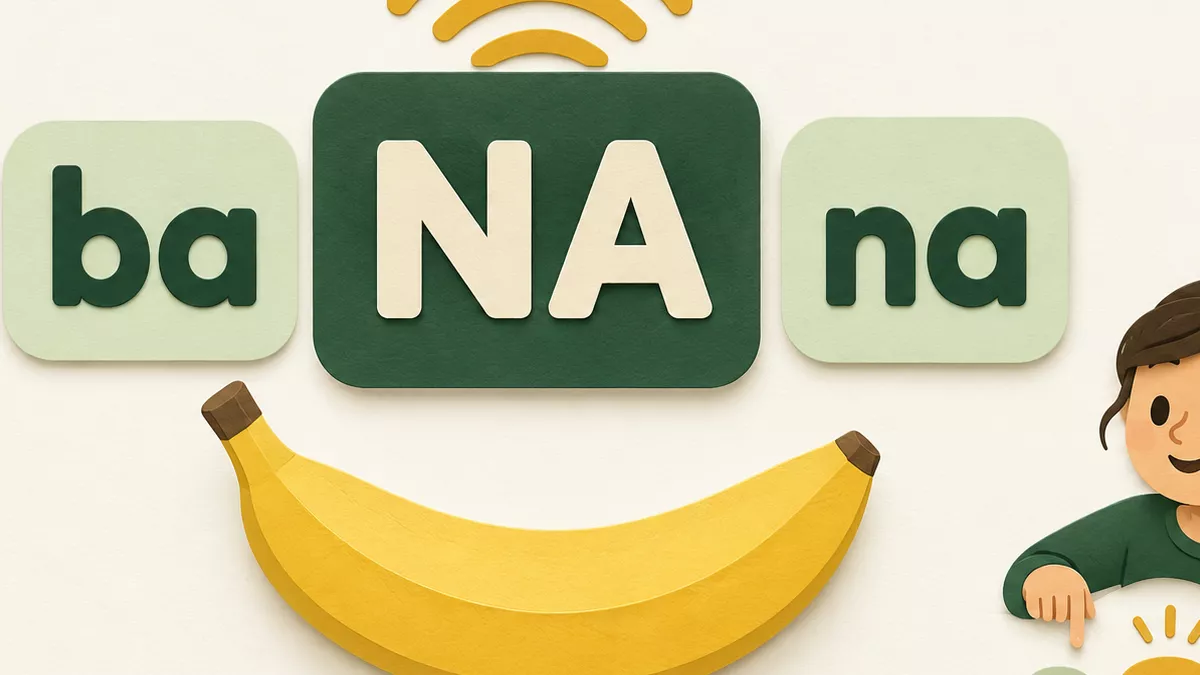
English word stress means giving one syllable more emphasis than the others in a word. In banana, the strongest beat is the middle one: ba-NA-na. In hotel, it is the last one: ho-TEL. Learning that strong beat can make a word easier to recognise and say clearly.
Begin by listening to a word, identifying its main stressed syllable, and repeating the whole word with the same pattern. You do not need to shout or change your accent. Aim for a clear difference between the stronger and weaker parts.
Hear syllables before looking at spelling
A syllable is a spoken beat, usually built around a vowel sound. The number of vowel letters does not always tell you how many syllables a word has. Listen to the pronunciation rather than counting letters.
For example, table has two spoken syllables. Banana has three. Say each word slowly and tap once for each syllable. Then say it at a comfortable speed and notice which tap feels strongest.
The separated spellings below are learning aids, not phonetic transcriptions. Capital letters mark the main stressed syllable. Hyphens show the approximate spoken groups; they are not part of the normal spelling of these words.
Five everyday examples
Normal spelling | Stress practice | Main stressed syllable |
|---|---|---|
table | TA-ble | First |
banana | ba-NA-na | Second |
hotel | ho-TEL | Second |
important | im-POR-tant | Second |
photograph | PHO-to-graph | First |
Scroll sideways to see all columns.
Try saying the words without looking at the final column. Tap a little more firmly on the capitalised part while allowing the other syllables to remain lighter.
The British Council's explanation of stress describes how a stressed syllable can be more prominent through length, loudness and pitch. The exact balance varies with the speaker and context; simply making one part very loud is not the whole skill.
Learn the pattern with the word
When you add a useful word to your notes, record its meaning and stress together. For example: “hotel — ho-TEL — We booked a hotel near the station.” This gives you a word, its rhythm, and a sentence you might actually use.
Do not assume that every two-syllable word has the same stress pattern. Table and hotel already show different patterns. Related words can change their stress too, so check unfamiliar words rather than applying a rule blindly.
A dictionary pronunciation guide can help. In many phonetic transcriptions, the mark ˈ appears immediately before the main stressed syllable. You can compare the audio and stress patterns in Cambridge Dictionary's entries for hotel, important, and photograph.
A five-minute stress practice routine
Choose three useful words. Start with words you already understand so meaning does not distract you.
Listen to a reliable model. Use dictionary audio or a clear short lesson example. Listen once without speaking.
Mark the strongest beat. Underline it in your notebook or write that part in capitals.
Repeat the whole word. Tap its rhythm, then say it again without tapping. Avoid leaving a long pause between syllables.
Use it in a sentence. Try “The hotel is near the station” or “This is an important message.”
Record your sentence on your own device and listen back. Does the word still have the same main stress when it is inside the sentence? Start slowly, then return to a comfortable speaking speed. A clear slower attempt is more useful than rushing through an unclear pattern.
If one word needs extra attention, try focused practice with Pronunciation Coach. For repeating words inside short phrases, Shadowing Practice provides another practice activity.
Practise: choose the stress pattern
Choose the version with the correct main stress for each word. Read both aloud before checking.
Answer on paper, then open the explanations below. Enable JavaScript to check answers here.
Now put two words into a short message: “This photograph shows our hotel.” Mark the strong part of each word, then say the whole sentence smoothly. Keep the full word together instead of saying isolated syllables one by one.
Avoid these common mistakes
Stressing every syllable equally: Try making the weaker syllables lighter while keeping them understandable. Contrast is the point.
Treating capitals as different spelling: Write banana normally in an email or message. ba-NA-na is only a practice notation.
Mixing up word stress and sentence stress: Word stress concerns the parts inside a word. Sentence stress concerns which words receive emphasis in a message. A speaker may emphasise different words to show contrast, but that does not mean you should move the main stress inside hotel to its first syllable.
Take three words into your next conversation
Choose three words you expect to use this week. Check the pronunciation, mark the main stress, and practise each in one relevant sentence. Return to those sentences the next day without looking at your notes. If you want a structured foundation in sounds and clearer delivery, explore the speaking learning path and choose a pronunciation lesson.





