
Bring vs Take, Come vs Go: Choosing the Right Verb
Choose bring or take and come or go by checking the speaker’s viewpoint. Compare everyday situations, follow short dialogues and practise the difference.
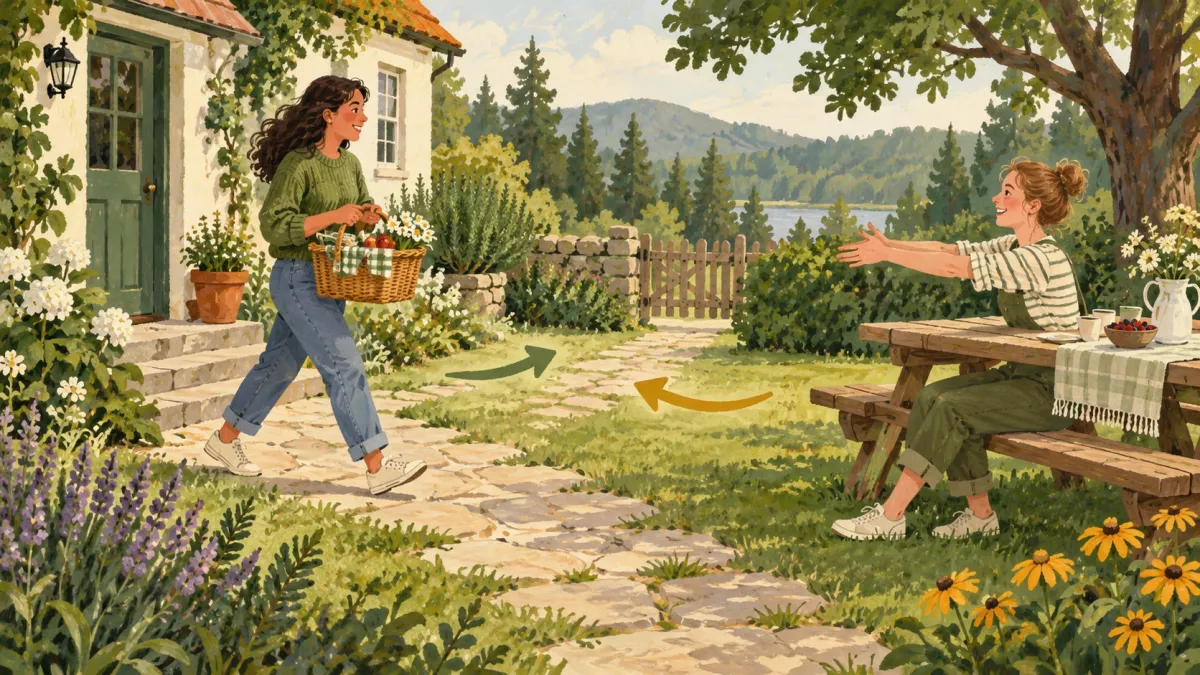
Bring and come often describe movement towards the speaker, listener or a place being treated as the destination of their meeting. Take and go often describe movement away to another place. Bring and take include moving an object or another person; come and go can describe the mover's own journey.
The useful question is “Whose viewpoint are we using?” A simple towards-or-away diagram helps, but a conversation may refer to where someone will be later, not only where they are standing now.
Use bring and take for moving something
Situation | Natural example | Viewpoint |
|---|---|---|
You are in the kitchen and want a cup there | Could you bring me a cup? | The cup moves towards you. |
You are leaving home for a picnic | I'll take some water with me. | You move it away from home. |
You invite someone to your home tomorrow | Can you bring a game? | Your home is the meeting destination. |
You send a parcel elsewhere | Please take this to the post office. | The parcel moves to another place. |
Scroll sideways to see all columns.
The object can be a person: “I'll take my sister to the station.” You are accompanying or transporting her there. For directions and destinations, see the existing directions lesson.
Use come and go for the journey
If you are at home, you can ask a friend, “Are you coming here after lunch?” If you are talking about a separate trip, you might say, “I'm going to the market.” The place you are treating as the centre of the conversation helps determine the verb.
A listener's location matters too. If a friend at the library asks where you are, “I'm coming to meet you” is natural even though you have not arrived. You are viewing the movement from the friend's destination.
Allow for a future meeting place
Imagine arranging tomorrow's picnic while both people are still at home. “Are you coming to the picnic?” treats the picnic as the shared destination. “I'll bring a blanket” uses the same viewpoint. Neither sentence requires the speaker to be at the park already.
You may also hear “Are you going to the picnic?” when the speaker describes attendance more generally. Both can fit a conversation, with a different viewpoint. Avoid a rule that marks every use of go as wrong whenever a meeting is involved.
Follow the viewpoint through a dialogue
Host: We're meeting at my house on Saturday. Can you come at six?
Guest: Yes. Shall I bring anything?
Host: Could you bring some fruit?
Guest: Of course. I'm going to the market in the morning, so I'll get some there.
Come and bring refer to the host's house. Going refers to the guest's separate market trip. The same speaker can switch verbs naturally as the destination changes.
These are movement meanings. Take also appears in phrases such as “take a break”, which do not describe carrying an object to a destination. Learn those as complete expressions. Our say, tell, speak and talk guide offers another example of choosing familiar verbs by context.
Practise choosing a viewpoint
Your turn · self-review
Follow the destination
Explain whose location matters before revealing the model.
Practice only. Your writing stays on this page; it is not submitted or saved.
-
Model answer and explanation
I'm coming to meet you, and I'm bringing your notebook. The friend's destination is the viewpoint. Other wording can work, but this is a natural connected answer.
-
Model answer and explanation
I'm going to the shop, and I'm taking this box with me. The movement is away from your current shared location to another place.
Draw the scene before choosing
Sketch two places and mark the speaker, listener and destination. Add an arrow for the person and another for anything carried. Then say one sentence. If the conversation concerns a future meeting, mark that destination too.
Use the earlier place prepositions guide to describe where people are. Practise changing who speaks: a guest leaving home and a host expecting the guest may describe the same journey differently. The viewpoint explains the change.





