
How to Understand Difficult Sentences With Text Coach
Use Text Coach to understand difficult English sentences by finding the main clause, checking linking words and comparing a plain-English explanation.
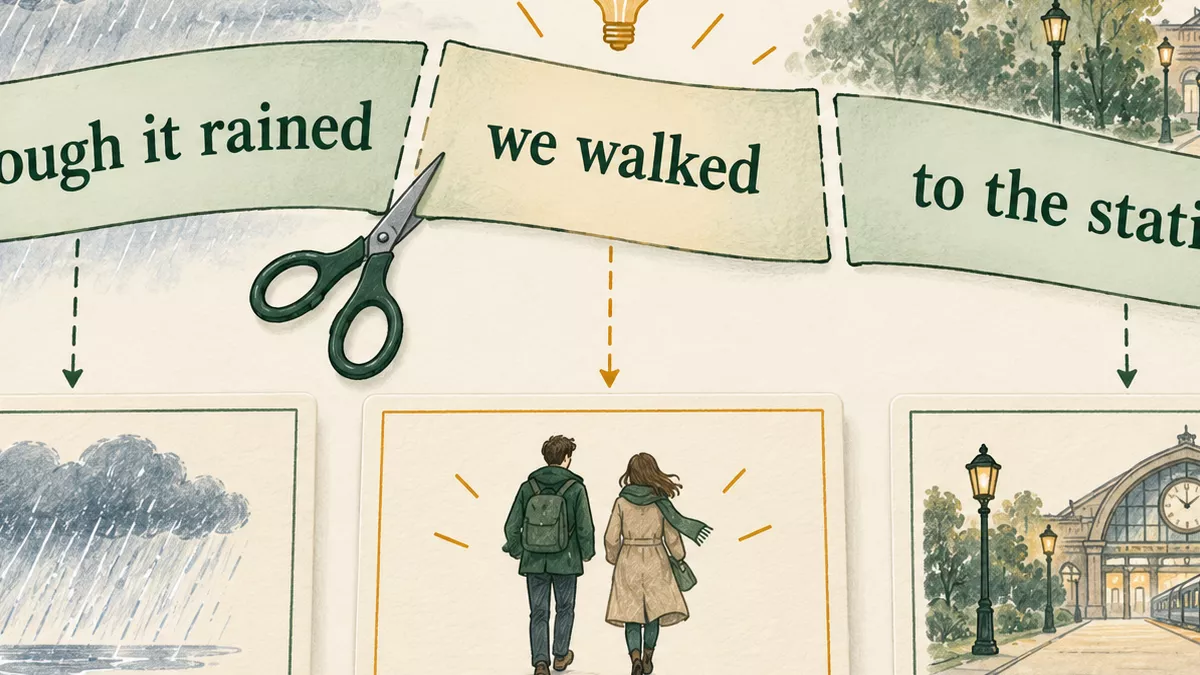
To understand a difficult English sentence, find the main action first, then work out how the other parts connect to it. Text Coach’s Explain mode offers a plain-English meaning and coaching notes you can compare with the original. Use the explanation to answer specific questions about the sentence, rather than simply copying an easier version.
Start with one sentence that is just beyond your comfort level. A sentence with although, because or a long noun phrase makes a useful task. The worked examples below are original lessons written for this guide; they are not claimed to be recorded outputs from the tool.
Use Explain mode for a meaning question
Open Text Coach’s Explain mode. The mode is labelled Explain in the workspace, with the heading Understand the sentence. Improve text is for revising writing; Explain is the mode to choose when you want to understand what you have read.
Paste one complete sentence into Your text. Keep a copy of the original in your study note.
Read the word minimum and character counter currently displayed. If the button is disabled, check that your input meets those requirements.
Choose Check text and wait for the result. Read Plain-English meaning, then open View coaching notes.
Compare the explanation with the original. The notes can include a Coach overview, learning notes linked to source excerpts and a Try next suggestion.
Use Edit if you want to change the source and try again. Copy result copies the explanation when your browser allows it.
Use as new input moves the result into the editor. For this reading exercise, keep the original sentence available: you need it to check meaning. Moving an explanation into the input does not preserve a separate comparison history for you.
Find the main message before the detail
Original example: “Although it rained, we walked to the station because the last bus had already left.”
The main message is “we walked to the station”. Two other parts explain its context. Although it rained describes a contrast: rain might make walking less attractive, but we walked anyway. Because the last bus had already left gives the reason for the decision.
Sentence part | Question it answers | Meaning to keep |
|---|---|---|
we walked to the station | Who did what, and where? | We travelled to the station on foot. |
Although it rained | What happened despite a difficulty? | It rained, but that did not stop the walk. |
because the last bus had already left | Why did we walk? | The bus had left before the decision or walk. |
Scroll sideways to see all columns.
A clear illustrative explanation is: “The last bus had left, so we walked to the station. We did this even though it was raining.” Compare this with any explanation you receive. It must keep both the reason and the contrast.
A version saying “We walked because it rained” changes the logic. A version saying “We caught the last bus” changes the event. Easy vocabulary alone does not make an explanation accurate.
Follow references, not just difficult words
Some sentences are hard because words refer back to something else. In “The volunteers collected the donated books and sorted them by age group”, them refers to the books. The verb sorted makes that reading sensible in this context.
Try tracing a pronoun to its likely noun before using the tool. Then check whether the explanation uses the same reference. If a sentence can mean more than one thing, the surrounding text may be needed. A single pasted sentence does not always provide enough information to resolve it.
A four-question meaning check
Who or what is the main subject?
What happened, or what is being said about that subject?
Do linking words show a reason, contrast, condition or sequence?
Does the explanation keep important negatives, time relationships and degrees of certainty?
Watch small words carefully. “The door may be locked” does not say that it definitely is locked. “Only members can enter” does not mean that everyone can enter. A useful explanation keeps these limits instead of silently removing them.
Practise on a new sentence
Original exercise: “Although the museum was closing soon, Ravi stayed to finish the drawing because he wanted to remember the sculpture.”
Your turn · self-review
Write, then compare
Make your own attempt, then compare it with the models. Other clear answers can also be correct.
Practice only. Your writing stays on this page; it is not submitted or saved.
-
Model answer and explanation
Finish the drawing.
-
Model answer and explanation
He wanted to remember the sculpture.
-
Model answer and explanation
No. Although introduces a contrast with the closing time; because introduces his reason for staying.
Now paste the original sentence into Explain mode. Compare your answers with the result. If they differ, return to the exact linking words and ask which reading the sentence supports.
Know when to look for more context
Text Coach uses generated assistance, so explanations can be mistaken or incomplete. Check a confusing word in a reliable dictionary and read the surrounding paragraph when available. If the tool gives a confident explanation of an ambiguous pronoun, confidence alone is not evidence.
For example, “Leah told Priya that her bag was missing” does not clearly identify whose bag it was without context. Your useful next action is to ask or read more, rather than memorising one guess as a grammar rule.
Build a small reading note
Save the original sentence, your own plain-English meaning and one useful pattern, such as although + subject + verb. Return later and explain the sentence without looking at the coached version. Explore the reading learning path for wider practice, or the grammar learning path to study a pattern you keep meeting.
Grammar reference: the British Council’s guide to contrasting ideas explains how although connects contrasting clauses.





