
Shadowing in English: A Step-by-Step Practice Guide
Learn English shadowing with a short listen-repeat-review routine, worked rhythm examples and a clear guide to Study Kit’s Shadowing Practice tool.
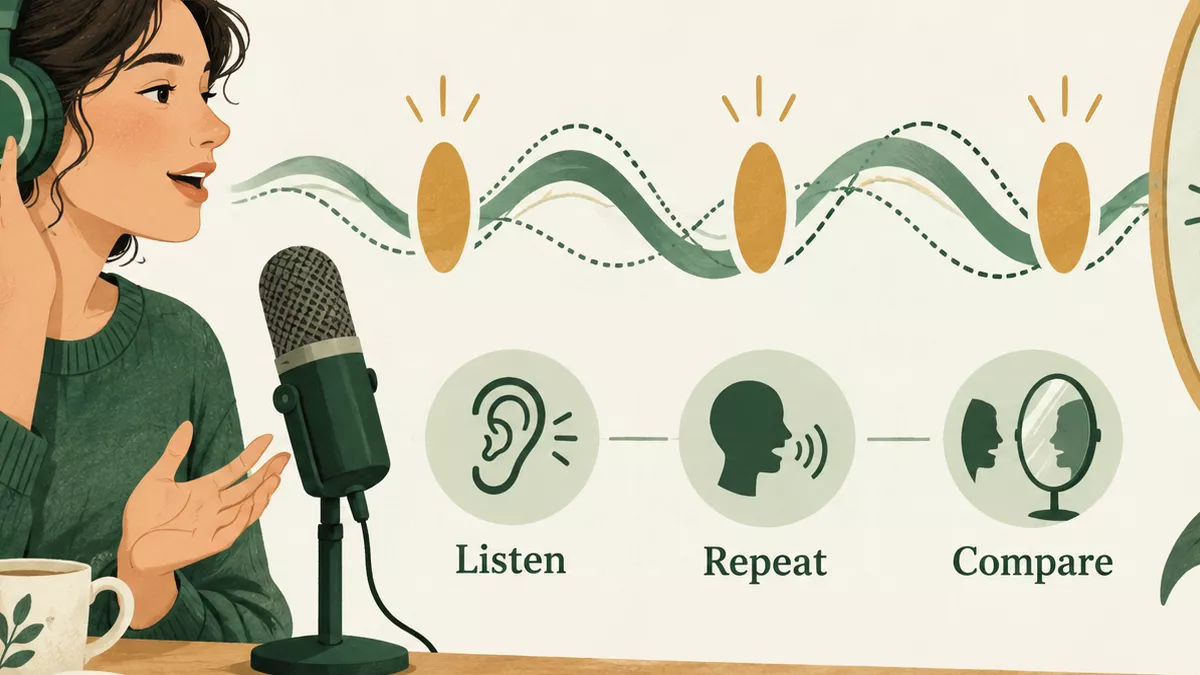
English shadowing practice means listening to a short piece of speech and trying to follow its words and rhythm closely. Start with one sentence you understand. Listen, repeat it aloud, then compare your attempt with the model. You can build towards speaking just behind the voice once the sentence feels manageable.
English Study Kit’s Shadowing Practice gives you a sentence, a listening control, voice recording and a word comparison. Use those tools for a focused practice loop. Alongside the on-screen feedback, listen to your recording yourself to notice pauses, stressed words and clarity.
Prepare a short sentence
Open Shadowing Practice. The Practice sentence panel shows your reference text. You can keep that sentence, choose Random for another sample, or select Edit to enter your own. Save your edited sentence before starting.
Choose everyday language of roughly one short sentence. Understand the meaning before repeating it. For example: “I’m meeting my friend after work.” This gives you a clear message and a few natural groups of words, without overloading your attention.
Use the listening button beside the sentence to hear the reference voice. The workspace labels the reference English as en-US. You can practise its model without treating one accent as the only acceptable way to speak English.
Use the controls in a simple order
Listen to the reference sentence once for meaning. Listen again to notice the parts that sound stronger. Once you know it, replay the reference and quietly follow the voice without starting a recording.
Press the microphone control in Shadow now and allow microphone access when asked. Recording also needs a browser that supports the tool’s speech recognition.
Say the sentence clearly on your own, using the rhythm you just practised.
Stop your attempt with the main control when you finish, then wait for the feedback.
Play Your recording and the Expected answer. Compare the sound as well as the recognised text, then try the sentence again.
You do not need to speak loudly or race. A quiet space and a steady voice make the recording easier to review. If the browser reports that speech recognition is unavailable, use a supported browser or device for the recording workflow; you can still listen and repeat aloud.
The British Council’s shadowing activity moves from listening and following the audio to speaking without it and reviewing a recording. In this workspace, finish playing the model before you record your own voice, so you can hear your attempt clearly afterwards.
Listen for groups and strong words
English speech does not normally give every word the same emphasis. Important information often sounds stronger. Small connecting words can sound shorter. The exact stress also changes when a speaker wants to contrast or correct something.
Try the sentence below. The capital letters are practice markings, not spelling you should copy into normal writing. The slashes suggest useful groups; they do not mean you must insert a long pause.
I’m MEETING my FRIEND / after WORK.
First, say it slowly in those groups. Next, join the groups without losing the message. Finally, listen again and imitate the model’s timing as closely as you can. Let the quieter words fit between the stronger ones.
Practice sentence | A possible focus | Listen for |
|---|---|---|
Could you HELP me / with this BAG? | A polite request | The important action and object. |
We’re LEAVING / at HALF past NINE. | A plan | The time information. |
I wanted the BLUE one. | A contrast | BLUE can be stronger when correcting a colour. |
Scroll sideways to see all columns.
These are possible emphasis patterns, not one compulsory rhythm. If the model sounds different, notice what it does and use the recording as your reference.
Understand the feedback
The review screen shows your recognised words, the expected sentence and a word comparison, including missing or extra words. The percentage reflects how the recognised words match the reference. It is not a separate measurement of your accent, stress or intonation.
For example, if the reference is “We’re leaving at half past nine” and the recognised text leaves out “at”, the comparison can help you notice that missing word. Listen to your recording before deciding why it happened. You may have omitted it, said it very quietly or been misheard by speech recognition.
A high word-match score can still leave room to improve your rhythm. A lower score can also include recognition errors. Ask two questions: “Did I say the intended words?” and “Does my recording communicate the sentence clearly?”
Try a small rhythm exercise
Your turn · self-review
Three attempts, one review
Practise “Could you help me with this bag?” aloud three times. Use the boxes for optional observations, then compare with the review suggestions. Record and replay your voice in Shadowing Practice or with your own device if you wish; this block does not record or assess speech.
Practice only. Your writing stays on this page; it is not submitted or saved.
-
Model answer and explanation
One possible note: “I made help and bag clear, but I missed with.” If you miss a small word, point to it in the reference and include it in your next attempt. These are possible emphasis choices, not a compulsory accent or rhythm.
-
Model answer and explanation
One possible note: “I paused after every word, so I will try Could you HELP me / with this BAG?” Use two meaningful groups without forcing a long pause. If you rush the ending, practise the final group slowly before joining it to the start.
-
Model answer and explanation
One possible note: “The request sounded clearer this time. I will briefly practise bag, then say the whole sentence again.” You might instead repeat the sentence or change a pause. Choose one focus and listen to your own recording; the notes here are not a pronunciation score.
Keep a five-minute practice loop
Spend a minute choosing and understanding the sentence, a minute listening carefully, two minutes making and reviewing attempts, and a final minute saying it without looking. This is a suggested routine, so adjust it if you need more time.
Keep a note such as “I remembered every word, but paused before ‘with’.” At your next session, start with that sentence and focus on the pause. Tracking one concrete observation is more useful than chasing a percentage alone.
Take the sentence into real speech
Change one part of your practised sentence: “Could you help me with this box?” Keep the request natural and clear. The aim is to use the pattern when you need it, as well as repeat a model.
For your next step, choose another short sentence in the speaking learning path. If hearing the words is the main difficulty, use the listening learning path before returning to the recording loop.





