
English Learning Games for Families: 5 Simple Activities
Try five English learning games for families using familiar objects, pictures and simple questions. Includes easy adaptations and phrases to practise.
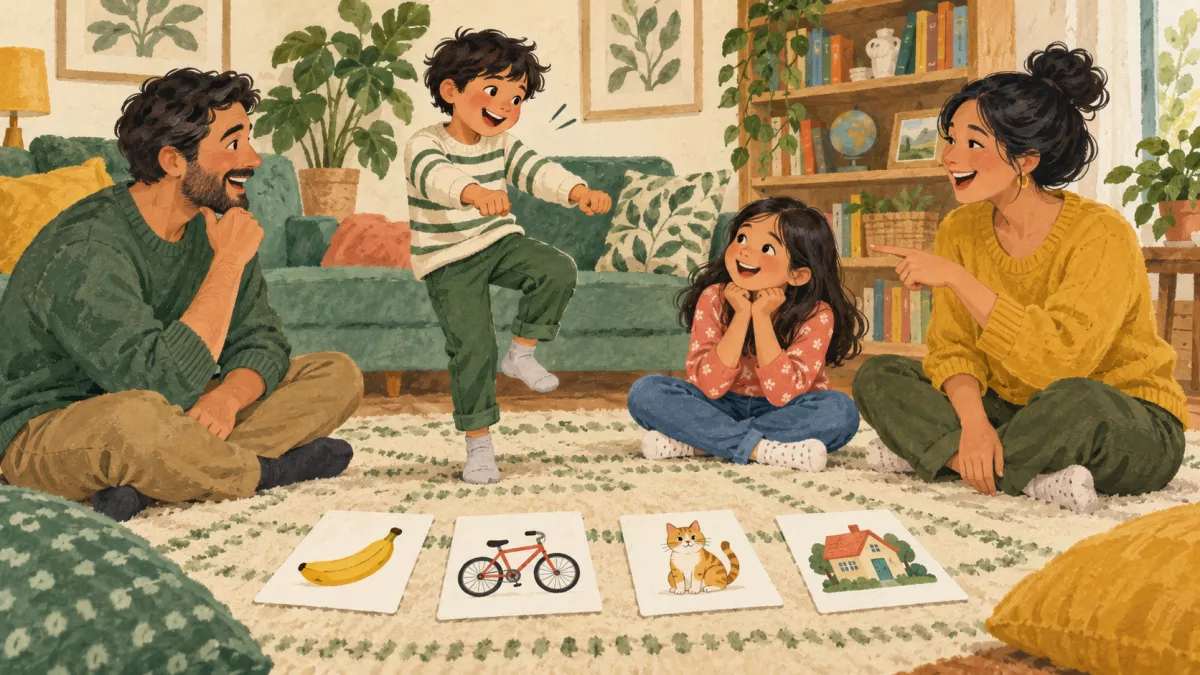
Family English games can be simple: name familiar objects, guess a picture, act out a word or build a short story together. Choose language everyone can join in with and make the game cooperative when that feels more comfortable. You can play these five activities with paper, everyday objects and a little imagination.
Choose a small shared goal
Pick a topic such as food, toys or things in your home. Decide whether you want to practise single words, short descriptions or questions. A younger beginner might point and say “cat”; another family member might say “The cat is sleeping”. Both can take part in the same activity.
Explain one turn before starting and show an example. You can use a home language to clarify the rules, then return to the English words you want to practise. Learning English at home has more ideas for making practice fit everyday life.
1. Play a picture guessing game
Draw or collect a few pictures of familiar objects. One person chooses a picture without showing it and gives a clue: “It is yellow. You can eat it.” The others guess “A banana?” Then show the picture and say a full phrase together.
For beginners, leave the pictures visible so they can choose from them. For more confident players, ask questions such as “Is it an animal?” or “Can you find it in a kitchen?” Keep clues accurate and avoid making every round a spelling test.
2. Try an object memory tray
Put four or five familiar objects on a tray, name them together and cover them with a cloth. Remove one while the others look away. Ask “What is missing?” Players name the object or describe it: “The blue pen is missing.”
Start with fewer objects if the memory part is too demanding. The goal is to use the language, so you can uncover the tray and model the words again whenever needed.
3. Act out everyday actions
One player acts out reading, cooking, sleeping or riding a bicycle. Others guess using the pattern that fits the learner: “Reading!” or “You are reading a book.” Swap roles so everyone gets to act and speak.
Choose actions your space allows comfortably. You can mime sitting down, opening a book or brushing your hair without moving around the room. Invite a player to pass or choose a different action if they prefer.
4. Build a story together
Start with “One day, a cat found a small bag.” Each person adds one sentence. Keep three picture cards nearby to offer ideas when someone gets stuck. The story can be silly, but ask players to listen so the next sentence connects.
If making a story feels difficult, describe one picture together instead: who is there, what they are doing and where they are. Introducing yourself offers familiar sentence patterns you can adapt for a character.
5. Play and talk with a digital activity
Choose a short activity from Games and take turns. Pause afterwards to name a picture, describe a choice or use one word in a new sentence. Stay beside a child when they need help with the language or controls.
Using Letter Learning together gives specific ideas for letters and first words. For a family with different ages, a host-led team quiz can work with a suitably chosen deck and supportive teams.
If a player needs … | Try … |
|---|---|
More support | Visible pictures and two possible answers |
More language | A full sentence and one follow-up question |
Less competition | A shared goal: use every target word together |
Scroll sideways to see all columns.
Your turn · self-review
Adapt a family game
Plan one change and a useful phrase before comparing with the model.
Practice only. Your writing stays on this page; it is not submitted or saved.
-
Model answer and explanation
Show two pictures and ask “Is it an apple or a banana?” Then model “It is red. It is an apple.” Let the learner repeat or point before giving their own clue.
-
Model answer and explanation
Ask “When do you read?” and offer “I read before bed” as a model. Each player can make a true sentence or choose from examples.
Return to a few useful words
Finish by naming two words everyone used and one phrase to try again next time. Repeat a favourite game with a small change rather than constantly adding new rules. Spaced vocabulary practice explains how later returns can fit into your routine.
Keep the atmosphere friendly and let family members contribute at their own level. A shared laugh and a clear new sentence give you a useful place to begin the next session.





