How to Use Vocabulary Coach to Spot Repeated Words
Use Vocabulary Coach to find repeated words, understand word families and revise a paragraph carefully without losing necessary meaning or clarity.
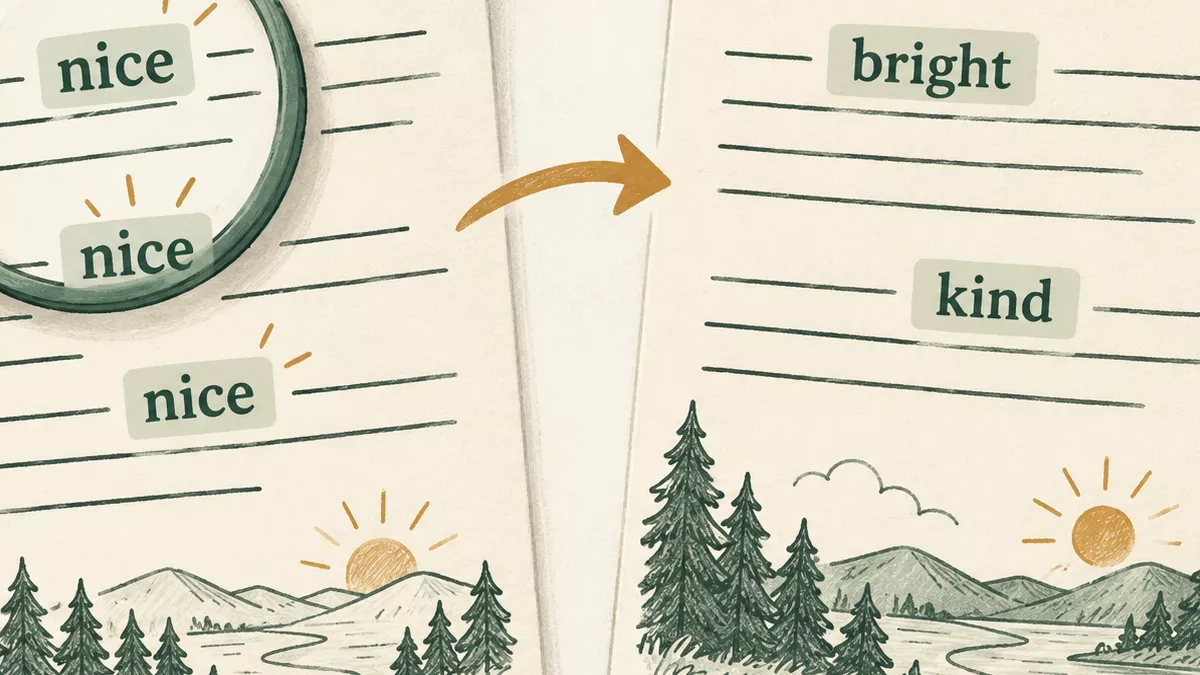
Vocabulary Coach can help you spot repeated content words in an English paragraph. Paste your text, run the analysis and review Repetition & word families. Then decide which repetitions help your reader and which make the writing vague. The aim is clear meaning, not a paragraph with a different word in every sentence.
A repeated topic word can be useful. A paragraph about a bus service may need the word bus several times. By contrast, using nice for a room, a teacher and a lesson gives the reader little detail. You can improve that writing by describing what you actually mean.
Find the repetitions in your text
Open Vocabulary Coach and use the Your English text box. A short paragraph of your own makes a better editing task than a long passage copied from somewhere else.
Paste or type the paragraph. Check the word and character counters, and follow the limits currently shown on the page.
Choose Analyze text. Analysis runs when you submit, rather than while you type. Wait for the report.
Read Repetition & word families. The list shows repeated content lemmas, their detected forms and their occurrence counts.
Select a highlighted word in the analysed paragraph to inspect its lemma, part of speech and other available details.
Make one careful edit in your source. Editing clears the old report, so choose Analyze text again to review the new version.
Use an example can show you the workspace before you analyse your own writing. Clear empties the input. Keep your original paragraph in a separate note if you want to compare versions after editing.
What is a lemma?
A lemma is a base form used to group related grammatical forms. For example, work, works and worked may be grouped under work when the analysis identifies them as forms of that verb. This helps you notice repetition that a simple search for one exact spelling could miss.
The repeated list concerns content vocabulary, such as many nouns, verbs and adjectives. Do not expect every occurrence of the, and or a to become a problem in this list. Automatic analysis can also make mistakes, so check the words in their actual sentences.
Improve a vague paragraph
Original practice paragraph: “Our new classroom is nice. We have a nice teacher. Her lessons are nice, and she gives us time to ask questions.”
Nice is repeated three times in this original sample. It is not grammatically wrong, but it hides three different ideas. Before replacing it, ask what you know about the classroom, teacher and lessons. Choose details that are true.
Original wording | Possible revision if true | Meaning added |
|---|---|---|
a nice classroom | a bright classroom | The room has plenty of light. |
a nice teacher | a kind teacher | The teacher treats people considerately. |
nice lessons | lessons with clear examples | The explanations are easy to follow. |
Scroll sideways to see all columns.
A possible revision is: “Our new classroom is bright. Our teacher is kind, and her lessons include clear examples. She gives us time to ask questions.” This is a original illustration, not a captured Vocabulary Coach result. Bright and kind are suitable only if they describe the situation accurately.
Sometimes the best fix is deleting an unnecessary sentence, combining two sentences or naming a detail. You do not always need a synonym. Replacing nice with magnificent, exceptional and outstanding would add stronger opinions that the original may not support.
Keep repetition that protects meaning
Consider this original notice: “Bring your library card. Show your library card at the desk before borrowing a book.” Repeating library card makes the instruction clear. Replacing the second phrase with it is possible here, but adding more nouns between the two mentions might make that pronoun harder to understand.
Keep a key term when a new label could suggest a different thing.
Use a pronoun only when its reference is clear.
Replace a broad adjective when a precise, true detail helps the reader.
Remove wording that repeats the same idea without adding useful information.
Do not judge an edit only by whether the repeated-word list becomes shorter. Read the paragraph aloud and ask whether a new reader can follow it.
Use the other indicators carefully
The tool also shows estimated difficulty labels for individual words and measures such as lemma diversity. These describe features of the submitted text. They do not measure your overall CEFR level, provide an exam mark or mean that a more difficult word is better.
Compare passages of similar length if you look at diversity figures. A short paragraph and a long essay are different tasks. There is no ideal quota of adjectives or adverbs, and changing every repeated word can make the writing less natural.
Try a revision decision
Your turn · self-review
Write, then compare
Make your own attempt, then compare it with the models. Other clear answers can also be correct.
Practice only. Your writing stays on this page; it is not submitted or saved.
-
Model answer and explanation
Answer: “The guide gave clear instructions” expresses the detail you know. You still need more information before deciding what good means for the whole workshop. The second tray can stay because it names the same object clearly; “it was ready” also works while the reference remains obvious.
Make one useful edit today
Analyse one paragraph, select a repetition and explain your decision in a note: “I kept bus because the topic needs it” or “I changed good to clear because I mean easy to understand.” Practise more word choices through the vocabulary learning path. For a wider clarity review after your own edits, try Text Coach’s Improve text mode.
Further reading: Purdue OWL’s guidance on concision discusses choosing effective, specific wording. Apply that principle to your meaning rather than treating shorter text as automatically better.