
This, That, These and Those: Near, Far, One and More
Learn this, that, these and those with near-and-far pictures, clear examples and 12 interactive questions about number, distance and is or are.
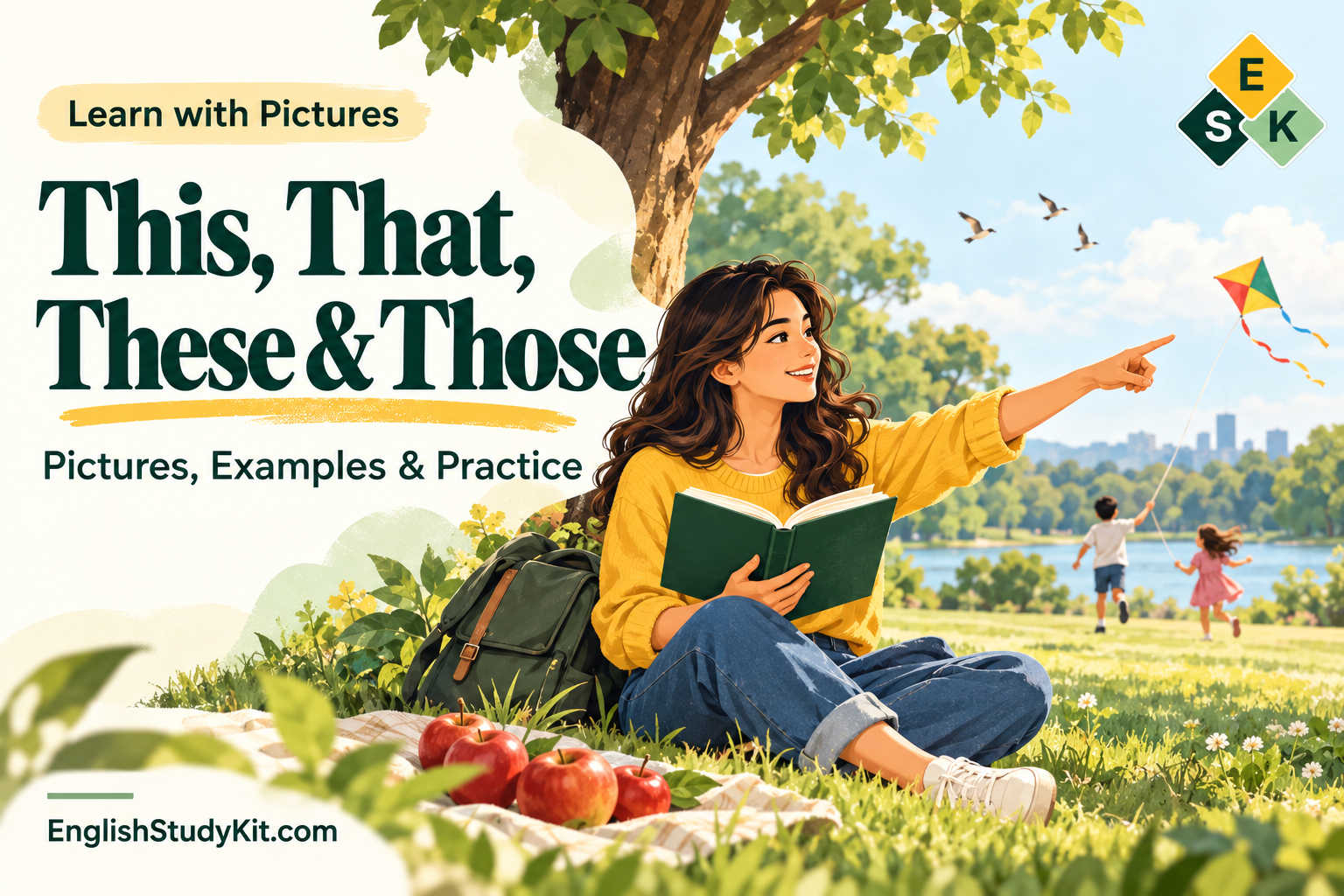
This book or that book? These apples or those apples? English uses four small words to show which things we mean. In this picture lesson, make two choices: one or more than one, then near or far from the speaker. Use the four poster examples and twelve questions to practise.
This is part of Learn with Pictures, a series of beginner English lessons. Use the illustration to notice the meaning, then use the written examples and practice to build your own sentences.
Start with the picture poster
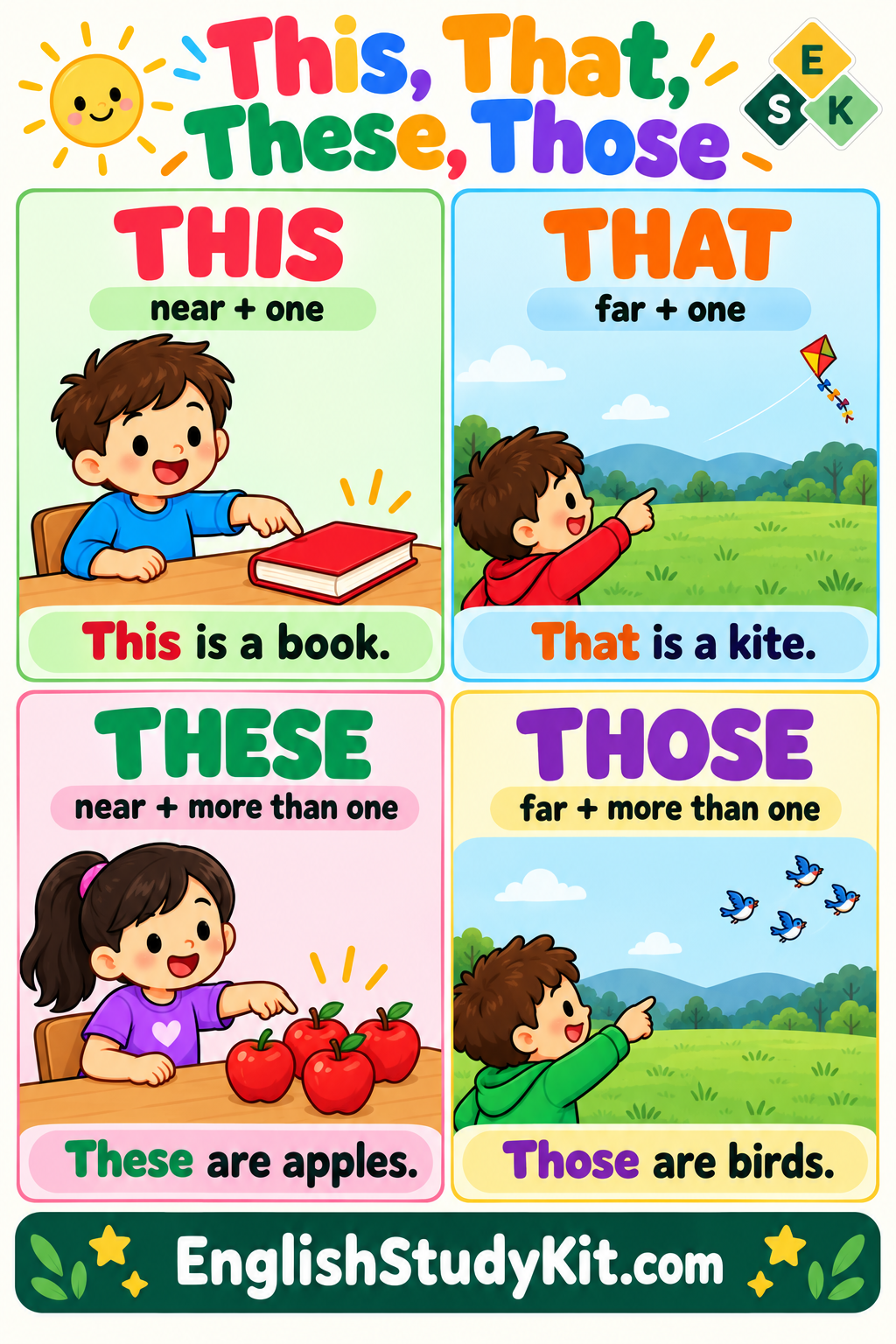
The poster contrasts a nearby book with a distant kite, and nearby apples with distant birds. Notice the speaker’s position as well as the number of things. Every label and teaching example is also written below, so you can follow the lesson without reading text inside the image.
Find the pictures as you read. You can return to the poster when you need a reminder.
Make two choices: number and distance
This and that are singular: they point to one thing. These and those are plural: they point to more than one. This and these usually point to things near the speaker. That and those usually point to things farther away.
One and near: this. “This is a book.”
One and far: that. “That is a kite.”
More than one and near: these. “These are apples.”
More than one and far: those. “Those are birds.”
Near and far are relative to the person speaking. There is no fixed distance in metres. A book in your hand is usually this book; a book across the room may be that book. If the speaker moves, the same book may need a different word.
The four poster examples
1. This is a book.
The speaker is showing one nearby book. This points to one thing that is close.
Example: This is my book. I am holding it.
2. That is a kite.
The speaker points to one kite farther away. That points to one more distant thing.
Example: That is a kite in the sky.
3. These are apples.
The picture shows four nearby apples. These points to more than one thing close to the speaker.
Example: These are apples on the table beside me.
4. Those are birds.
The picture shows four birds farther away. Those points to more than one more distant thing.
Example: Those are birds in the tree over there.
Use is with this and that; are with these and those
In these identification sentences, the number controls the verb. Say “This is a pencil” and “That is a ruler”. For more than one, say “These are pencils” and “Those are rulers”. Do not mix a plural word with is: “These is” is not the pattern.
This is a chair. These are chairs.
That is an orange. Those are oranges.
Is this your bag? Are these your books?
In a plural sentence, the noun usually needs a plural form too. “These are book” is incomplete in this pattern; use “These are books”. You do not need a or an before the plural noun.
Two ways to use the pointing word
You can let the word stand on its own: “This is a book.” Or put it directly before the noun: “This book is mine.” Both point to a specific book.
This is a pencil. / This pencil is blue.
These are apples. / These apples are green.
That is a chair. / That chair is empty.
Those are birds. / Those birds are small.
Change the speaker, change the viewpoint
Imagine Sara holds a book while Ben stands across the room. Sara says, “This book is mine.” Ben points towards her and says, “That book is Sara’s.” They mean the same book, but they speak from different positions.
You may also hear this and that used for ideas or time, as in “this week”. Those uses can wait. This lesson focuses on visible things so you can first practise the number-and-distance choice.
Ask a simple question
A: Are these your pencils? B: Yes, they are. A: Is that your bag by the door? B: No, it isn’t. My bag is here.
After the question, use it for one thing and they for more than one in a short answer. The pointing word helps identify the object; the answer confirms whose object it is.
Practice 1: Choose the best answer
Choose one answer for each question. Check your answers, read the explanations and try again if you need to.
Answer on paper, then open the explanations below. Enable JavaScript to check answers here.
Practice 2: Complete the sentences
Type only the missing word or words. Use the clue in each question. Check the explanations after you finish.
Answer on paper, then open the explanations below. Enable JavaScript to check answers here.
Your turn: point from two positions
Your turn · self-review
Four objects, four clear sentences
Choose objects in a room or imagine a scene. Make the speaker’s position clear.
Practice only. Your writing stays on this page; it is not submitted or saved.
-
Model answer and explanation
This is my notebook in my hand. That is the clock across the room. These are my pens beside me. Those are the chairs near the far wall.
-
Model answer and explanation
Near the book: This book is blue. Across the room: That book is blue.
Check: One thing or more than one? Near or far from the speaker? Is or are? Does the noun match the number? These four checks help you build the sentence without guessing.
Keep learning
Choose a small number of new words or patterns to use today. Say your sentences aloud, check one detail and repeat them tomorrow.





