How to Remember English Vocabulary With Spaced Repetition
Remember English vocabulary with a flexible review calendar, useful word cards and short recall exercises that help you use new words in real sentences.
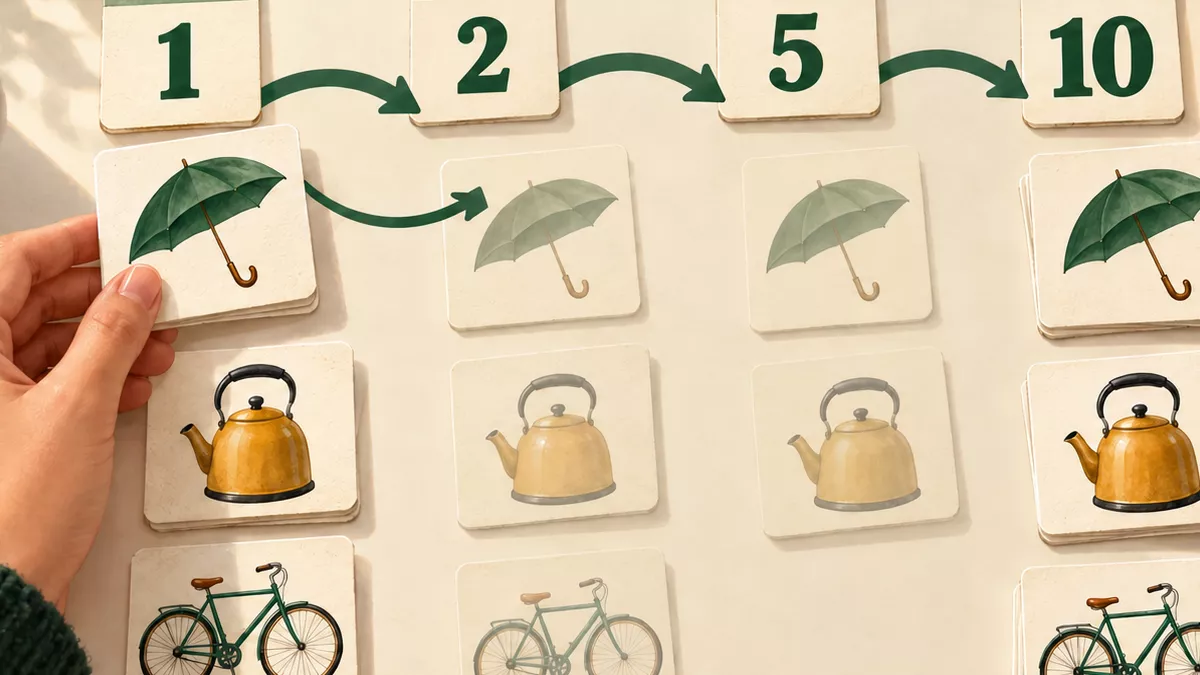
To remember English vocabulary, return to useful words on different days and try to recall them before checking your notes. Then use each word in a fresh sentence. This combination gives you a practical way to move beyond recognising a word towards using it when you need it.
Spaced repetition means revisiting learning after a gap. Retrieval practice means bringing it to mind without immediately seeing the answer. The Learning Scientists explain both spaced practice and retrieval practice. You can apply these ideas with paper cards, a notebook or a review app.
Choose words you have a reason to use
Begin with a small set from a lesson, a message or a conversation you want to have. Five carefully chosen words are a manageable starting point. If you are preparing to visit a library, borrow, return and available are more useful than an unrelated list of rare words.
Record a meaning that fits the situation, a short example and any important word partner. A translation can help you understand quickly, but add an English sentence so that you also learn how the word behaves. Check spelling and meaning before you practise: repeated practice should reinforce a correct example.
The vocabulary learning path is one place to find everyday topics. Choose words from the material you actually study rather than trying to collect everything.
Build a card that makes you think
Card side | Example |
|---|---|
Front: a situation or question | You want to use your friend's umbrella and give it back tomorrow. Which verb do you need? |
Back: answer and meaning | Borrow: take something for a time, intending to return it. |
Back: an original sentence | Can I borrow your umbrella until tomorrow? |
Back: a useful contrast | I borrow the umbrella. My friend lends it to me. |
Scroll sideways to see all columns.
A situation prompt asks you to produce the word. A card that shows the word first tests something different: whether you recognise its meaning. Practise both directions if both are useful to you. For pronunciation, check a dictionary recording and then say your sentence aloud; remembering a written form does not automatically mean you can say it comfortably.
Use a flexible review calendar
Here is an example schedule for a set learned on day 1. It is a starting plan, not a scientifically perfect timetable for every learner or word. Adjust the gaps according to what you can recall.
Day | What to do |
|---|---|
1 | Learn the meaning, check one example and create a clear prompt. |
2 | Answer without looking. Check the card and correct any mistakes. |
5 | Recall the word again, then use it in a different situation. |
10 | Mix it with older words and write a short message. |
Later | Return again after a longer gap if recall is comfortable. |
Scroll sideways to see all columns.
If you cannot recall borrow on day 5, read the example, explain the meaning in your own words and plan an earlier review. If you recall it easily several times, leave a longer gap. Keep difficult cards in the set without making every review feel like a test you must pass.
Try a five-minute review
Cover the answers and attempt the due cards. Say a word, write it or complete its sentence.
Check each answer immediately afterwards. Notice meaning, spelling and word order.
Mark each card: easy, uncertain or forgotten. Use these labels to decide which words need another visit sooner.
Write two new sentences with words you found difficult. Make the situations different from the card examples.
Record the next review date and stop. Add new cards only when your existing set is manageable.
For example, move from “Can I borrow your umbrella?” to “I borrowed a cookbook from the library.” You have changed the object, person and verb form. This gives you a more useful practice target than repeating one memorised sentence every time.
Practise recall with a small word set
Study these three words, then cover this paragraph: borrow means take something temporarily; return means give it back; available means ready to be used. Complete the sentences without looking. Use each word once.
Answer on paper, then open the explanations below. Enable JavaScript to check answers here.
Now close the answers and write your own sentence for each word. Tomorrow, try again from the situation rather than reading today's answers first. If the spelling is right but the meaning is wrong, treat the card as needing more practice.
Avoid three common review traps
Do not fill every card with several meanings. Start with the meaning you need and add another later. Do not judge success only by how familiar the card looks. And do not keep adding words while leaving old cards untouched: set aside time for the review queue before expanding it.
You can use Vocabulary Coach to explore vocabulary and repeated words in a text you choose. It is a text-analysis tool; use your notebook or review app to manage the calendar described here.
Your next action
Choose three useful words today. Make one situation card for each, schedule a review for tomorrow and prepare a different sentence for the next visit. A small system you return to is easier to maintain than a large collection you never use.