
Present Simple vs Present Continuous: Which Should You Use?
Compare present simple and present continuous with everyday situations, clear verb patterns and a practice quiz explaining habits, actions and states.
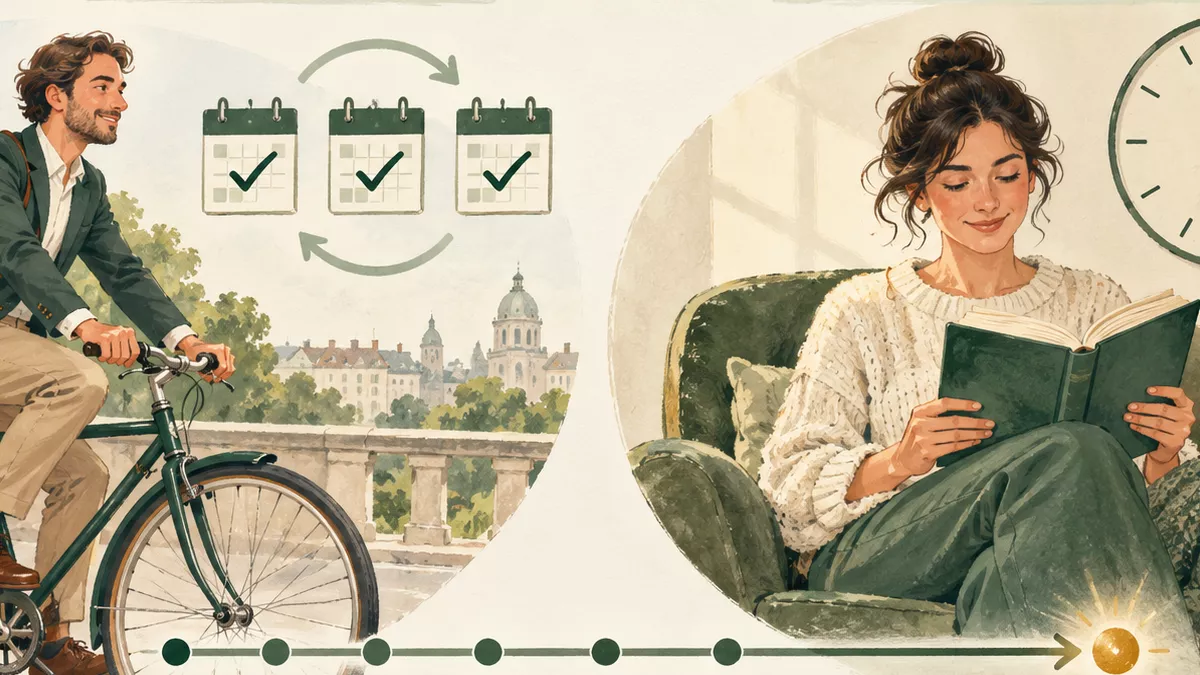
Use the present simple for habits, general facts and states: “I walk to work.” Use the present continuous for an action happening now or a temporary situation around now: “I am walking to work today.”
The choice tells your listener how you see the situation. A job can be a general fact about your life, while a project can be temporary. You do not need to decide whether something will last forever.
Compare the meanings first
What you want to say | Present simple | Present continuous |
|---|---|---|
A usual routine or an action now | I cook dinner most evenings. | I am cooking dinner at the moment. |
A general situation or a temporary one | Ravi works in a library. | Ravi is working in the café this week. |
A regular journey or today’s change | We take the bus to college. | We are taking a taxi today. |
A habit or an activity around now | Aya reads a lot. | Aya is reading a long novel this month. |
Scroll sideways to see all columns.
Aya does not have to be holding the novel when she speaks. “This month” gives the wider temporary situation. The present continuous can describe something in progress around now, as well as something happening at this second.
This contrast is explained in Cambridge’s present tense comparison.
Build the verb correctly
With most present simple verbs, use the basic form after I, you, we and they. Add s or es after he, she and it: “I teach”; “She teaches”. Study becomes studies.
For negatives and questions, use do or does. The main verb then returns to its basic form: “He does not teach”; “Does he teach?” Do not keep the s after does.
The continuous needs am, is or are + an ing form. Say “I am waiting”, “She is waiting” and “They are waiting”. In speech and informal writing, “I’m”, “she’s” and “they’re” are natural contractions.
Form | Present simple | Present continuous |
|---|---|---|
Statement | Maya studies English. | Maya is studying English. |
Negative | Maya does not study French. | Maya is not studying French. |
Question | Does Maya study English? | Is Maya studying English? |
Scroll sideways to see all columns.
For an extra form reference, use the British Council’s present simple lesson.
Meet Sam on an unusual day
Sam usually works at home. Every morning, he makes tea and checks his messages. Today, his internet connection is not working, so he is working in a shared office. He is using a different desk, but he still likes his own quiet room.
The simple verbs describe Sam’s normal routine and his preference. The continuous verbs describe the temporary change today. One paragraph can use both forms because the meanings differ.
Make your own version: “I usually study in my room, but today I am studying in the kitchen.” This is more useful than learning a tense without a situation.
Some verbs describe states
Words such as know, need, believe and understand often describe a state rather than an activity. They usually take the simple form, even when the state is true right now.
Say “I need help now”, rather than “I am needing help now”. Say “I understand the example”, rather than “I am understanding the example”.
Some verbs change meaning. “I think this answer is right” gives an opinion. “I am thinking about the answer” describes the process of considering it. “She has a bicycle” shows possession; “She is having lunch” describes an activity.
The British Council’s stative verb guide explains why “never use ing with this verb” can be too simple a rule.
Time words are clues, not commands
Usually and every day often point towards a routine. At the moment and this week can point towards an action or temporary situation. Read the meaning too: now does not change “I know the answer” into a continuous sentence.
There are also future uses. “The bus leaves at eight tomorrow” describes a timetable. “I am meeting Jo tomorrow” describes an arrangement. For today’s practice, concentrate on routines and present actions before adding these patterns.
Practise: choose the form that fits
Answer on paper, then open the explanations below. Enable JavaScript to check answers here.
Practise the contrast with your own day
Write three usual habits and three things happening today. Pair them where possible: “I usually drink tea, but today I am drinking coffee.” Check both your meaning and the verb form.
The grammar learning path can help you build the foundations. Use Grammar Coach to investigate a sentence you are unsure about, and keep a corrected example that you can reuse tomorrow.





