
Ordering Food in English: Useful Phrases and Dialogues
Practise ordering food in English with café and restaurant dialogues, polite requests, clarification phrases and a menu-based role-play exercise.
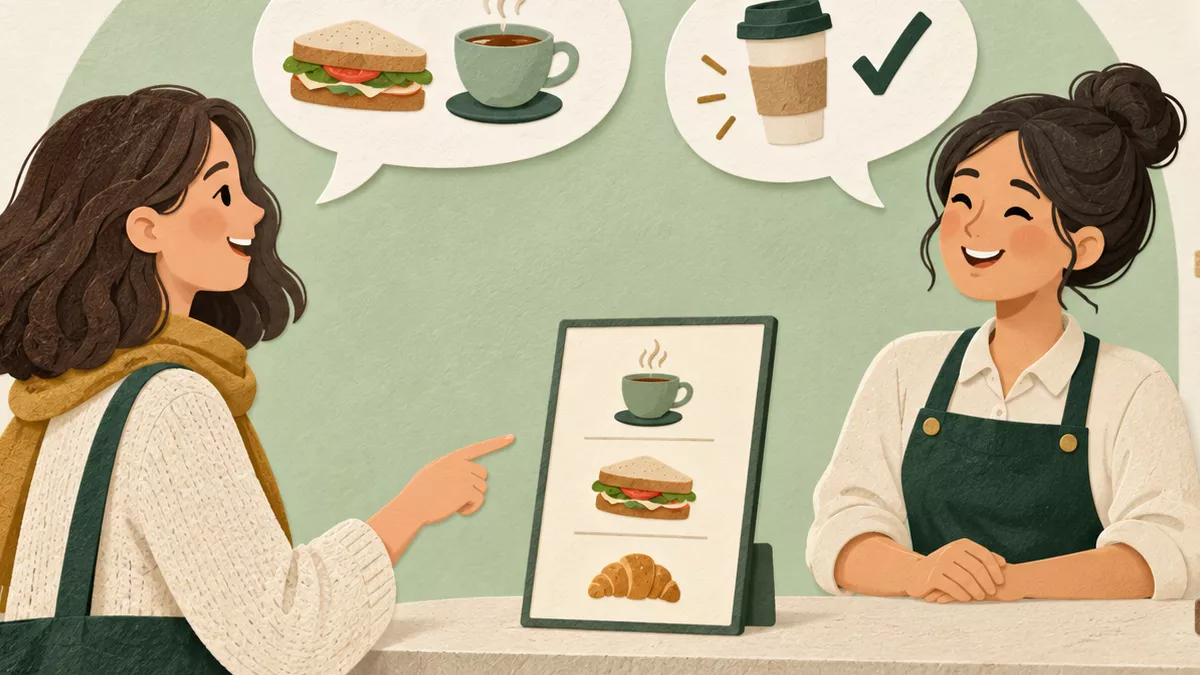
Ordering food in English becomes easier when you prepare three things: what you want, how to ask politely, and how to answer a short follow-up question. Start with “I'd like…” or “Could I have…?”, name the food or drink, and add “please”.
You might say, “Could I have a cheese sandwich and a tea, please?” The server may ask about size, extras, or whether you are eating there. These follow-up questions are part of the order, so practise answering them as well as saying your first sentence.
Keep the order in small pieces
What you need to do | Useful language | Example |
|---|---|---|
Order an item | I'd like…, please. | I'd like the vegetable soup, please. |
Ask for a change | Could I have it without…? | Could I have it without onions? |
Ask about a dish | What comes with…? | What comes with the sandwich? |
Check a detail | Does that include…? | Does that include a drink? |
Finish the order | That's all, thank you. | That's all, thank you. |
Scroll sideways to see all columns.
“I want…” is understandable, but “I'd like…” is a useful polite choice for many service situations. You can also order with a short noun phrase after the server asks what you want: “A small tea, please.”
“I'd” means “I would”. You do not need to make your request longer to make it polite. Speak clearly and leave space for the server to respond.
Café dialogue: a sandwich and tea
Server: Hello. What can I get you?
Customer: Could I have a cheese sandwich and a tea, please?
Server: Would you like a small tea or a large one?
Customer: A small one, please.
Server: Is that to eat in or take away?
Customer: To take away, please.
Server: Anything else for you?
Customer: No, that's all, thank you.
The customer does not repeat the whole order after each question. “A small one” refers to the tea, and “To take away” answers where the order will be eaten. In British English, you often hear “take away”; in American English, “to go” is common.
For an additional listening model, use the British Council's ordering food in a café lesson. The dialogues in this article are original practice examples.
Restaurant dialogue: from table to bill
Customer: Hello. Do you have a table for two?
Server: Yes, of course. Please follow me.
Customer: Thank you. Could we see the menu?
Server: Here you are. Are you ready to order?
Customer: Yes. I'd like the vegetable soup. What comes with it?
Server: It comes with bread.
Customer: Lovely. Could we also have some water, please?
Later, the customer can ask, “Could we have the bill, please?” In American English, “the check” is common in this context. You do not need to learn a completely different dialogue for each variety of English, but these familiar alternatives are useful to recognise.
At some places, you order and pay at the counter; at others, staff take your order at the table. If you are unsure, ask, “Do we order here or at the table?”
Clarify anything you did not hear
Short questions can arrive quickly. You may hear “Still or sparkling?” for water, or “Small or large?” for a drink. Repeat the choice you want: “Still water, please.”
If you do not understand, say “Could you repeat that, please?” You can check one detail with “Did you say the soup comes with bread?” This gives the server a specific point to confirm.
If an item is unavailable, pause and choose an alternative: “Okay, I'll have the salad instead.” If you receive the wrong item, explain calmly: “Excuse me, I ordered tea, but this is coffee.”
When ingredients matter, ask clearly instead of guessing from a dish name. For example: “Does this contain dairy?” For an allergy, state it plainly and ask staff to confirm what they can offer; the language practice here cannot guarantee that any dish is suitable for you.
Role-play with this practice menu
These are sample menu items for the exercise, not a real restaurant menu.
Item | Options |
|---|---|
Cheese sandwich | With or without onions |
Vegetable soup | With bread |
Tea | Small or large |
Water | Still or sparkling |
Scroll sideways to see all columns.
Take the customer role. Order two items, choose one option, and ask one question. Then take the server role and ask the follow-up questions. Record both parts on your own device or practise with a partner. Change one item and repeat without reading the full dialogue.
You can prepare the speaking side with the speaking learning path. If understanding the server is harder than making the order, practise short messages through the listening learning path.
Quick check: what would you say?
Answer on paper, then open the explanations below. Enable JavaScript to check answers here.
Practise one complete order
Before your next café visit, choose a food item and a drink, then practise the likely follow-up questions. Keep your request short and speak at a comfortable pace. You can also rehearse a suitable everyday interaction in AI Conversations. Aim to finish the whole exchange: order, clarify, confirm, and thank the server.





