
In, On and At for Time: A Visual Guide
Choose in, on and at for time with a clear reference table, calendar examples, useful exceptions and a practical planning exercise with answers.
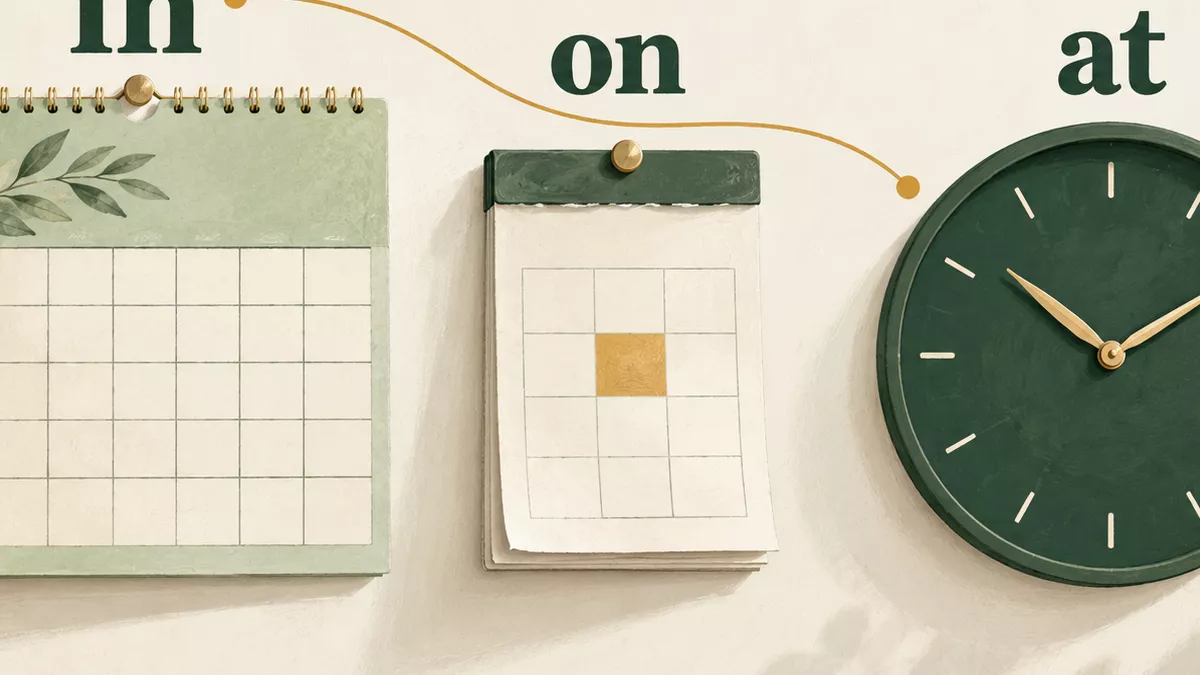
Use in for months, years and many longer periods; on for days and dates; and at for clock times and certain fixed expressions. For example, you can arrange a lesson “in July”, “on Tuesday” or “at half past six”.
Think of these as useful starting patterns. English also has expressions such as “at night” and “next week”, so learning complete phrases helps more than relying on one size rule.
Move from the calendar to the clock
Imagine zooming into a calendar. First, you see a year or month. Next, you choose a day. Finally, you select a time on that day.
Time you mean | Preposition | Everyday example |
|---|---|---|
Month | In | We are moving in September. |
Year | In | The library opened in 2022. |
Season | In | I walk more in spring. |
Part of the day | In | I study in the evening. |
Day of the week | On | The club meets on Thursday. |
Date | On | My appointment is on 14 June. |
Clock time | At | The lesson starts at 7.30. |
A fixed point in the day | At | We take a break at noon. |
Scroll sideways to see all columns.
This visual idea helps you remember the main groups. It does not explain every phrase. Check new expressions as a whole when you meet them.
For a fuller reference, see Cambridge’s guide to at, on and in for time.
A general morning or a particular morning?
Say “I read in the morning” when you mean that part of the day generally. When you identify a day, use on: “I have a meeting on Friday morning.”
The extra detail changes the phrase. Compare “in the evening” with “on the evening of the concert”. A description can have the same effect: “on a cold winter morning”.
Try this pair about your own life: “I usually practise English in the evening. This week, I am practising on Tuesday evening.” You have moved from a general period to a particular occasion.
Learn these exceptions as complete phrases
At night is the usual phrase for night-time generally: “The street is quiet at night.” You may also see “in the night” when someone means during one particular night.
In British English, at the weekend is common. American English often uses on the weekend. Both belong to real varieties of English; the difference does not make one careless.
A holiday period and a specific holiday day can differ too: “at Christmas” refers to that holiday period, while “on Christmas Day” identifies the day itself.
The British Council’s time preposition lesson gives further practice with these expressions.
Sometimes you need no preposition
Do not normally put in, on or at before phrases beginning with this, next, last or every. Tomorrow and yesterday also work without these prepositions.
“I will call next Monday”, rather than “on next Monday”.
“We met last year”, rather than “in last year”.
“I practise every morning”, rather than “in every morning”.
“The lesson is this evening”, rather than “at this evening”.
“Can we meet tomorrow?” has no extra time preposition.
Notice the useful contrast: “on Monday” but “next Monday”; “in the morning” but “every morning”. Save these pairs in your notes so that you remember both versions.
In two hours: future time or duration?
“In two hours” can tell you when something will happen: “The train leaves in two hours.” From the moment of speaking, wait two hours until departure.
It can also describe how long a task takes: “I finished the model in two hours.” Here, the whole task took two hours.
Compare for two hours, which tells you the length of an activity: “I studied for two hours.” The sentence does not say that you completed every part of the work.
Read the verb and the situation to understand the meaning. The preposition alone is not enough.
Plan a lesson: choose the missing word
Use in, on, at or a dash for no preposition.
Answer on paper, then open the explanations below. Enable JavaScript to check answers here.
Make a useful calendar entry
Write three real plans: one with a month, one with a day and one with a time. Add a fourth sentence using next or every without a preposition. Read them aloud and picture where each belongs on your calendar.
Continue through the grammar learning path. When you write a longer message, Grammar Coach can help you inspect a doubtful phrase. Keep the complete corrected time expression in your notes.





