
How to Write Clear Emails in English
Write clear emails in English with friendly and professional examples, better subject lines, polite requests and a practical proofreading checklist.
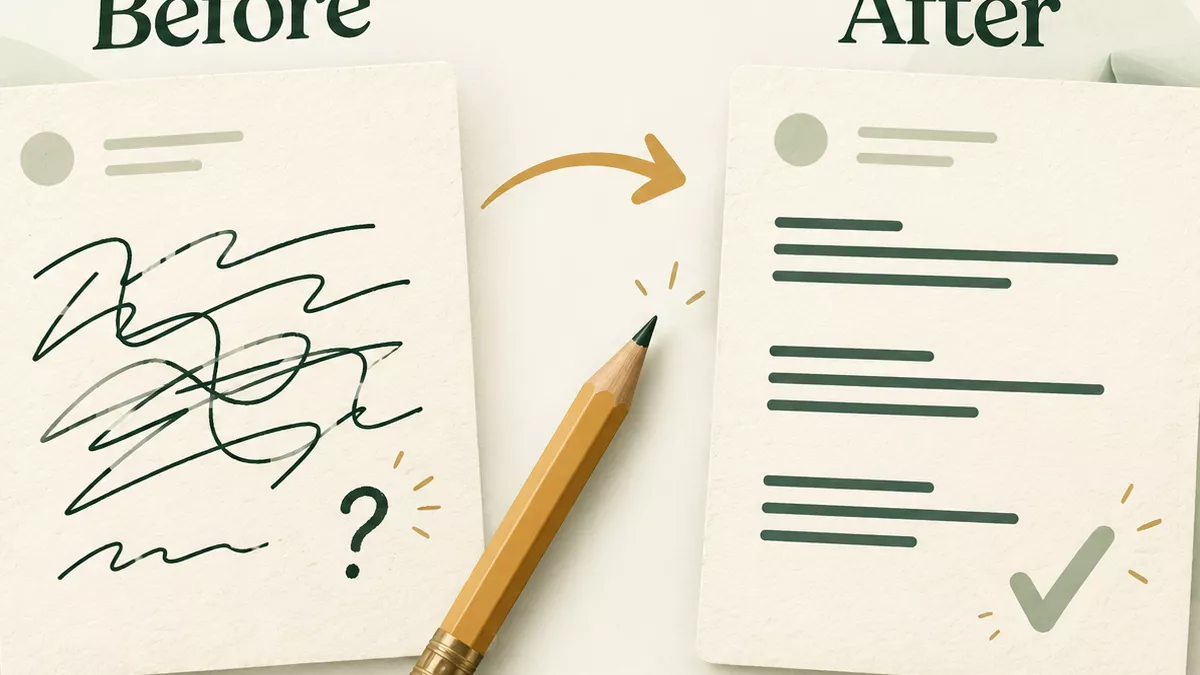
To write clear emails in English, tell the reader why you are writing, include the details they need and make the next action easy to understand. Choose a greeting and tone that fit your relationship. Simple, accurate language usually communicates more effectively than long sentences filled with formal words.
This guide uses original friendly and professional examples. You can adapt their structure, but check the names, dates and details every time rather than sending a copied template unchanged.
Decide what your reader needs
Before writing, answer three questions: who is the reader, what is the purpose, and what should happen next? An invitation to a friend needs a different tone from a request to a new work contact, but both need clear information.
Think about the situation as well as the relationship. A friendly colleague may still need a precise project deadline. A new contact may appreciate a concise, polite message without very formal expressions.
The writing learning path offers a starting point for building clear sentences before you combine them into longer messages.
Use a dependable structure
Part | What it does | Original example |
|---|---|---|
Subject | Names the topic clearly. | Meeting notes: request for Thursday |
Greeting | Addresses the reader appropriately. | Hi Maya, / Dear Mr Patel, |
Purpose | Explains why you are writing. | I’m writing to confirm our meeting time. |
Details | Gives necessary information. | We will meet in Room 2 at 10 a.m. |
Next action | Says what you need or will do. | Could you let me know if that time works? |
Closing | Ends politely and identifies you. | Best wishes, / Kind regards, followed by your name. |
Scroll sideways to see all columns.
Not every short message needs a separate paragraph for each part. The structure is a checklist for meaning, not a rule that every email must be long.
Friendly email: make the plan complete
Before
Subject: Hello
Hi Alex,
Do you want to come tomorrow? We can go there after lunch. Let me know.
Sam
This message is friendly, but Alex does not know where to go or what time to arrive. “Tomorrow” may also become unclear if the email is read later.
After
Subject: Coffee at Willow Café on Saturday?
Hi Alex,
Would you like to meet for coffee at Willow Café on Saturday? I can be there at 2 p.m.
Let me know if that works for you, or suggest another time.
See you soon,
Sam
The revised email names the activity, place, day and time. It gives Alex two useful ways to reply: agree or suggest a different time. If confusion is possible, include the date as well as the day.
Professional email: make the request specific
Before
Subject: Urgent
Hi,
Send me the thing for the meeting. I need it soon. Please reply.
Arun
The recipient cannot identify “the thing” or “soon”. The word “urgent” adds pressure without explaining the deadline. The direct request may also sound abrupt in this situation.
After
Subject: Request for updated agenda by Thursday, 12 November
Dear Ms Chen,
Could you please send me the updated agenda for Monday’s planning meeting by 3 p.m. on Thursday, 12 November?
I need it to prepare the project summary. If that deadline is difficult, please let me know when the agenda will be ready.
Thank you for your help.
Kind regards,
Arun
The revised version gives a clear document name, purpose and deadline. It also allows the recipient to raise a problem. In an international team, include a time zone if the deadline could be interpreted differently. These dates are example details, so replace them before using the message.
Choose a tone that fits
“Hi” and a first name are common in many friendly and workplace emails. “Dear” can be useful when you want a more formal opening or do not yet know the person well. Follow the relationship and the organisation’s usual style rather than assuming one greeting is always correct.
Contractions such as “I’m” and “we’ll” are normal in many everyday workplace messages. You may prefer full forms in a more formal situation. Avoid slang or unexplained abbreviations when the reader may not understand them.
The British Council’s professional email advice also emphasises matching the relationship, keeping the message focused and checking the information before sending.
Practise improving a request
Your turn · self-review
Write, then compare
Make your own attempt, then compare it with the models. Other clear answers can also be correct.
Practice only. Your writing stays on this page; it is not submitted or saved.
-
Model answer and explanation
Subject: Joining link for Friday’s 6 p.m. lesson Dear course team, I cannot find the joining link for the online lesson on Friday at 6 p.m. Could you please send it to me? Thank you for your help. Kind regards, Nia This works because the team can identify the lesson and the requested action. You could add the date, course name or your registration details if the organiser needs them. There are several suitable greetings and closings; clarity and an appropriate tone matter more than matching every word of this model.
Proofread in two passes
First check the message itself: correct recipient, clear purpose, necessary details and a realistic next action. Then check the language: sentence boundaries, spelling, verb forms and punctuation. Also confirm that any attachment you mention is actually attached.
Use Grammar Coach to explore language corrections, or Text Coach’s improve mode to work on clarity. Read every suggestion before accepting it and make sure names, dates and your intended meaning remain correct.
Keep this final checklist beside your next draft:
Does the subject describe the actual topic?
Will the reader understand why I am writing from the opening?
Have I named the relevant document, event or problem?
Is any deadline clear, including the time zone when needed?
Does the reader know what to do next?
Have I checked recipients, dates, links and attachments?
Take one email you need to send and write its purpose in a single sentence first. Build the draft around that sentence, then use the checklist to remove anything that makes the reader work harder than necessary.





