How to Write a Clear Paragraph in English
Write a clear English paragraph with one main idea, connected details and useful examples. Try sentence-order exercises and revise an original paragraph.
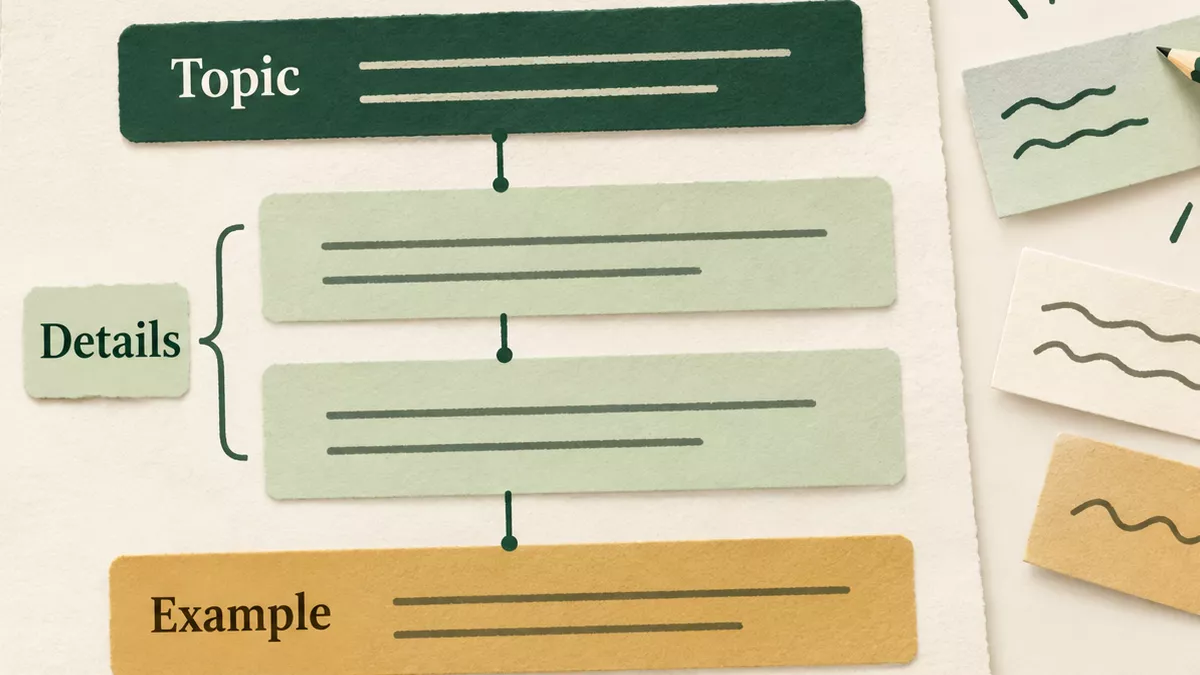
To write a clear paragraph in English, decide what one main idea you want the reader to understand, add details that support it, and arrange the sentences in a useful order. Check that words such as “it” and “this” have clear references. A paragraph needs enough explanation for its purpose, not a fixed number of sentences.
This lesson focuses on a short paragraph about a familiar place. The same planning questions can help with descriptions, opinions and everyday explanations. The examples are original and use straightforward language.
Choose a main idea you can explain
“The library” is a subject. “The library is a useful place for my evening study” is an idea about that subject. The second gives you a direction for choosing details: the library’s study conditions.
Write the idea in one sentence before adding more. Putting that sentence near the beginning is a helpful starting approach, although effective paragraphs can organise their ideas differently. Purdue OWL’s explanation of paragraphs describes how focus and connections help a reader follow a paragraph.
Build a paragraph from relevant details
The library is a useful place for my evening study. It stays open until eight, so I can visit after work. The upstairs room is quiet, and there are several large tables. For example, I can spread out my notes without disturbing other readers. These features make it easier for me to concentrate.
Sentence job | What it does in this example |
|---|---|
Main idea | Explains why the writer is describing the library. |
Practical detail | Connects the opening time to the writer’s schedule. |
Further detail | Describes the quiet room and tables. |
Example | Shows how the tables help with an actual study activity. |
Closing thought | Connects the features back to concentration. |
Scroll sideways to see all columns.
This is one useful arrangement, not a rule that every paragraph must contain these five parts. A short description might end with a detail. A longer explanation might need more than one example. Keep a sentence if it helps your reader understand the main idea.
Remove a detail that sends the reader elsewhere
Suppose we insert: “My cousin bought a bicycle last week.” It may be true, but it does not explain how the library supports evening study. It belongs in another paragraph unless you can show a relevant connection.
Now compare a related detail: “The entrance is close to my bus stop.” This could support the main idea because it explains why the visit fits the writer’s journey. Relevance comes from the connection, not simply from mentioning the same place.
For available practice with short texts, explore the writing learning path. Before choosing complicated vocabulary, make sure the paragraph has something specific to say.
Give the sentences a sensible order
Choose an order that fits your purpose. A story may follow time. A description may move from the outside of a place to the inside. An explanation may give a reason and then an example. The reader should not have to keep rebuilding the situation.
Your turn · self-review
Write, then compare
Make your own attempt, then compare it with the models. Other clear answers can also be correct.
Practice only. Your writing stays on this page; it is not submitted or saved.
-
Model answer and explanation
A good order is B, D, A, C. B introduces the writer’s view. D gives a supporting detail. A provides an example of that food, so “For example” connects naturally to D. C explains the outcome of the visit. Other versions are possible if you change the wording and preserve clear connections.
Make references and linking words clear
In the library example, “It” refers to “The library”. “These features” points back to the opening time, room and tables. Clear reference allows sentences to connect without repeatedly naming every detail.
Compare: “The café is beside the library. It closes at eight.” The reader may wonder which place closes at eight. If the timing matters, write “The library closes at eight” or “The café closes at eight”. Repeating a noun is useful when a pronoun would be unclear.
Use linking words for real relationships. “Because” gives a reason, “however” signals a contrast, and “for example” introduces an illustration. Adding “however” to unrelated sentences does not create a meaningful contrast. Simple sentences can connect well without a linking word in every line.
If sentence structures are causing problems, use the grammar learning path to choose available practice with the pattern you need. Keep the paragraph’s message visible while you revise.
Revise an original paragraph
Read this draft. Which sentence is off-topic, which word has an unclear reference, and how could the writer connect the final idea more naturally?
The park is a pleasant place for a short break. The benches are near the trees. My phone has a new case. It gives shade in summer. I often eat my lunch there.
The phone-case sentence is off-topic. “It” is unclear: the nearest singular noun is “case”, but the intended shade comes from the trees. One revision is: “The park is a pleasant place for a short break. Its trees provide shade in summer, and there are benches beneath them. I often sit on a bench to eat my lunch.”
This revision removes the unrelated sentence, names the source of shade and connects lunch to sitting on a bench. “Its” refers to the park, and “them” refers to the trees. Another clear version is: “The trees provide shade in summer.” You do not need a longer sentence if the shorter option works better.
Check your own paragraph in two passes
Check the message: identify the main idea, underline supporting details and remove any sentence that belongs to a different topic.
Check the connections: confirm the order, identify each pronoun’s reference and make sure linking words describe the intended relationship.
You can use Text Coach to improve a passage for another perspective on wording. Compare suggested changes with your intended meaning before using them.
Today, write one paragraph about a place you know. Include two relevant details and one example if it helps. Then explain one change you made during revision. Being able to say why a sentence belongs is a useful check on the paragraph’s clarity.