
How to Turn a Short Reading Text Into a Quiz Deck
Turn a short English reading text into a quiz deck with clear questions, text-based answers and a simple follow-up speaking activity for learners.
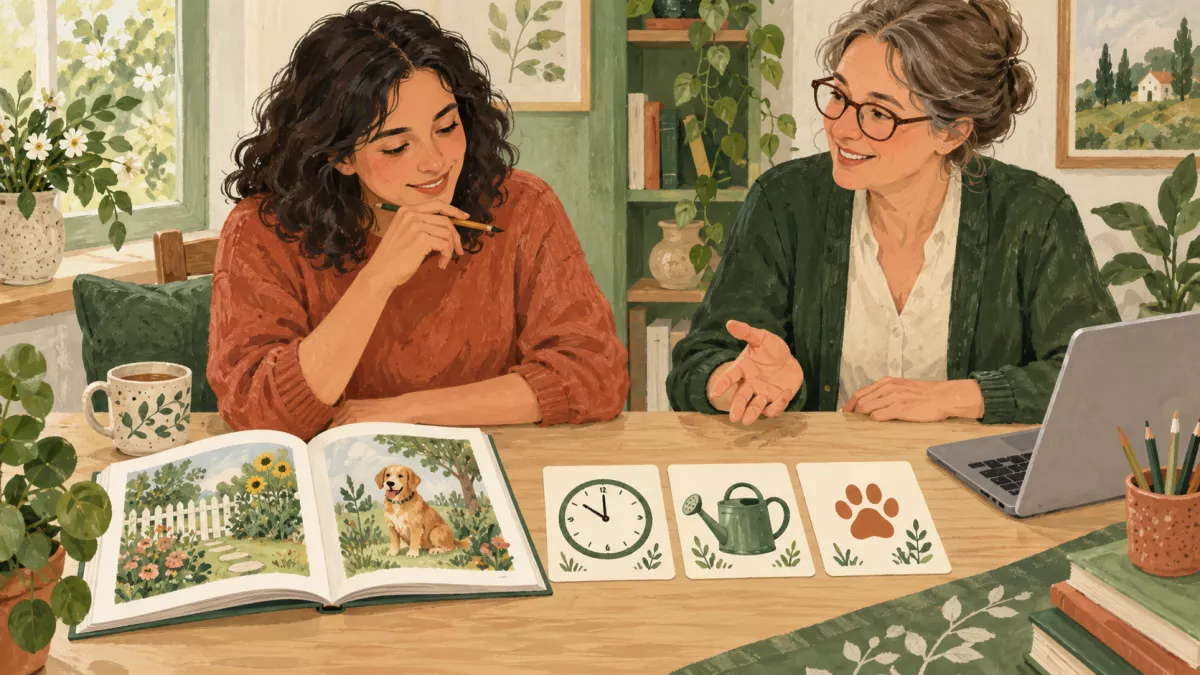
You can turn a short reading text into a quiz deck by choosing its main idea, selecting a few useful details and writing questions whose answers are supported by the text. Prepare the questions yourself, then enter them in a teacher game deck if you have deck-creation access. This guide uses an original story you can adapt.
Start with a text learners can understand
Choose a short passage with a clear event or problem. Learners should be able to follow most of it without looking up every word. A quiz works best after they have read for meaning, rather than while they are trying to decode an unfamiliar sentence.
Here is our example: “On Saturday morning, Leena visited her neighbour, Mr Bell. He was away for the day and had asked her to water his garden. Leena took her dog, Pip, with her. While she filled the watering can, Pip hid one of her gloves behind a flowerpot. Leena looked under the chair first. Then she saw Pip beside the pot and found the glove. She laughed, watered the flowers and went home before lunch.”
Read it once for the situation and once for the sequence. For a broader reading routine, try improving reading comprehension.
Select three kinds of question
Purpose | Question | Answer supported by the story |
|---|---|---|
Main idea | Why did Leena visit Mr Bell’s garden? | To water it while he was away. |
Detail | Where did Pip hide the glove? | Behind a flowerpot. |
Sequence | What did Leena do before she saw Pip beside the pot? | She looked under the chair. |
Scroll sideways to see all columns.
A question about the dog's colour would be unfair because the passage does not tell us. A question about Leena's favourite flower would have the same problem. Keep a copy of the text beside you and underline the evidence for every answer.
Make the options useful
For a multiple-choice version of the main-idea question, offer “To water the garden”, “To buy flowers” and “To borrow a chair”. Mark only the first as correct. Keep the options similar in length and grammar so the answer is not obvious from its shape.
Avoid asking “What did Leena do on Saturday?” if several events in your options happened that day. Narrow the question: “What did she do after finding the glove?” An explanation can point learners back to the relevant sentence rather than simply repeating “Correct!”
A vocabulary card can ask what “away for the day” means in this story. Give the answer “not at home that day”. For more ideas about teaching phrases through a passage, see vocabulary in a short story.
Add the questions to a deck
Create a clearly titled teacher deck, such as “Leena’s garden visit: reading check”, and save it as a private draft.
Add each question, its answer options and the correct answer. Use the explanation field to identify the evidence.
Check that the chosen question type works with the game you intend to use. Supported play choices depend on the deck.
Keep the passage available separately during the first attempt. A deck title alone does not give learners the story.
These are manually prepared questions; saving a reading passage does not automatically convert it into quiz cards. The vocabulary-deck guide explains the current creation workflow and the difference between draft status, visibility and question exposure.
Check your questions before playing
Your turn · self-review
Check the evidence
Answer using only information in the story.
Practice only. Your writing stays on this page; it is not submitted or saved.
-
Model answer and explanation
The text says she laughed, which suggests amusement, but it does not directly describe all her feelings. For a basic factual quiz, ask “What did Leena do when she found the glove?” Answer: She laughed.
-
Model answer and explanation
Question: Did Leena go home before or after lunch? Answer: Before lunch. Evidence: the final sentence.
Read every card from the learner's point of view. Check pronouns, time words, spelling and the marked answer. If two options could be correct, revise the prompt before the activity.
Finish with a short retelling
After the quiz, ask learners to retell the story in three sentences: the reason for the visit, the small problem and the ending. They can compare their versions with the passage and repair a missing detail. Summarising a text offers another way to practise selecting important information.
For a later lesson, change the story's setting and write new questions together. Learners can also use skimming and scanning to prepare independently. A useful deck checks understanding and gives you a reason to return to the language.





