
How to Talk About Your Last Weekend in English
Describe your last weekend in English with a simple story structure, useful past verbs, natural follow-up questions and exercises with explained answers.
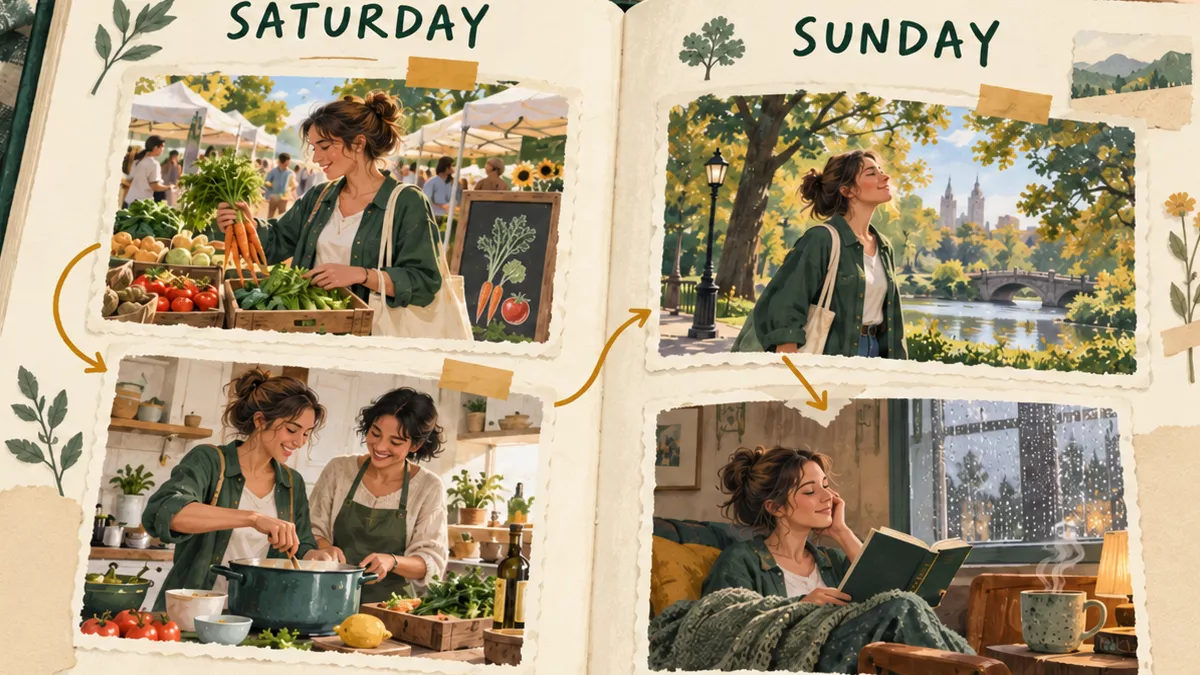
To talk about your last weekend in English, say what you did, put the events in a simple order, and add one detail about how you felt. Use the past simple for completed events: “I visited the market on Saturday. On Sunday, I stayed at home and read.”
A quiet weekend is still worth describing. You do not need an exciting trip or a perfect story. A small plan, a change in the weather, or something you enjoyed gives your listener a reason to respond.
Choose three moments instead of a long list
Think of your weekend as three small scenes: the main activity, another moment, and your overall feeling. A beginning such as “It was quite relaxing” gives the listener an idea of the weekend before the details arrive.
Opening: “It was a busy weekend” or “I had a quiet weekend.”
First moment: what happened on Saturday, with one detail.
Second moment: what happened on Sunday, or what changed.
Closing: your feeling, or the part you enjoyed most.
You can change the structure if you work at the weekend or your days off fall on different days. “I worked on Saturday, so Sunday was my day off” gives helpful context. Do not invent activities because you think your real life sounds too ordinary.
A short weekend story
I had a relaxing weekend. On Saturday morning, I went to the market and bought some vegetables. In the afternoon, my friend Sara came over, and we cooked soup together. On Sunday, I went for a walk in the park. I wanted to stay longer, but it started to rain, so I came home and read a book. Nothing special happened, but I enjoyed having some quiet time.
The story gives a sequence rather than a timetable. “But” introduces a change: the rain affected the plan. “So” explains the result: the speaker came home. The final sentence tells us how the speaker feels about the whole weekend.
For help with everyday spoken answers, explore the speaking learning path and choose relevant available practice. Practise giving a short answer that follows the event order.
Keep a small bank of past verbs
Everyday verb | Past form | Weekend example |
|---|---|---|
go | went | I went for a walk. |
buy | bought | I bought vegetables. |
come | came | My friend came over. |
read | read | I read a book on Sunday. |
stay | stayed | I stayed at home. |
cook | cooked | We cooked dinner together. |
Scroll sideways to see all columns.
The past form of “read” has the same spelling as the base form but sounds like “red”. If you only write the story, this difference is easy to miss. Practise the sentence aloud so you prepare for speaking as well as writing.
For a negative with an ordinary verb, use “didn’t” and the base form: “I didn’t go out”, not “I didn’t went out”. Questions follow the same idea: “What did you do?” and “Did you enjoy it?” For “be”, use “was” or “were”: “Was it busy?”
The grammar learning path can help you explore past-tense forms in more detail. When telling your story, choose three useful verbs first and practise their past forms in complete sentences.
Answer a follow-up without restarting the story
Ben: How was your weekend?
Asha: Quite nice. I visited my cousin on Saturday.
Ben: Where does your cousin live?
Asha: In Bristol. We had lunch together and walked by the river.
Ben: Did you stay overnight?
Asha: No, I came home that evening. How about your weekend?
Notice that a follow-up may use the present: “Where does your cousin live?” asks about the cousin’s current home. The events of the visit use the past. You do not have to force every sentence into the past just because the conversation began with last weekend.
If you forget a word, keep the story moving with simpler language. “We went to a place with old paintings” can help you describe an art gallery. Afterwards, find the phrase you needed and add it to your notes.
Check the story and repair the sentences
Use the first weekend story, then answer these questions before reading the explanations.
Your turn · self-review
Write, then compare
Answer in your own words, then compare the meaning and evidence with the models. Other clear answers may also be correct.
Practice only. Your writing stays on this page; it is not submitted or saved.
-
Model answer and explanation
Sara, the speaker’s friend. The cooking happened after Sara came over on Saturday afternoon.
-
Model answer and explanation
It started to rain. The story uses “so” to connect the weather change with coming home.
-
Model answer and explanation
“I didn’t buy anything.” After “didn’t”, use the base form “buy”; “did” already carries the past meaning.
-
Model answer and explanation
“Did you enjoy the weekend?” Put “did” before the subject and use the base form “enjoy”.
Make a forty-second weekend story
Draw three boxes on paper. Write a few words in each: first activity, second activity, feeling. Add one connector such as “then”, “but” or “so”. Tell the story from the boxes, leaving short pauses between scenes. If you record it on your own device, listen for the order and the main past verbs rather than correcting every detail at once.
You can also try an appropriate available scenario in AI Conversations or exchange weekend stories with a partner. Ask one follow-up question about a detail you actually want to know.
Finish by choosing one sentence to improve. Add a reason, make the event order clearer, or fix one useful verb. Then tell the story again. A clear small story with a personal detail is enough to make this everyday conversation worthwhile.





