How to Talk About Your Daily Routine in English
Talk about your daily routine in English with useful action phrases, time expressions, a natural model answer and exercises with clear explanations.
To talk about your daily routine in English, describe a few regular activities in order, add useful time expressions, and mention one detail that makes the day yours. “I get up at seven, take the bus to work, and cook dinner in the evening” is a clear starting point.
A routine answer does not need to list every movement from waking up to sleeping. Choose the parts your listener will find useful: when your day starts, what you usually do, and how the evening is different. Choose activities that reflect your own day: study, work, caring responsibilities or free time.
Collect useful action phrases
Part of the day | Useful phrases | An original example |
|---|---|---|
Starting the day | wake up, get up, get dressed | I wake up at six, but I get up at half past six. |
Food | have breakfast, pack lunch, cook dinner | I pack my lunch before I leave. |
Travel and work | take the bus, walk to work, start work | I take the bus and start work at nine. |
Free time | go for a walk, call a friend, read a book | I go for a walk after dinner. |
Ending the day | get ready for bed, go to bed | I usually go to bed before eleven. |
Scroll sideways to see all columns.
“Wake up” means stop sleeping. “Get up” means leave your bed. “Go home” does not need “to”: say “I go home at five”, not “I go to home at five”. Learn the whole phrase rather than a separate verb that you have to rebuild during a conversation.
The vocabulary learning path can help you explore everyday words. For this task, collect five action phrases that describe your actual day; you do not need every phrase in the table.
Build a morning, afternoon and evening answer
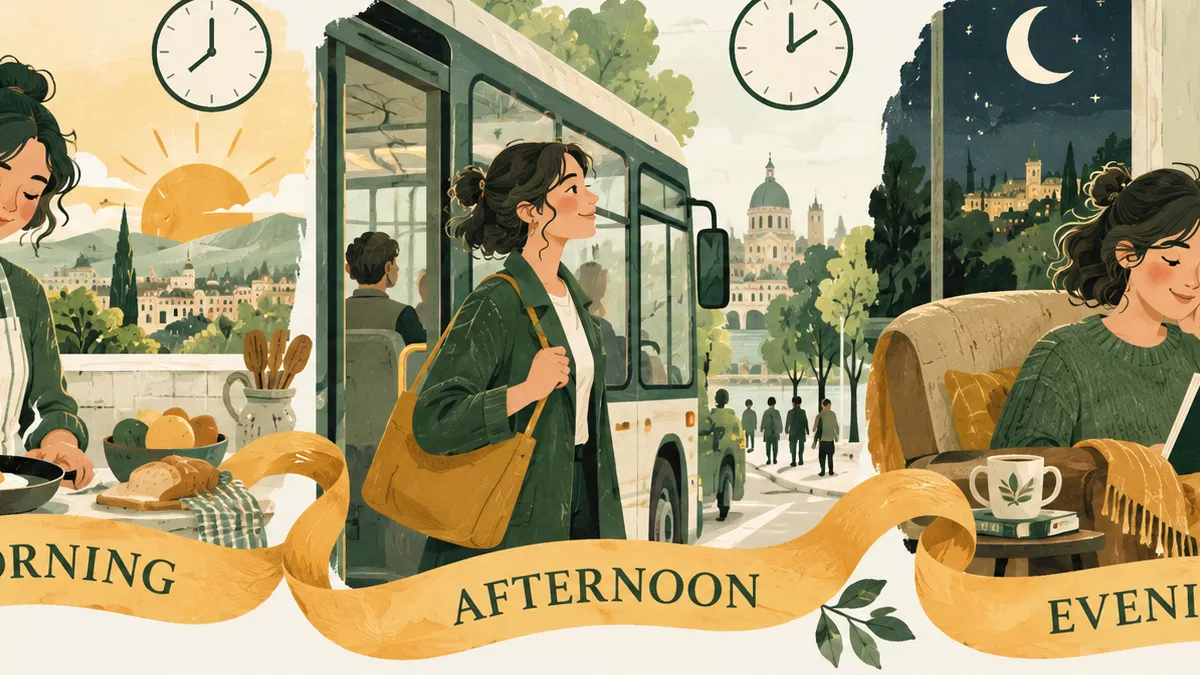
Use the present simple for regular activities: “I work at a library” and “I have lunch at one”. Add “then” or “after that” when it helps the listener follow the order. You can pause between parts of the day instead of joining everything into one long sentence.
On weekdays, I get up at half past six. I have breakfast with my sister and pack my lunch. Then I take the bus to the library, where I work. I start at nine. In the afternoon, I help visitors and put books back on the shelves. I usually get home around six. After dinner, I go for a short walk or read. I go to bed at about ten thirty. Wednesdays are different because I attend an evening class.
This answer has a clear sequence and one exception. It gives enough detail to invite a question without describing every minute. If your work or study hours change, say so: “My shifts change each week” or “I do not have the same routine every day.”
Say when and how often
Meaning | Useful expression | Example |
|---|---|---|
Exact or approximate time | at seven; around seven | I leave home around seven. |
Part of the day | in the morning; in the evening | I exercise in the evening. |
A regular pattern | on weekdays; every Saturday | I work on weekdays. |
How often | usually; sometimes; hardly ever | I sometimes have lunch outside. |
An exception | except on Fridays | I walk to work, except on Fridays. |
Scroll sideways to see all columns.
With an ordinary main verb, “usually” often comes before the verb: “I usually eat at home.” With “be”, it usually comes after the verb: “I am usually tired in the evening.” These are useful everyday patterns, not a rule that every frequency expression must stay in one position.
If you need more support with these forms, visit the grammar learning path and look for relevant available lessons. Keep your spoken answer simple while you practise the meaning and order.
Turn your routine into a conversation
Lina: What time do you usually start work?
Noor: At nine, but I leave home at eight because I take the bus.
Lina: Do you have lunch at work?
Noor: Yes, usually. I bring food from home. What about you?
Lina: I work from home, so I cook something at lunchtime.
A short answer plus a useful detail sounds more complete than “At nine” alone. “What about you?” returns the question. You can also ask “Is your weekend routine different?” when you want to compare two patterns.
Put the routine in order
These sentences describe one person’s morning. Arrange them using the clues, then fix the two language mistakes below.
Your turn · self-review
Write, then compare
Answer in your own words, then compare the meaning and evidence with the models. Other clear answers may also be correct.
Practice only. Your writing stays on this page; it is not submitted or saved.
-
Model answer and explanation
The order is 3, 2, 4, 1: get up, get dressed, have breakfast, take the bus. “Before breakfast” and “after breakfast” tell you where those actions belong. This is the order in the exercise, not a rule about everybody’s morning.
-
Model answer and explanation
A becomes “I go home at six”: “home” follows “go” directly in this expression. B becomes “I am usually busy in the afternoon”: add the missing verb “am” before the adjective “busy”. In this neutral everyday pattern, “usually” comes after “am”.
Prepare your own short answer
Write only three headings: morning, afternoon and evening. Under each, note one or two activities.
Add one time, one frequency word and one exception that is true for you.
Speak from those notes for about forty seconds. Do not read a complete script.
Ask a partner one question about their routine, then answer the same question yourself.
Explore the speaking learning path for further practice. Next time someone asks about your day, give a clear sequence and one personal detail; that is more useful than trying to mention everything.