
How to Take Useful Notes While Listening in English
Take useful notes while listening in English with short keywords, a clear purpose and a simple review method, plus an announcement to practise with.
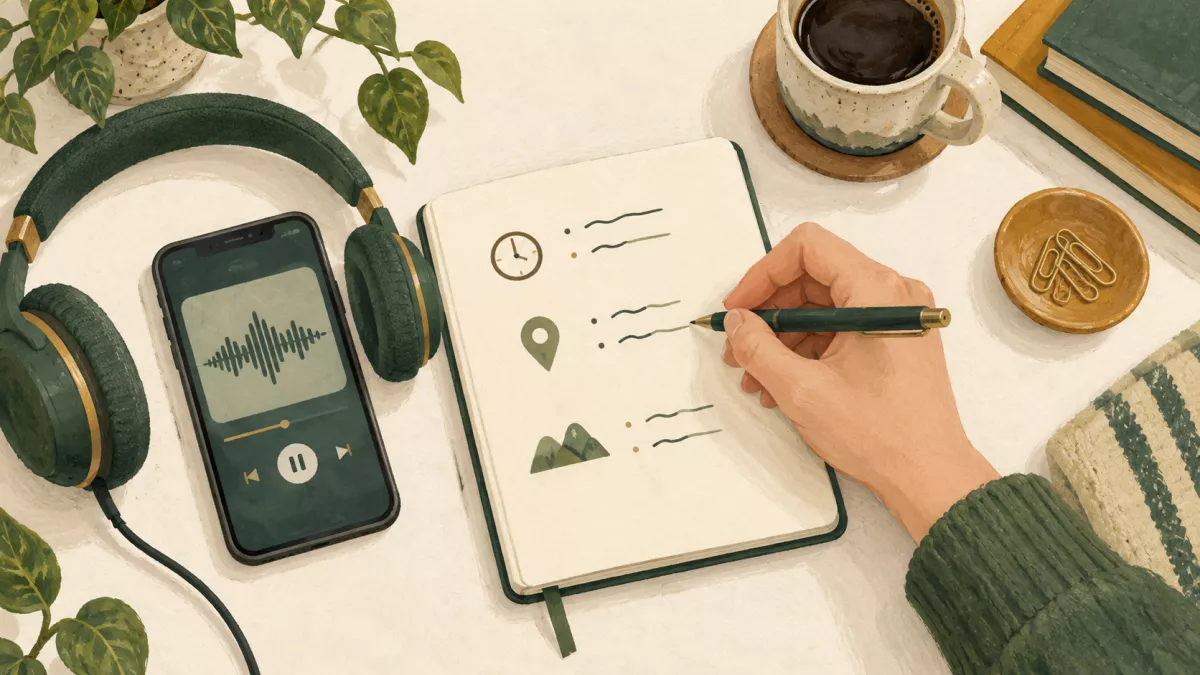
To take useful notes while listening in English, write the information you will need later: the main point, important details and any action to take. Use short words or symbols you understand, then check and expand your notes afterwards. Trying to copy every sentence can make it harder to follow the next one.
Your notes should fit the situation. A travel announcement calls for a place and time; a talk about gardening may need three main ideas. There is no single correct page layout. The useful test is whether your notes help you explain the message or do the task.
Prepare a question before you listen
Decide why you are listening. If a friend explains a meeting plan, ask yourself: Where should I go, when should I arrive and what should I bring? Write those three headings before the recording starts. A blank page then becomes a small set of spaces to fill.
For general listening practice, use the approach in our podcast listening plan. If the aim is to hear the exact wording, dictation practice is a separate activity; it asks you to write much more precisely.
Write keywords that preserve the meaning
Heard message | Possible note |
|---|---|
Meet at the east entrance, not the main door. | Meet: east entrance; NOT main |
Bring your own water bottle. | Bring: water |
The workshop begins at ten thirty. | Start: 10:30 |
Scroll sideways to see all columns.
Leave out words only when the meaning stays clear. “Not Friday” is very different from “Friday”, so keep negatives. Record units with numbers: £15, fifteen minutes and fifteen people are different details. A question mark can show uncertainty, but do not let a guessed time look like a confirmed one.
Use abbreviations that make sense to you. An arrow can show a change, and a plus sign can connect items. You do not need a special shorthand system. If a symbol takes longer to invent than the word takes to write, use the word.
Follow the speaker's changes
Listen for phrases such as “first”, “another reason” and “finally”. They can help you separate ideas. Also notice corrections: “We planned to meet at nine, but the new time is ten.” Your final note needs ten, with the earlier time crossed out or clearly marked as changed.
If you miss a detail, leave a gap and keep listening. In a recording you can replay that section later. In a real conversation, use a clarification question: “Did you say ten or ten thirty?” Our guide to asking someone to repeat or explain gives more examples.
Try a short announcement
Here is an original practice script. Read it aloud for a partner, or ask someone to read it to you while you take notes: “Tomorrow's walking tour starts outside the museum at quarter past nine. Please arrive ten minutes early. The tour costs six pounds. Bring a raincoat because we will stay outdoors. The cafe stop has been cancelled.”
Possible notes are: tour tomorrow; museum outside; start 9:15; arrive 9:05; £6; raincoat; no cafe. Notice that arrival and start are separate. A long copy of the announcement is unnecessary if these notes let you prepare correctly.
Check whether your notes are usable
Your turn · self-review
Listen, select and check
Use the announcement above. Write your answer before comparing with the model.
Practice only. Your writing stays on this page; it is not submitted or saved.
-
Model answer and explanation
Add outside the museum; start 9:15 and arrive 9:05; £6 rather than an unexplained 6; cafe stop cancelled. Also add a raincoat. The missing relationships matter more than perfect sentences.
-
Model answer and explanation
Bring notebook; no laptop needed. Keeping “no” or “not needed” prevents the note from suggesting that both items are required.
Review soon after listening
Read your notes while the message is still fresh. Expand unclear abbreviations, mark gaps and write a one-sentence summary. Check uncertain details against the recording or transcript when available. If your summary adds something the speaker never said, remove it or label it as your own idea.
Keep one small goal for the next attempt, such as preserving corrected times or recording reasons. You can also try the subtitle replay routine to check uncertain video details. Useful notes make the message available later; neat handwriting and complete sentences are optional.





