
How to Set English Learning Goals You Can Measure
Set measurable English learning goals with practical examples, a simple progress record and a two-week plan that shows what you can actually do.
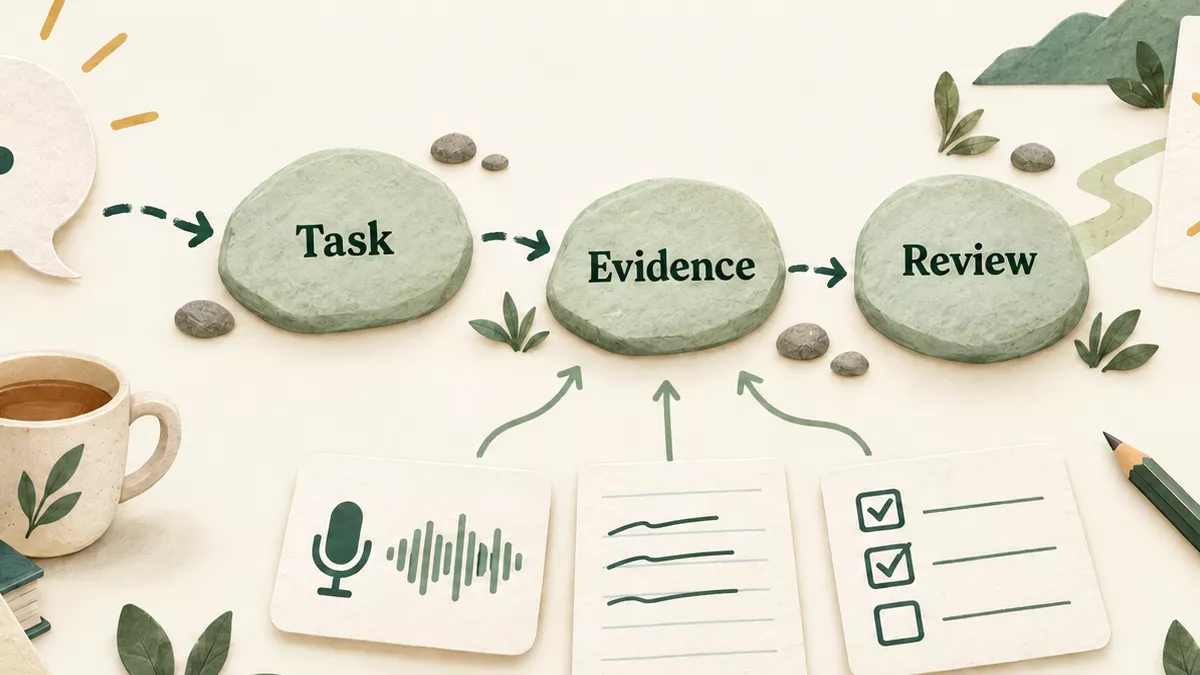
To set English learning goals you can measure, choose one real task, describe what a successful attempt looks like, and decide when you will check it. Save a small piece of evidence, such as a recording, a written paragraph or answers to a short listening task. This makes your next learning decision clearer.
“Improve my English” tells you the direction, but it does not tell you what to practise today. A useful goal might be: “By next Sunday, I will explain my journey to work in six connected sentences, using only three keyword notes.” The task, support and review date are all visible.
Choose a task that matters to you
Think about a situation in which you want to use English: joining a conversation, understanding an announcement or describing a problem. Choose one situation for your first goal. Trying to improve every skill at once makes it harder to identify what helped.
You can use the Council of Europe’s CEFR self-assessment grid to explore descriptions of different language activities. Treat those descriptions as a guide to possible tasks. Completing one personal goal does not establish a CEFR level or replace an assessment.
Turn a broad wish into a checkable goal
Broad wish | A smaller goal | Evidence to keep |
|---|---|---|
Speak more confidently | On Saturday, describe my usual journey in six sentences with three keyword notes. | A short recording and a checklist of included information. |
Understand more English | By Friday, find the meeting place and start time in two short, clear recordings. | My answers and the correct details from the recordings. |
Learn more vocabulary | Next week, use five travel phrases accurately in a new trip description. | A paragraph with the five phrases highlighted. |
Write better | On Sunday, write a paragraph explaining one reason I enjoy my neighbourhood, with two supporting details. | My first draft and revised paragraph. |
Scroll sideways to see all columns.
These are examples to adapt, not targets that everyone should meet. If six sentences are too demanding, begin with three. If you can already do the task easily, add one relevant challenge, such as a follow-up question.
Check your starting point
Try the task before doing extra practice. Keep this first attempt, even if it contains gaps. Use the same instructions at the review so you can compare fairly. A prepared speech and an unexpected conversation require different skills, so do not treat them as equivalent evidence.
Choose two or three things to check. For the journey description, check that you name your transport, explain the route and give a reason for your choice. Accuracy matters too: if a sentence changes the intended meaning, mark it for repair. You do not need to count every tiny hesitation.
Separate practice from the result
“Practise on four days” is a useful activity target. “Explain my journey clearly” is an outcome target. Keep both, but label them separately. Four completed sessions show effort; the final description shows what you can do with that effort.
For a speaking goal, use the speaking learning path to choose relevant available practice. If your difficulty is understanding the other person, consider the listening learning path instead. Select material that matches the task, rather than completing activities only to increase a count.
A worked two-week plan
Imagine Nina wants to describe a local place to a visiting friend. Her goal is to explain where it is, what people can do there and why she recommends it, without reading a full script. Her three keywords are “location”, “activities” and “reason”. This is a fictional planning example, not a report of measured results.
Before practice: record one attempt and check those three points. Identify the point that is hardest to explain.
During week one: collect a few useful phrases, write a short model and practise the difficult point in fresh sentences.
At the first review: make another recording with the same three keyword notes. Compare the information and clarity, not just the length.
During week two: repair the main gap and describe a different local place. At the final review, try a similar description again.
Changing the place tests whether Nina can reuse the language. Repeating only one memorised script might produce a smoother recording without showing that transfer. If the new task is harder, record that difference rather than assuming her English has become worse.
Practise choosing a useful target
Your turn · self-review
Write, then compare
Make your own attempt, then compare it with the models. Other clear answers can also be correct.
Practice only. Your writing stays on this page; it is not submitted or saved.
-
Model answer and explanation
Answer: B gives a task, two details to find, a deadline and a clear condition. A leaves “excellent” and “soon” undefined. B still needs suitable recordings and an answer check; a measurable goal also needs evidence you can trust.
-
Model answer and explanation
One possible version: “By Sunday, I will write three short descriptions of familiar places and revise each one so its main idea and two details are clear.” Other answers work if they define a manageable task and a way to review it.
Review the goal and choose the next step
Keep a brief record: task, date, support used, what worked and one next action. If the goal is too large, reduce its scope. If it is complete, repeat it in a new situation before adding another challenge. A missed session is information for adjusting the plan.
For a writing goal, the writing learning path offers a place to find available practice. Today, write one goal sentence and make your starting attempt. A small comparison you can explain is more useful than an impressive target with no evidence.





