
How to Learn From Your English Grammar Corrections
Learn from grammar corrections by reviewing suggestions, understanding the reason, writing new examples and keeping a small, useful English error log.
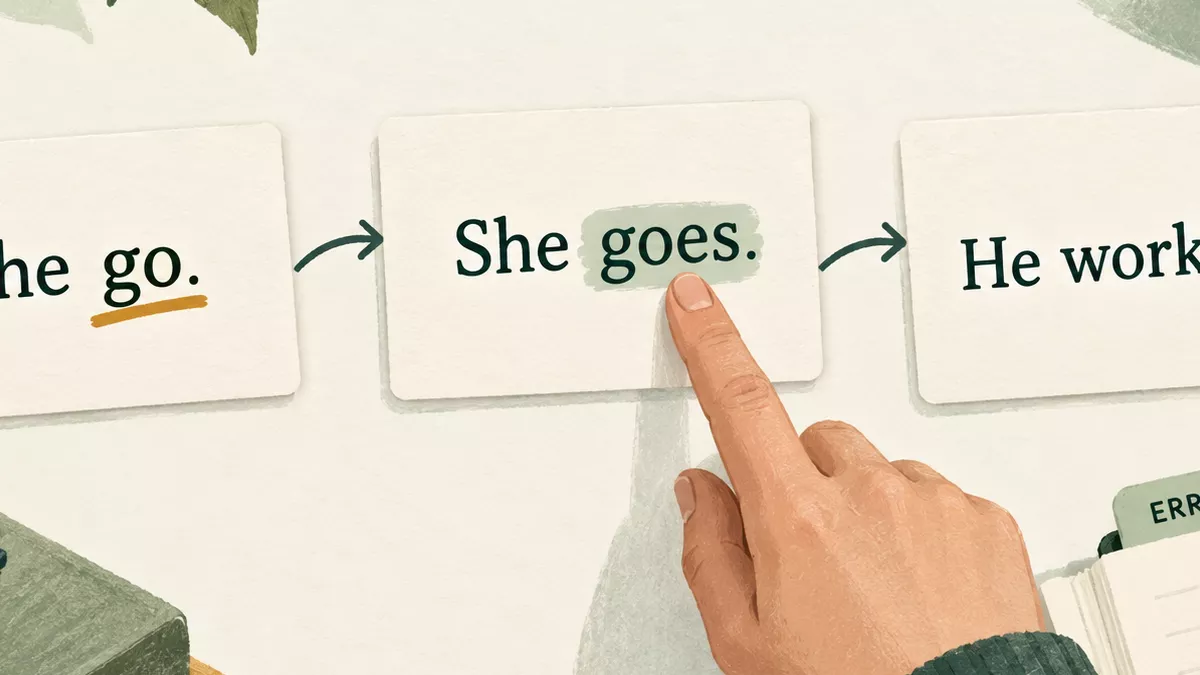
To learn from grammar corrections, do more than replace the underlined words. Read the suggestion, work out what changed and use the same pattern in a new sentence. A correction becomes useful when you can make the choice again without being shown the answer.
English Study Kit’s Grammar Coach checks writing and offers findings for grammar, spelling, punctuation and style. This guide explains how to review those findings and build a small error log that supports your next piece of writing.
Start with a short piece of your own writing
Open Grammar Coach. Type or paste a short message into the editor. You can use the example provided, but writing three or four sentences of your own will make the review more relevant. Stay within the word and character limits shown on the page.
Before selecting Check text, read your message once. Ask what you want the reader to understand. For example: “I usually arrive at nine. Yesterday I was late because the bus did not come.” Knowing your intended meaning helps you judge whether a suggested change fits.
Select Check text when you are ready. The results show a findings summary and flagged text. Hover over or select an underline to review the issue and any suggested replacements. On touch devices, select the highlighted wording.
Review one finding at a time
Read the complete sentence, not only the highlighted word.
Read the issue message and available suggestions.
Choose a replacement only when it expresses your intended meaning.
Write a short note describing the pattern you want to remember.
Create one new sentence using that pattern before moving on.
The workspace lets you apply an individual replacement or use Fix all issues for preferred available replacements. Applying all fixes can be convenient after review, but it does not explain the choices for you. Read the fixed version and check that the message still says what you meant.
Use Edit if you want to revise the writing yourself, then Check again. Editing clears the earlier findings so you can check the new version. A message saying no issues were found is useful feedback, but it does not prove that every sentence or meaning is correct.
Turn a correction into a pattern
Consider this original example: “My sister work in a bookshop.” The correction is “My sister works in a bookshop.” Here, “my sister” refers to one person, like “she”. An affirmative present-simple sentence normally needs the third-person form of the verb.
The British Council’s present-simple explanation describes this pattern and the different forms used for negatives and questions. The useful note is more precise than “always add s”: use “works” in “She works”, but use the base form in “She doesn’t work” and “Does she work?”
Original wording | Corrected wording | A useful note |
|---|---|---|
My sister work in a bookshop. | My sister works in a bookshop. | She/he/it needs the third-person form in affirmative present-simple sentences. |
She doesn’t works on Sundays. | She doesn’t work on Sundays. | After doesn’t, use the base verb. |
I bought an notebook. | I bought a notebook. | Notebook starts with a consonant sound, so use a. |
I dont know the answer. | I don’t know the answer. | Don’t is a contraction and needs an apostrophe. |
Scroll sideways to see all columns.
These are teaching examples, not a promise that the checker will flag every item in exactly this way. A finding can point you towards a pattern, while a lesson or reference helps you understand it.
Separate errors from style choices
A spelling error such as “recieve” needs the spelling “receive”. A missing verb ending can change grammatical correctness. Style suggestions may instead concern wording, repetition or readability.
For example, “In my opinion, I think the room is too small” can often become “I think the room is too small.” Both phrases introduce an opinion, so one may be enough. Whether you shorten a sentence depends on your purpose, the reader and the tone you want.
Keep your meaning first. A shorter sentence is useful when it communicates the same message clearly.
Do not replace a word simply because it looks more advanced. Compare the suggested sentence with your original intention. If you are unsure, keep the question in your notes and check the relevant lesson before using the pattern elsewhere.
Make an error log you will revisit
Use four small columns in a notebook: original sentence, correction, pattern and new example. Write the entire corrected sentence so you can see the word in context. Keep the pattern short enough to read quickly.
Original | Correction | Pattern | New example |
|---|---|---|---|
He live near the station. | He lives near the station. | He + third-person verb form. | He starts work at eight. |
We was tired. | We were tired. | We + were in this past-tense sentence. | We were at home yesterday. |
Scroll sideways to see all columns.
Choose only two or three items from a writing session. If you copy every finding into a large list, it becomes difficult to review. Look for a repeated pattern that matters to messages you often write, such as daily routines or plans.
Try a correction exercise
Answer on paper, then open the explanations below. Enable JavaScript to check answers here.
Now write a new sentence for each pattern using different details. Possible examples are “My friend cooks on Fridays”, “He doesn’t drink coffee” and “I bought a bag”. Check whether your own sentence follows the same rule before using the tool.
Use the pattern in your next message
At your next writing session, read two entries from the error log before you begin. Write a short message, check it yourself and then use Grammar Coach. Notice whether the pattern still needs attention.
If the reason for a correction is unclear, use the grammar learning path to practise it in context. Then apply it in a short task on the writing learning path. Your goal is a sentence you understand and can write again, with less help each time.





