
How to Learn English at Home: A Beginner’s Guide
Learn English at home with a beginner-friendly roadmap, practical examples and a flexible weekly plan that connects reading, listening, speaking and writing.
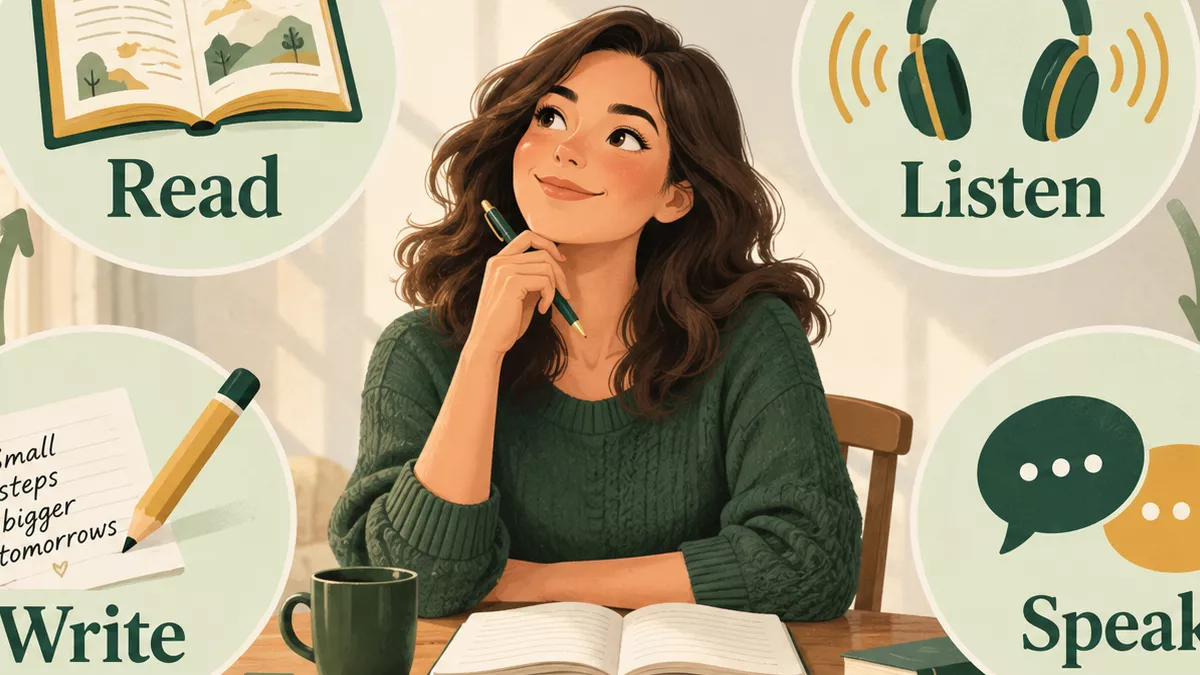
You can learn English at home by combining a small amount of useful input with practice you produce yourself. Read or listen to something you mostly understand, notice a few useful words, then speak or write about the same topic. A clear, repeatable plan is more useful than collecting dozens of unrelated lessons.
This guide gives you a starting point if you know some English but feel unsure what to do next. You can use a notebook, your phone and short lessons. Choose activities that fit your current level and the situations in which you want to use English.
Start with one real-life goal
“I want better English” is difficult to practise. “I want to introduce myself to a new colleague” gives you words, sentences and a situation to work on. Other useful goals include understanding a café order, describing your day or writing a clear message.
Write a goal for the next week. Keep it small enough to demonstrate. For example: “By Sunday, I will describe my morning in five sentences without reading every word.” This is a practice target, not a promise about how quickly you will become fluent.
Check what you can already do
Try a short task before you start. Read a simple paragraph, listen to a short lesson or say three sentences about yourself. Notice where communication breaks down. Do you lack a word? Can you recognise it in writing but miss it in speech? Can you understand a sentence but struggle to make your own?
These observations help you choose a starting point. The English Study Kit learning paths organise practice by skill, so you can work on the area that currently needs the most attention.
Follow a simple learning loop
Use the same topic across several activities. That makes your reading, listening, speaking and writing support each other instead of competing for your time.
Step | What to do | Example: your morning |
|---|---|---|
Meet the language | Read or listen to a short example. | A learner describes getting ready for work. |
Notice useful patterns | Choose two or three phrases. | I get up at… / I usually… / After breakfast… |
Make it personal | Change the details to fit your life. | I get up at seven. I usually walk to work. |
Use it again | Say or write the ideas later without looking first. | Describe tomorrow’s routine from memory. |
Scroll sideways to see all columns.
You do not need to understand every word before using a text. However, if each sentence contains several unfamiliar words, choose an easier example. A manageable challenge lets you focus on meaning as well as language.
Build sentences from useful examples
Start with complete phrases that you can adapt. Learning “appointment” is useful; learning “I have an appointment at…” also shows you how to use it.
For each phrase, write one original sentence. Check that it says something true or relevant to you. Then ask a simple question about it: “What time is your appointment?” This turns one example into a small conversation.
Keep your collection short. Five phrases that you can use are a better starting task than fifty words you have only copied. Revisit earlier phrases and try them in a new situation rather than filling every study session with new material.
Give all four skills a place
Reading helps you see how sentences are organised. Listening helps you connect written words with their sounds. Speaking gives you practice finding language in the moment. Writing gives you time to shape and check a message.
You can give one skill extra attention while keeping the others active. If conversation is your main goal, practise listening and speaking more often, but use reading and writing to prepare the ideas you want to express.
Day | Main activity | Small result to keep |
|---|---|---|
Monday | Read a short text about your chosen topic. | Three useful phrases. |
Tuesday | Listen to a short lesson on a similar topic. | One sentence you understood. |
Wednesday | Say five personal sentences aloud. | A short recording or written note. |
Thursday | Write a small message using the phrases. | A draft of four or five sentences. |
Friday | Revisit one difficult point. | A corrected sentence and explanation. |
Weekend | Repeat the original task with less help. | A note about what felt easier. |
Scroll sideways to see all columns.
For structured listening practice, start with the listening path. For supported speaking situations, explore AI conversations and choose a topic close to your weekly goal.
Try your first home-learning task
Use these sentence starters to describe your morning. Change every detail that does not fit your life.
Your turn · self-review
Write, then compare
Make your own attempt, then compare it with the models. Other clear answers can also be correct.
Practice only. Your writing stays on this page; it is not submitted or saved.
-
Model answer and explanation
Example: “I usually get up at seven.” Give a clear subject, verb and a time that fits your life. Other true, clear answers can be correct. Read your sentences aloud and try again without looking.
-
Model answer and explanation
Example: “First, I make breakfast.” Name one real activity. Other true, clear answers can be correct. Read your sentences aloud and try again without looking.
-
Model answer and explanation
Example: “After breakfast, I pack my bag.” Make the order clear. Other true, clear answers can be correct. Read your sentences aloud and try again without looking.
-
Model answer and explanation
Example: “I go to work by bus.” If you do not travel to work or school, describe your own situation. Other true, clear answers can be correct. Read your sentences aloud and try again without looking.
-
Model answer and explanation
Example: “In the morning, I feel calm because the house is quiet.” Give your feeling and a reason. Other true, clear answers can be correct. Read your sentences aloud and try again without looking.
Keep progress visible
Save a small sample each week: a message, a recording or answers to a short reading task. Compare similar tasks so you can notice specific changes. “I used three sentences without my notes” is useful evidence; the number of lessons opened tells you less about what you can communicate.
If you miss a day, return with a smaller task. You can read one paragraph or practise one exchange. Adjust the plan to your life instead of abandoning it because it was too ambitious.
Choose your weekly goal now, write your five morning sentences, and keep them as your first practice sample. Tomorrow, return to the same topic and add one useful detail.





