
How to Keep an English Conversation Going
Keep an English conversation going by listening for details, adding useful replies and asking follow-up questions, with dialogues and practice tasks.
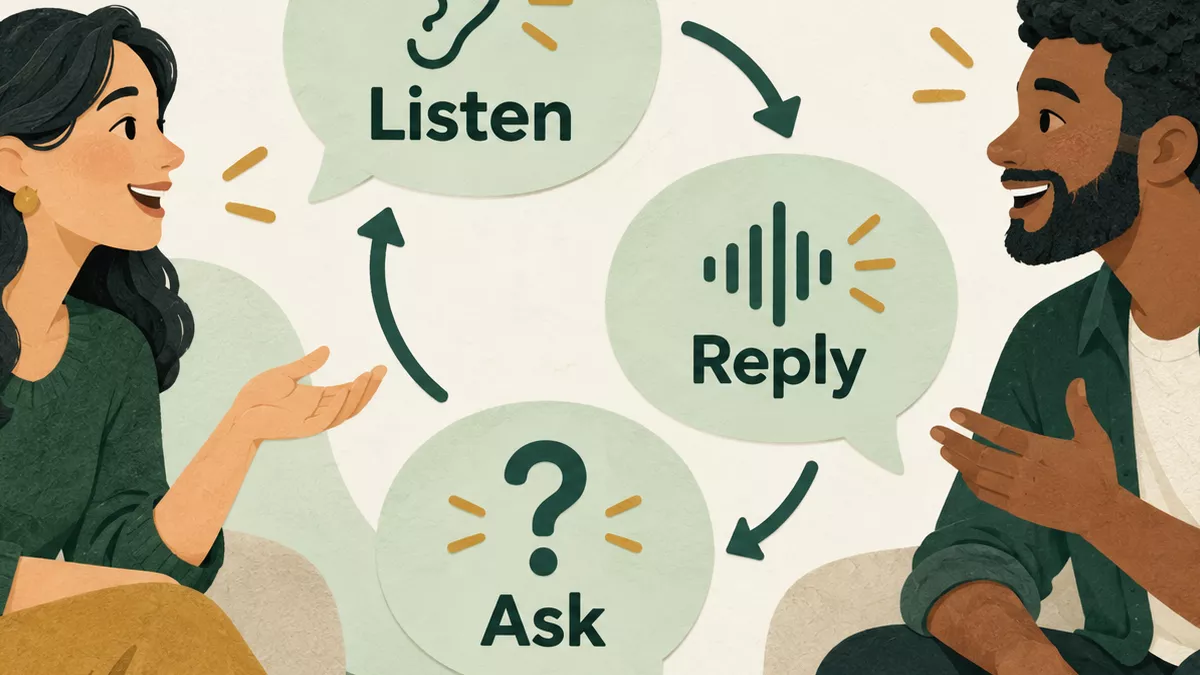
To keep an English conversation going, listen for one useful detail, reply to that detail, and ask a question connected to it. You do not need a new topic after every sentence. Most everyday conversations grow from what the other person has just said.
If someone says, “I went walking by the river,” you could reply, “That sounds relaxing. Which part of the river did you walk along?” The question shows that you listened and gives your partner something specific to talk about.
Use a simple listen, reply, ask pattern
Listen: Notice a place, person, activity, feeling, or reason in the answer.
Reply: React appropriately or share one related detail of your own.
Ask: Choose one question that helps the person continue.
This is a practice pattern, not a rule for every turn. Sometimes a short reaction is enough; sometimes your partner asks you a question first. The aim is to share the conversation instead of making it feel like an interview.
Expand a short answer
Compare these two exchanges.
Short exchange
Nora: Do you like cooking?
Ishan: Yes.
Nora: Oh, okay.
Expanded exchange
Nora: Do you like cooking?
Ishan: Yes, especially simple pasta dishes. I made one with mushrooms yesterday. What do you like cooking?
Nora: I usually make soup. I like trying different vegetables.
Ishan answers the question, adds a concrete example, and gives Nora a turn. He does not need to speak for a long time. Two or three connected sentences can give the other person plenty to respond to.
Choose questions that follow the answer
Your partner says | Detail you noticed | Connected follow-up |
|---|---|---|
I started a new job last month. | A recent change | How are you finding it so far? |
My train was late this morning. | A difficult journey | Did you have to wait long? |
I'm learning to make bread. | A new activity | What kind of bread have you tried? |
My sister is visiting tomorrow. | A visitor | What are you planning to do together? |
Scroll sideways to see all columns.
Questions beginning with what, how, or where often invite a fuller answer. Yes/no questions are useful too, especially when you are checking a detail. If your partner says “Yes,” you can follow with one gentle question instead of changing the topic immediately.
Avoid several questions in a row without reacting. “Where? When? Who with? How much?” can feel rushed. Listen to each answer and share something relevant when you can.
Match your reaction to the message
When someone shares good news, a warm reaction fits. When they describe a difficulty, show understanding before looking for another topic.
Good news: “I passed my driving test.” — “That's wonderful. How are you celebrating?”
A difficulty: “I missed my appointment.” — “That sounds frustrating. Were you able to book another one?”
Your tone matters as much as the phrase. A cheerful “Great!” would not fit the missed appointment. The British Council's showing interest lesson offers listening practice for reactions. Use it to notice delivery as well as words.
Handle a pause without panicking
A short pause is normal. You may be thinking, finding a word, or deciding what to say. You can say “Let me think for a moment” when you need a little time.
If you miss part of the message, ask for the specific part: “Did you say Tuesday or Thursday?” If the whole sentence was unclear, “Could you say that more slowly?” is a useful request. Pretending to understand makes the next reply harder.
If you forget a word, explain its purpose. Instead of stopping because you cannot remember “kettle,” try “the thing we use to boil water.” You can ask for the word after your meaning is clear.
For the listening side of this skill, the listening learning path provides a place to practise understanding short messages before responding.
Practise: build the next turn
Read each message. Choose the better reply and explain why before checking the answers.
Answer on paper, then open the explanations below. Enable JavaScript to check answers here.
Now answer this message in your own words: “I visited a small seaside town last weekend.” Write one reaction, one connected question, and an optional related detail. For example, you could ask what the town was like or what the person did there. There is no single correct answer.
Know when to change the topic or finish
If someone gives repeated short answers, they may be busy or may not want to discuss that subject. You can change to a neutral topic or end politely. A conversation does not need to continue forever.
Try “Before I go, how is your course going?” for a gentle topic change, or “It was good talking with you. I need to get back to work now” to finish clearly.
For your next practice session, choose an everyday scenario in AI Conversations. Concentrate on one detail in each reply and ask a related question. Afterwards, note one moment where the exchange developed naturally. The speaking learning path can support clearer delivery as you build this habit.





