
Countable and Uncountable Nouns: Everyday English Examples
Learn countable and uncountable nouns through shopping examples, useful quantity phrases and a short quiz covering common mistakes and changing meanings.
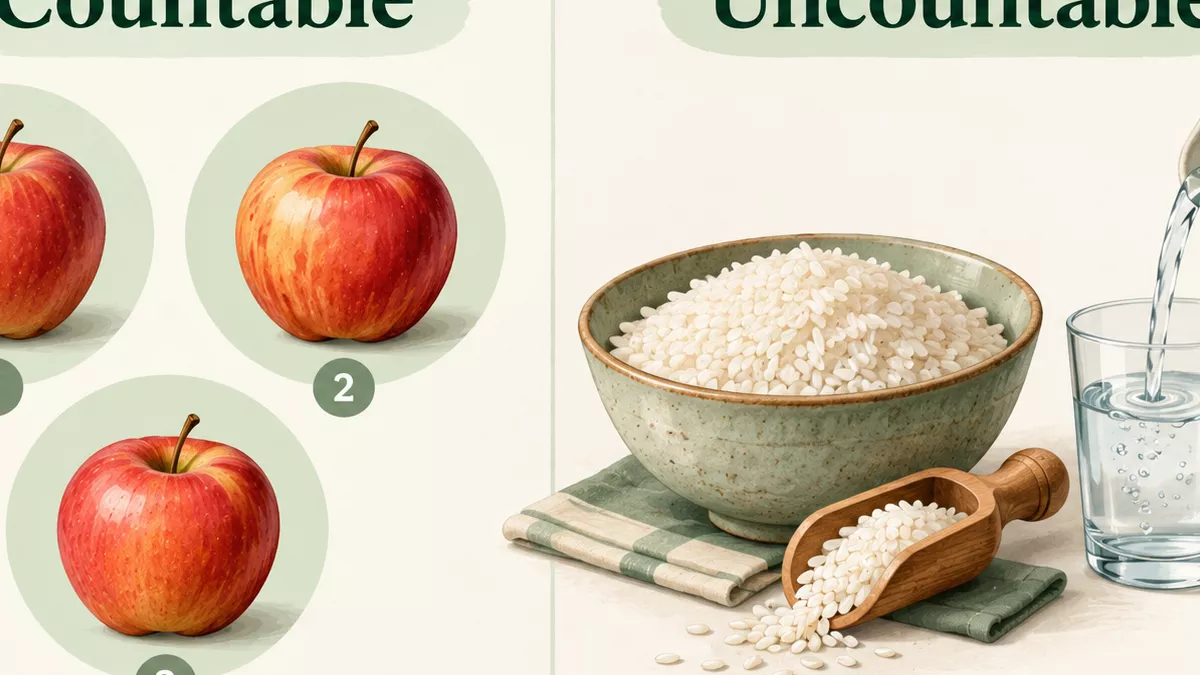
Countable nouns name things you can describe as separate items: one apple, two apples. Uncountable nouns describe an amount, substance or idea without counting the noun itself: some rice, a little time. The important question is how the noun is being used in your sentence.
This difference helps you choose a verb, a quantity word and sometimes a container. You can count three bottles of water, but water remains uncountable in that phrase. The bottles are the things you count.
A shopping bag makes the difference clear
Maya needs four tomatoes, some rice and a bottle of oil. She also wants two notebooks. At the shop, she asks, “How much rice is in this bag?” Then she checks, “How many notebooks do I have?”
Tomatoes and notebooks are separate items. Rice and oil are treated as amounts. Notice the two different questions: how many asks for the number of countable items; how much asks about an uncountable amount. “How much is this notebook?” is also correct when much refers to its price.
Type | Useful forms | Example |
|---|---|---|
Singular countable | a/an, one, this | A tomato is missing. |
Plural countable | some, many, a few | A few tomatoes are soft. |
Uncountable | some, much, a little | A little rice is left. |
Either plural countable or uncountable | a lot of | There are a lot of tomatoes. There is a lot of rice. |
Scroll sideways to see all columns.
A singular countable noun usually needs a word before it: a chair, my chair or this chair. For plural countable nouns, choose a plural verb: “The chairs are heavy.” For these uncountable examples, choose a singular verb: “The furniture is heavy.”
Count the container, piece or unit
Uncountable does not mean impossible to measure. It means you do not normally put a number directly before that noun in this meaning. Add a useful unit when the amount matters.
Water: three glasses of water or two litres of water.
Bread: a slice of bread or two loaves of bread.
Advice: a piece of advice or two useful tips.
Information: a piece of information or three useful facts.
The unit controls agreement: “A bottle of oil is on the shelf” and “Two bottles of oil are on the shelf.” When you learn a new noun, save a whole phrase with it. “A piece of advice” is more useful than learning advice by itself.
The vocabulary learning path is a place to explore words alongside the phrases they appear in. Check a learner’s dictionary when you are unsure whether a particular meaning is countable.
Common nouns that surprise learners
In their usual everyday meanings, money, furniture, luggage, advice, information and homework are uncountable. Use “The information is useful” rather than “The informations are useful”. Use “I have some homework” rather than “I have a homework”.
You can choose a different countable noun when you need separate items: coins, chairs, bags, suggestions, facts and assignments. Money is uncountable, but a coin is countable. Being able to count the real objects does not automatically make every related English noun countable.
The same noun can have two uses
Noun | An uncountable use | A countable use |
|---|---|---|
Coffee | I drink coffee after lunch. | We ordered two coffees: two servings. |
Chicken | There is some chicken in the sandwich. | Three chickens live on the farm. |
Paper | We need some paper for the printer. | I wrote two papers for the course: two written assignments. |
Scroll sideways to see all columns.
These are changes in meaning or in what the speaker is counting. Do not add plural endings to every uncountable noun just because coffee can mean a serving. For a new meaning, look at a dictionary example or a reliable sentence first.
Some and any are useful, but context matters
Some is common in positive statements: “We have some eggs and some flour.” Any is common in negatives and neutral questions: “We don’t have any eggs. Do we have any flour?” Both work with plural countable and uncountable nouns.
Offers and requests often use some: “Would you like some water?” and “Could I have some rice?” A question can also use some when you expect a positive answer. Learn these situations rather than treating every question as an automatic instruction to use any.
Try six small decisions
Choose the word in brackets that fits the sentence. For number 6, use the usual everyday meaning of information.
Answer on paper, then open the explanations below. Enable JavaScript to check answers here.
Build your own useful shopping list
Write a list with three countable nouns and three uncountable nouns from your kitchen or room. Add a quantity to every item. Then turn two entries into questions: “How many …?” and “How much …?” Read them aloud and check whether the verb agrees.
Review sentence patterns in the grammar learning path. If you check your own list with Grammar Coach, compare each suggestion with the meaning you wanted.
Open Grammar Coach for sentence checking. Keep one corrected sentence in your notes with a short reason, such as “furniture takes is”.
References
The rules were checked against British Council’s countable and uncountable nouns guide.
For nouns with changing meanings, see British Council’s common problems with count and uncount nouns.





