
How to Ask Someone to Repeat or Explain in English
Learn how to ask someone to repeat or explain in English, check important details and choose polite phrases through dialogues and answered tasks.
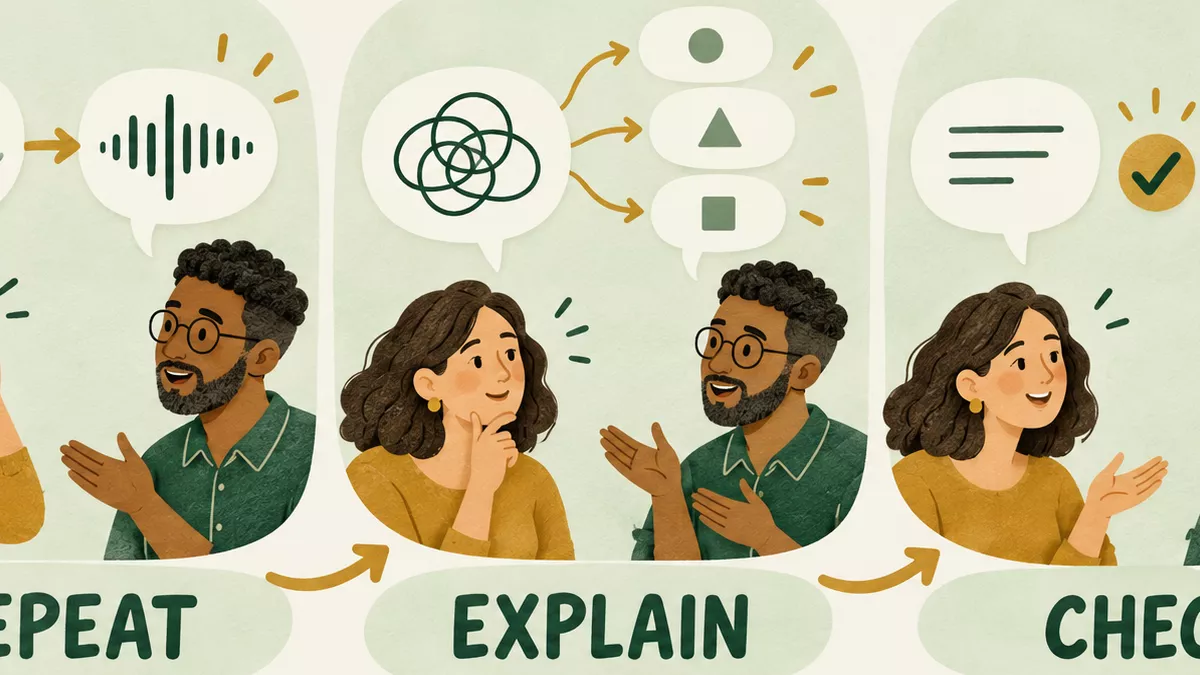
When you do not understand someone in English, ask for the help you need: repeat the words, explain their meaning, or check a detail. “Could you say that again?” helps when you missed the sound. “What does that mean?” helps when you heard the words but did not understand the message.
You can repair a conversation without pretending to understand or giving a long apology. The useful skill is noticing which part is unclear and asking a short, specific question about it.
Repeat, explain or check?
Your problem | What to ask | What the request does |
|---|---|---|
You did not hear the sentence. | Sorry, could you say that again? | Requests the same message again. |
The speaker is moving too fast. | Could you speak a little more slowly, please? | Requests a change of pace. |
One word is unfamiliar. | What does “delivery” mean here? | Asks about meaning in context. |
The idea is still unclear. | Could you give me an example? | Asks for a concrete explanation. |
You think you understood a detail. | Did you say four or five? | Checks between possible answers. |
Scroll sideways to see all columns.
A repeated sentence may still be confusing if the problem is meaning. In that situation, move from “Could you repeat that?” to “Could you explain it in a different way?” Conversely, asking for a long explanation is unnecessary if you only missed a room number.
Repair one missed detail
Receptionist: Your appointment is on Thursday at four, in room twelve.
Visitor: Sorry, did you say four or five?
Receptionist: Four o’clock.
Visitor: Thank you. And room twelve, is that right?
Receptionist: Yes, room twelve on the first floor.
Visitor: Great. Thursday at four, room twelve.
The visitor already understood Thursday, so the questions focus on time and room. Repeating the final details makes the agreement clear. For a name or address, “Could you spell that, please?” may help more than hearing the whole sentence again.
The listening learning path offers a starting point for practising how you identify details. During your own listening practice, note whether you missed a sound, a word meaning or the connection between ideas.
Ask for meaning without blaming the speaker
Colleague: We need to move the meeting back.
Learner: Could you tell me the new time?
Colleague: It will be at three instead of two.
Learner: So it is one hour later?
Colleague: Yes, exactly.
Some expressions are unclear even to experienced speakers. “Move the meeting back” can be interpreted differently, so the new time is more useful than arguing about the expression. Ask for the actual date, time or action when that is what you need.
Keep the request friendly and direct. “Could you explain the last part?” identifies the problem. “You make no sense” criticises the person. “Sorry” can be a polite introduction, but one brief “sorry” is enough; you do not need to apologise for asking a reasonable question.
Make the checking sentence your own
“So, you mean we should send the form today?” checks an interpretation.
“Do you mean the blue folder or the green one?” checks an object.
“Let me check: the entrance is beside the café?” checks a location.
“Could you show me which button?” asks for a demonstration when words are not enough.
Checking is stronger when you name the detail. “Do you understand?” is a question for the listener; “Have I understood correctly?” is a question you can ask about your own understanding. In a practical conversation, your paraphrase often gives the other person more to work with than a simple yes-or-no question.
Choose the best repair
Choose repeat, explain or check for each situation. Then say a suitable sentence aloud before reading the answers.
Answer on paper, then open the explanations below. Enable JavaScript to check answers here.
Other polite sentences can work too. In the third task, “Could you confirm the departure time?” also makes sense. The answer key shows the reason for each choice, rather than suggesting there is only one correct phrase for every real conversation.
A three-minute conversation task
Use an available scenario in AI Conversations or practise with a partner. Ask a question about a place, appointment or activity. If a genuine detail is unclear, request repetition or explanation. Then summarise the answer in your own words.
With a partner, add a practice challenge: the speaker gives an instruction with one unfamiliar word, and the listener asks about that word before acting. Switch roles. On the second round, make the message shorter instead of speaking louder; volume does not explain unfamiliar vocabulary.
Explore the speaking learning path for further practice. Keep three phrases ready: one for repetition, one for an example, and one for checking a detail. Use the phrase that solves the actual problem.





