
Am, Is and Are: A Beginner's Guide With Pictures and Practice
Learn am, is and are with seven picture-based subject patterns, simple explanations, short forms and 12 interactive practice questions.
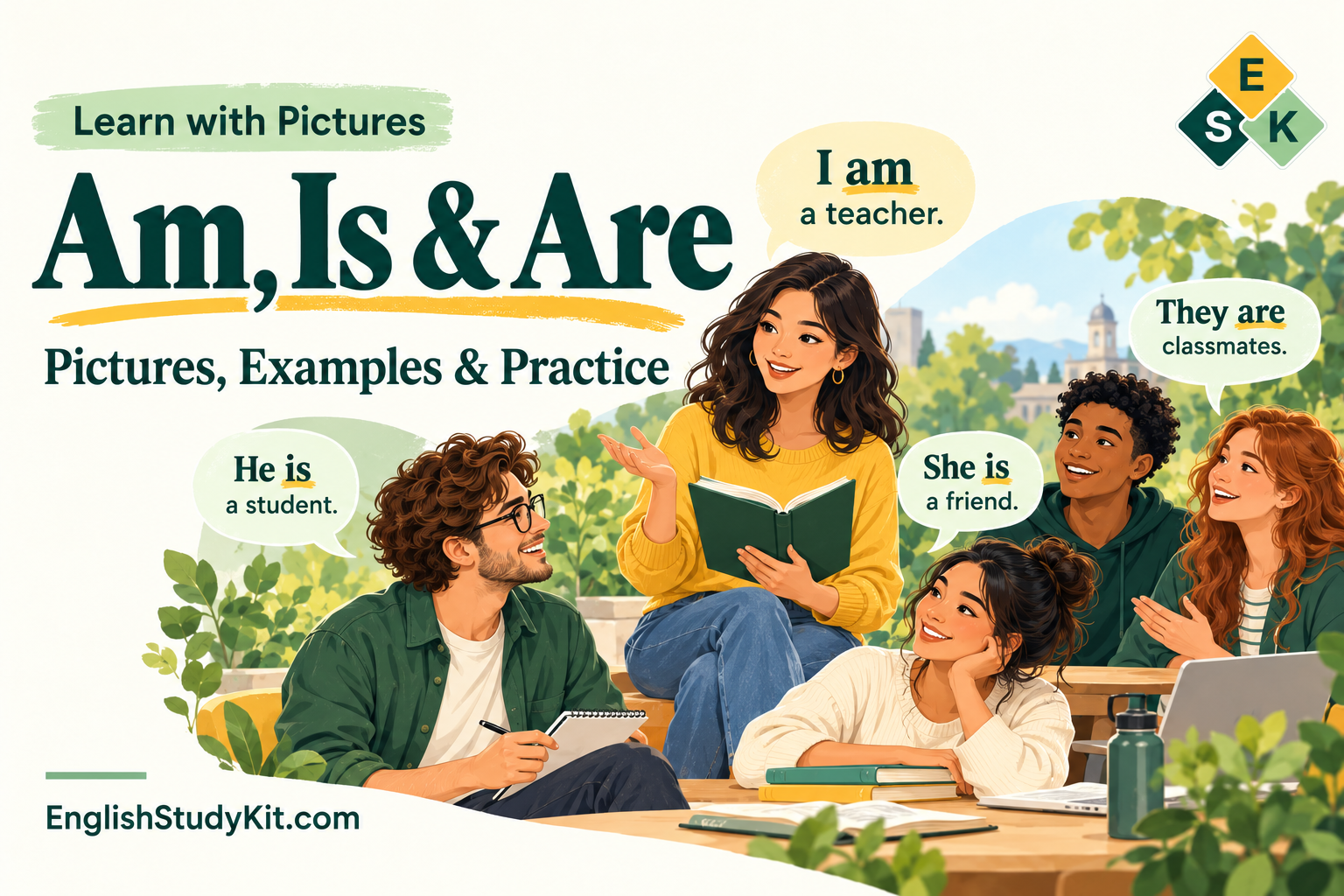
I am happy. She is a teacher. We are a team. Am, is and are are three present forms of the verb be. This lesson helps you choose the right one for seven common subject patterns, including the poster’s We bonus. Practise with twelve questions and write a short introduction.
This is part of Learn with Pictures, a series of beginner English lessons. Use the illustration to notice the meaning, then use the written examples and practice to build your own sentences.
Start with the picture poster
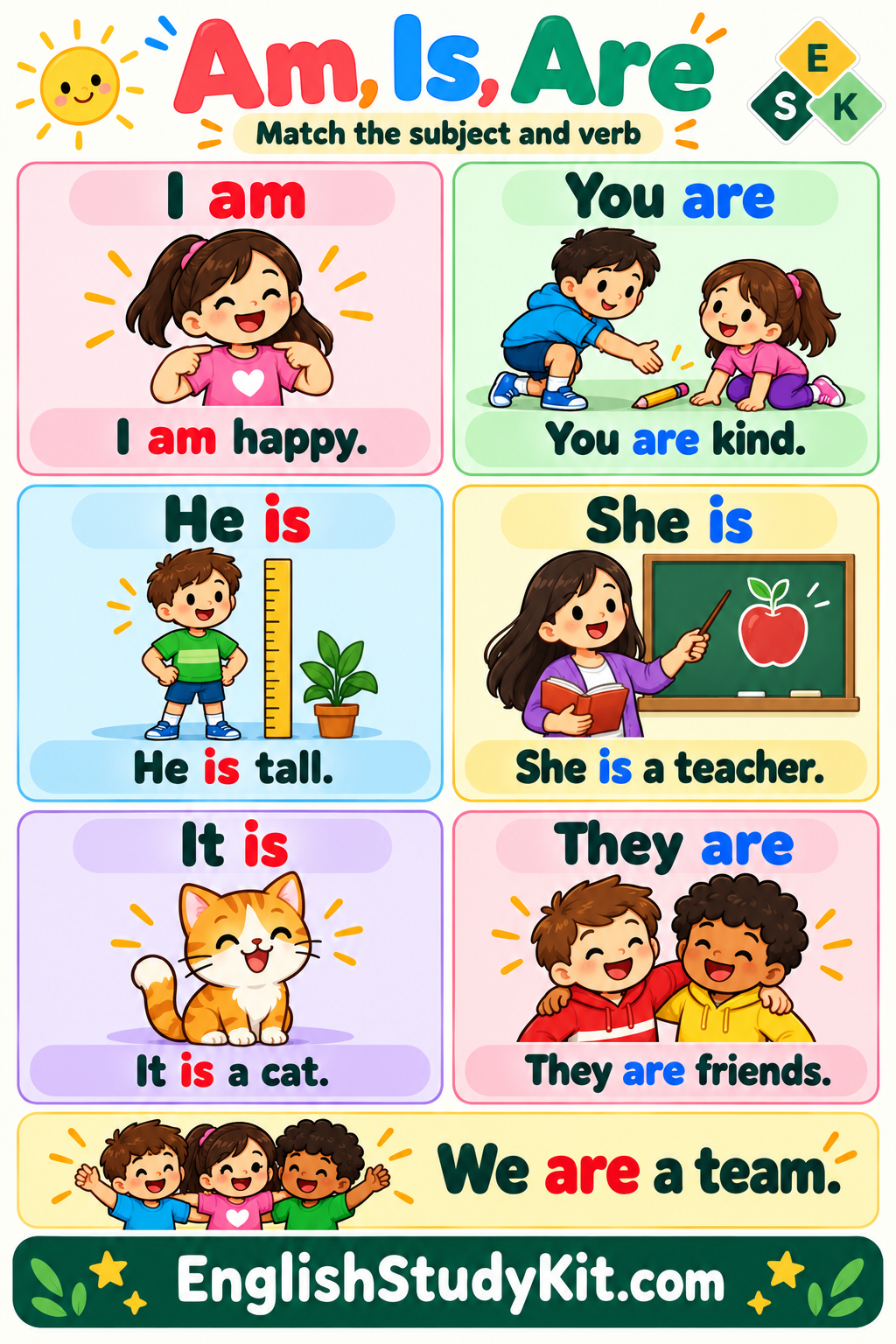
Read the six main cards and the We are a team bonus. Match the person word at the start of each sentence to am, is or are. Every label and teaching example is also written below, so you can follow the lesson without reading text inside the image.
Find the pictures as you read. You can return to the poster when you need a reminder.
Three forms, seven useful subject patterns
The subject tells us who or what the sentence is about. Choose am with I; is with he, she or it; and are with you, we or they. Learn the whole short pattern, not the verb by itself.
I am.
He is. She is. It is.
You are. We are. They are.
Use you are when speaking to one person and when speaking to more than one person. They are can refer to several people or things. English also uses they for one person in some contexts; the verb is still are.
All seven poster examples
1. I am happy.
Use am with I to describe your own feeling or state.
Example: I am ready for class.
2. You are kind.
Use are with you, whether you are speaking to one person or a group.
Example: You are a good friend.
3. He is tall.
Use is with he. An adjective such as tall can follow be.
Example: He is tired today.
4. She is a teacher.
Use is with she. A singular job noun usually needs a or an here.
Example: She is an artist.
5. It is a cat.
Use is with it when identifying one thing or an animal in this simple pattern.
Example: It is a small cat.
6. They are friends.
Use are with they. Friends is plural in the poster sentence.
Example: They are in the classroom.
7. We are a team.
Use are with we. We includes the speaker and at least one other person.
Example: We are ready to practise.
What can come after be?
Be connects the subject to information. You can give a feeling or quality, identify someone or something, or name a location.
Feeling or quality: “I am tired.” “The room is quiet.”
Identity or job: “She is a teacher.” “It is a book.”
Location: “We are at school.” “The bag is on the chair.”
A name or noun can replace the person word: “Maya is happy” works like “She is happy”. “Maya and Leo are here” works like “They are here”. “The books are new” is plural, so it uses are.
Short forms in everyday English
In speaking and informal writing, the subject and be often join: I am → I’m; you are → you’re; he is → he’s; she is → she’s; it is → it’s; we are → we’re; they are → they’re. The apostrophe marks missing letters.
“I’m happy” and “I am happy” mean the same thing. Practise full forms first if that helps you remember the pattern. Do not confuse you’re, meaning you are, with your, meaning belonging to you: “You’re kind” but “your book”.
Make a negative with not
I am not tired. Short form: I’m not tired.
She is not here. Short forms: She isn’t here or She’s not here.
They are not ready. Short forms: They aren’t ready or They’re not ready.
Put not after am, is or are. For a standard negative with I am, use I’m not. You do not need do or does in these be sentences.
Ask a question by changing the order
Statement: “You are ready.” Question: “Are you ready?” Move am, is or are before the subject. “She is a teacher” becomes “Is she a teacher?” “They are here” becomes “Are they here?”
A: Are you ready? B: Yes, I am. A: Is Leo here? B: No, he isn’t. Use the full form in a short positive answer such as “Yes, I am” or “Yes, she is”, rather than ending with “Yes, I’m” or “Yes, she’s”.
Practice 1: Choose the best answer
Choose one answer for each question. Check your answers, read the explanations and try again if you need to.
Answer on paper, then open the explanations below. Enable JavaScript to check answers here.
Practice 2: Complete the sentences
Type only the missing word or words. Use the clue in each question. Check the explanations after you finish.
Answer on paper, then open the explanations below. Enable JavaScript to check answers here.
Your turn: introduce a small group
Your turn · self-review
Say who you are and where you are
Use real details only if you want to share them. Imaginary names and situations are welcome.
Practice only. Your writing stays on this page; it is not submitted or saved.
-
Model answer and explanation
I am a student. Maya is my friend. We are in the classroom. They are our teachers.
-
Model answer and explanation
Are you ready? Yes, I am. I’m not tired.
Check: Did the subject control your choice of am, is or are? Did you keep a or an before a singular job? Did you use the full verb in a short positive answer?
Keep learning
Choose a small number of new words or patterns to use today. Say your sentences aloud, check one detail and repeat them tomorrow.
Explore the Learn with Pictures series
Use action words in everyday sentences





