
Adjectives vs Adverbs: Choosing the Right Word
Choose adjectives and adverbs with clear sentence pairs, linking verb examples and an editing exercise that explains good, well, fast and hard.
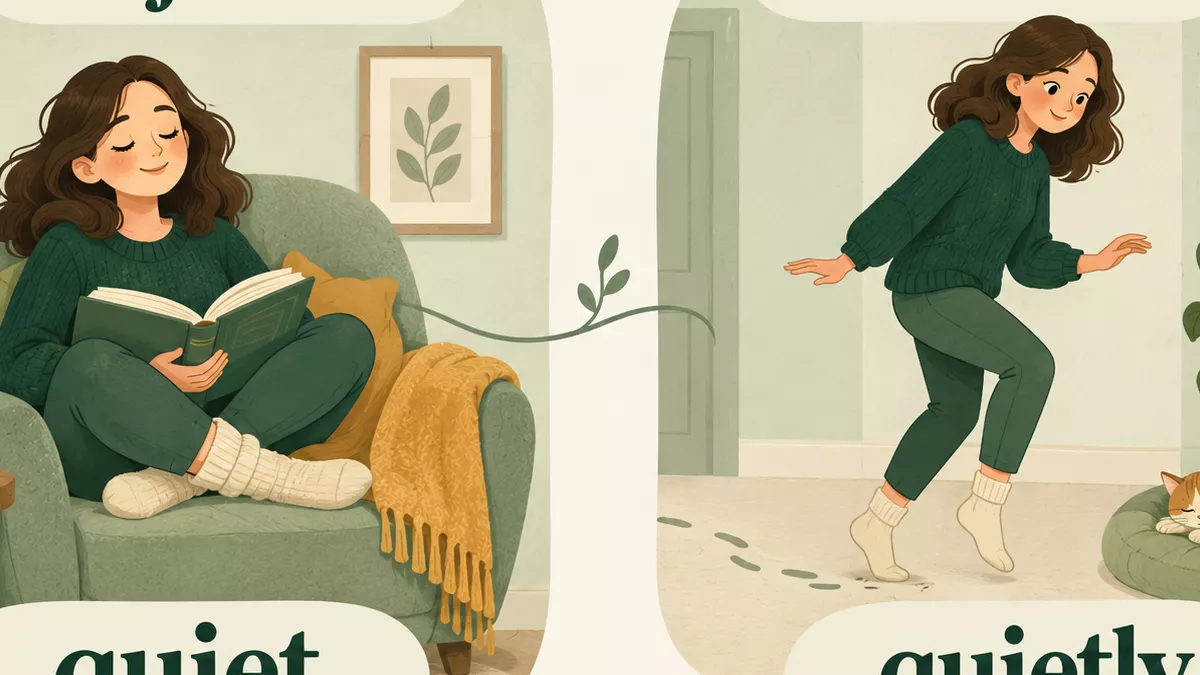
An adjective describes a person or thing: “Leah is quiet.” An adverb can describe how an action happens: “Leah closes the door quietly.” Choose the word by asking what it describes, rather than by looking only at its ending.
Adverbs have other jobs too. Soon tells us when, often tells us how frequently, and very adds degree in “very quiet”. This lesson starts with the common choice between a quality and the way someone does something.
Follow the word to what it describes
An adjective describes a noun | An adverb describes an action | What changes? |
|---|---|---|
It is a careful answer. | Noah answers carefully. | Careful describes the answer; carefully describes answering. |
The music is loud. | The band plays loudly. | Loud describes the music; loudly describes playing. |
She is a patient teacher. | She explains patiently. | Patient describes the teacher; patiently describes explaining. |
It was an easy task. | We finished it easily. | Easy describes the task; easily describes finishing it. |
Scroll sideways to see all columns.
Adjectives often appear before a noun: a patient teacher. They can also appear after be: “The teacher is patient.” Many manner adverbs appear after a verb or its object: “She explains patiently” and “She explained the rule patiently”.
For an everyday sentence, keep the verb and its object together. “He opened the parcel carefully” is a clear pattern. You do not need to experiment with more unusual positions while you are learning the difference.
Some verbs connect a person or thing to an adjective
Some verbs connect the subject with a description. Be, seem, become and feel often do this. Look, smell and taste can do it too: “The soup smells wonderful.” Wonderful describes the soup, not the way it performs an action.
The room looks bright. Bright describes the room.
Arun looks carefully at the map. Carefully describes how Arun looks at it.
The verb look has different jobs in these sentences. In the first it means “seems”; in the second it means directing your eyes towards something. The meaning helps you decide between the adjective and the adverb.
Compare “I feel tired” with “I walk slowly”. Tired is a description of me; slowly describes walking. If a sentence sounds strange, identify what the describing word is connected to before changing it.
For more sentence patterns, explore the grammar learning path and practise explaining which person, thing or action each word describes.
Often add -ly, but learn the exceptions
Adjective | Useful adverb or phrase | Example |
|---|---|---|
Careful | Carefully | Check the address carefully. |
Happy | Happily | They chatted happily on the bus. |
Good | Well | Your brother draws well. |
Fast | Fast | The train moves fast. |
Hard | Hard | We worked hard on the poster. |
Friendly | In a friendly way | The receptionist spoke in a friendly way. |
Scroll sideways to see all columns.
Many adjectives take -ly. Careful becomes carefully, with both letters l kept. In happy, the y changes to i before -ly: happily. But fastly is not the standard adverb of fast, and friendly is already an adjective.
Hardly does not mean “with a lot of effort”. “I worked hard” says I made an effort. “I hardly worked” says I did almost no work. The added letters change the meaning, so this is not a spelling choice.
Late can describe a noun or an action: “a late bus” and “The bus arrived late”. Lately means recently: “I have been busy lately.” Save each word in a short sentence that shows its meaning.
Good and well need context too. “She is a good singer” describes the singer; “She sings well” describes singing. Well can also be an adjective meaning healthy, as in “I’m well again”, so do not label every use of well as an adverb.
Edit a short museum visit
In this practice passage, choose the word that fits each blank. The two options describe different things, so read the surrounding sentence before deciding.
Answer on paper, then open the explanations below. Enable JavaScript to check answers here.
Now read the corrected passage aloud. Then change its details: a guide can speak patiently, a room can look bright, and a child can draw carefully. Build the sentence around the meaning rather than replacing words at random.
Two quick checks for tricky meanings
Your turn · self-review
Check two tricky meanings
Answer in your own words, then compare the meaning and evidence with the models. Other clear answers may also be correct.
Practice only. Your writing stays on this page; it is not submitted or saved.
-
Model answer and explanation
“I could hardly hear the music” means it was barely audible. Listening hard means making an effort to listen.
-
Model answer and explanation
Easy after seemed describes the puzzle; easily describes solving it.
Use one quality and one action today
Write four pairs about a place you know. Start with a quality: “The shop is busy.” Add an action: “The assistant works quickly.” The words do not need to be related; their jobs need to be clear. Underline the noun described by each adjective and the action described by each manner adverb.
You can check your sentences with Grammar Coach. Treat suggestions as prompts to think: if an adjective follows a linking verb, first check whether it describes the subject.
For further written practice, visit the writing learning path and use these choices in a short description of a place.
References
British Council’s adverbials of manner guide explains common forms and positions.
Cambridge’s adverbs: forms guide checks linking verbs and words whose forms stay the same.
For the meaning contrast, see Cambridge’s hardly or hard guide.





