
A, An and The: A Simple Guide With Everyday Examples
Learn when to use a, an and the with everyday examples, clear sound rules, a short story and a practical quiz with explained answers.
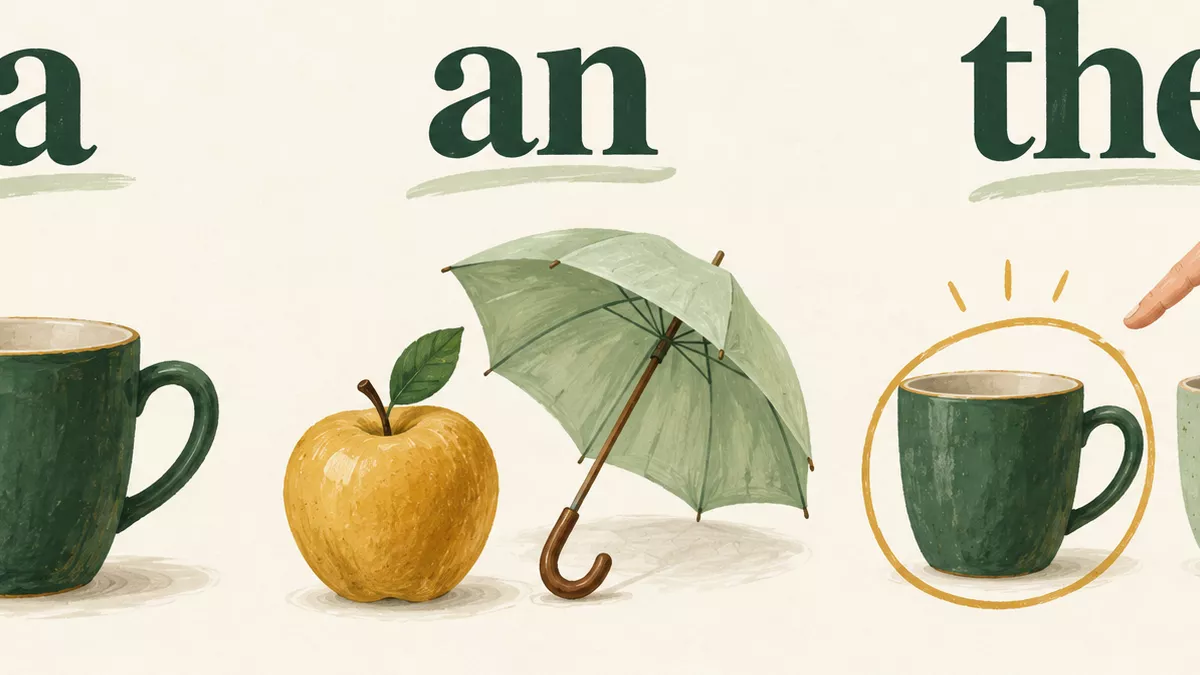
Use a or an to introduce one countable thing when the listener does not yet know which one you mean. Use the when you expect the listener to identify it. Sometimes you need no article at all: “I like music” talks about music in general.
These little words become easier when you look at the whole situation, rather than the noun alone. This lesson uses things you can picture: a bag, an umbrella, a cup and the objects around you.
Start with three questions
Before choosing an article, ask: Can I count this noun? Am I talking about one thing or several? Does the other person know which thing I mean?
Meaning | Example | Why this works |
|---|---|---|
One thing, introduced here | There is a blue bag on the chair. | We are introducing a bag. |
The same thing, now identified | The bag belongs to Noor. | The listener can identify that bag. |
A particular group | The bags by the door are ours. | We mean the bags in that place. |
Things in general | Bags can be expensive. | We mean bags generally, not one group. |
Scroll sideways to see all columns.
The does not mean that a thing must have been mentioned before. Context can identify it too. At a table with one sugar bowl, “Please pass the sugar” is clear. “Close the door” works when everyone knows which door needs closing.
For more explanation of this distinction, see Cambridge’s guide to articles.
A or an? Listen to the next sound
The choice depends on sound, not just the first written letter. Say the following phrase aloud and listen to its beginning.
A cup, a ticket and a green apple begin with consonant sounds.
An orange, an umbrella and an old bag begin with vowel sounds.
A university begins with a “y” sound, although university starts with the letter u.
An hour begins with a vowel sound because the h is silent.
An adjective can change the article you need: “an umbrella”, but “a small umbrella”. You are listening to small, the word immediately after the article. Similarly, “a lesson” becomes “an interesting lesson”.
Do not choose an article from spelling alone. If you are unsure how a word begins, listen to its pronunciation before writing the phrase.
Check whether the noun is countable
In their ordinary meanings, chair, apple and student are countable: you can have one or two. A singular countable noun usually needs an article or another word that identifies it, such as my or this.
Say “She is a student” and “This is my chair”. Do not combine the article with my: “the my chair” does not work.
Words such as information, advice and water are normally uncountable. Say “I need some information” or “Could I have a glass of water?” The countable container, glass, takes a.
You can still use the with an uncountable noun when it is specific: “The water in this bottle is cold.” Purdue OWL’s article guide provides a useful reference for countable and uncountable nouns.
Follow the objects through a short story
Lina bought a notebook and an orange. She put the notebook in her bag. At home, she ate the orange and wrote in the notebook.
The first sentence introduces two objects. After that, the reader knows which notebook and orange the story means. Notice “her bag”: the possessive her already identifies the bag, so another article is unnecessary.
Now compare “Lina likes oranges”. This describes her general taste. “Lina likes the oranges from that shop” identifies a particular group.
Practise: choose a, an, the or no article
Use a dash to show that no article is needed. Read the situation carefully; it helps you choose the meaning.
Answer on paper, then open the explanations below. Enable JavaScript to check answers here.
Make the rule part of your writing
Choose three objects near you. Introduce each one, then write a second sentence about it: “I have a mug. The mug is green.” Add one sentence about something you like generally, such as music or books.
Continue with the grammar learning path. If a sentence still puzzles you, check it with Grammar Coach, then explain the choice yourself. The aim is to connect the article with the meaning you intended.





