
8 Weather Words in English: Pictures, Examples and Practice
Learn eight weather words with pictures, simple sentences and ten interactive questions. Practise It is, rainy versus raining, and weather descriptions.

What is the weather like? Learn eight useful weather words from the poster and use them in short, natural sentences. You will describe the sky, rain, wind and temperature, then try ten questions and make a short weather message. All situations in the practice are invented examples, not a live forecast.
This is part of Learn with Pictures, a series of beginner English lessons. Use the illustration to notice the meaning, then use the written examples and practice to build your own sentences.
Start with the picture poster
Find the eight labels: sunny, rainy, cloudy, windy, snowy, stormy, foggy and hot. Hot describes temperature; the other pictures focus on different weather conditions. Every label and teaching example is also written below, so you can follow the lesson without reading text inside the image.
Find the pictures as you read. You can return to the poster when you need a reminder.
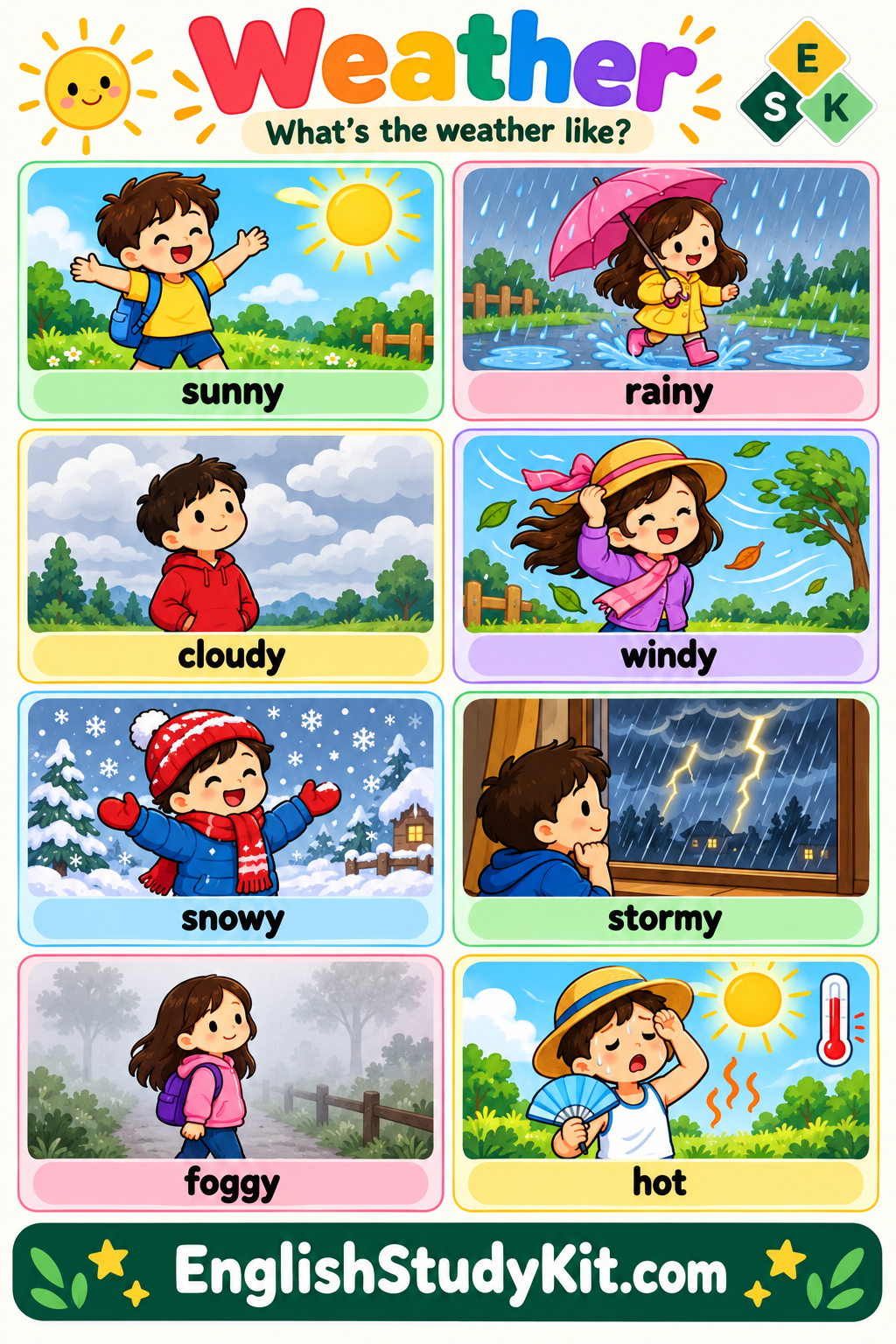
Eight weather words
1. sunny
With plenty of sunshine. The sun is visible or shining strongly.
Example: It is sunny this morning.
2. rainy
With rain or a lot of rain during the period you are describing.
Example: It is a rainy afternoon.
3. cloudy
With many clouds in the sky.
Example: It is cloudy, but it is not raining.
4. windy
With a lot of wind: the air is moving strongly.
Example: It is windy by the sea.
5. snowy
With snow falling or covering the ground.
Example: It is a snowy day in the mountains.
6. stormy
With a storm, often involving strong wind and sometimes heavy rain, thunder or lightning.
Example: It is stormy outside tonight.
7. foggy
With a thick cloud close to the ground that makes it hard to see far.
Example: It is foggy early in the morning.
8. hot
With a high temperature.
Example: It is hot in the afternoon.
Start with It is
The simplest pattern is It is + weather adjective: “It is sunny.” “It is foggy.” In conversation, use the shorter form it’s: “It’s windy today.” Keep it and the verb; “Is sunny” is not a complete standard English sentence on its own.
Today: “It is cloudy today.”
A place: “It is hot in my town.”
A time: “It is often foggy in the morning.”
Two conditions: “It is sunny and windy.”
You can also put the adjective before a noun: “a rainy day”, “a hot afternoon”, “a snowy morning”. Do not add -s to the adjective: “rainy days”, not “rainys days”.
Rainy and raining are different forms
Rainy is an adjective. It describes weather with rain: “It is rainy today.” Raining is part of a verb phrase. “It is raining now” tells you rain is falling at this moment. A rainy day can include a short break when no rain is falling.
The same useful contrast works with snow: “It is snowy” describes snowy conditions, while “It is snowing” says snow is falling. Do not say “It is rain” to describe rain falling now. Use “It is raining”.
Ask and answer about weather
A: What is the weather like today? B: It’s cloudy and windy. A: Is it raining? B: No, it isn’t. A: Is it hot? B: No, it’s quite cool.
“What is the weather like?” asks for a description. You can also ask “How is the weather?” Do not combine the two patterns as “How is the weather like?” The reply can be short; one or two accurate words are enough.
Build a useful weather message
An imaginary message: “Hi Sam. It’s rainy here this morning, so I have my umbrella. It’s not very windy. What is the weather like in your town?”
Notice the place, time and two observations. Use this example to practise giving a short weather description. Describe what you can observe, or clearly mark the situation as imaginary.
Practice 1: Choose the best answer
Choose one answer for each question. Check your answers, read the explanations and try again if you need to.
Answer on paper, then open the explanations below. Enable JavaScript to check answers here.
Practice 2: Complete the sentences
Type only the missing word or words. Use the clue in each question. Check the explanations after you finish.
Answer on paper, then open the explanations below. Enable JavaScript to check answers here.
Your turn: a two-place weather message
Your turn · self-review
Describe and ask
Describe real weather only if you can observe it, or clearly invent a situation. The model below is imaginary.
Practice only. Your writing stays on this page; it is not submitted or saved.
-
Model answer and explanation
It is cloudy in my town this morning. It is windy, but it is not raining. What is the weather like where you are?
-
Model answer and explanation
It is sunny and cold in the mountains. There is snow on the ground.
Check: Did you include it is or it’s? Did you distinguish temperature from sunshine? If you used raining, did you mean rain is falling now?
Keep learning
Choose a small number of new words or patterns to use today. Say your sentences aloud, check one detail and repeat them tomorrow.





