
6 Prepositions of Place: Where Is the Cat?
Learn in, on, under, next to, between and behind with a cat-and-box poster, clear examples and 12 interactive practice questions.
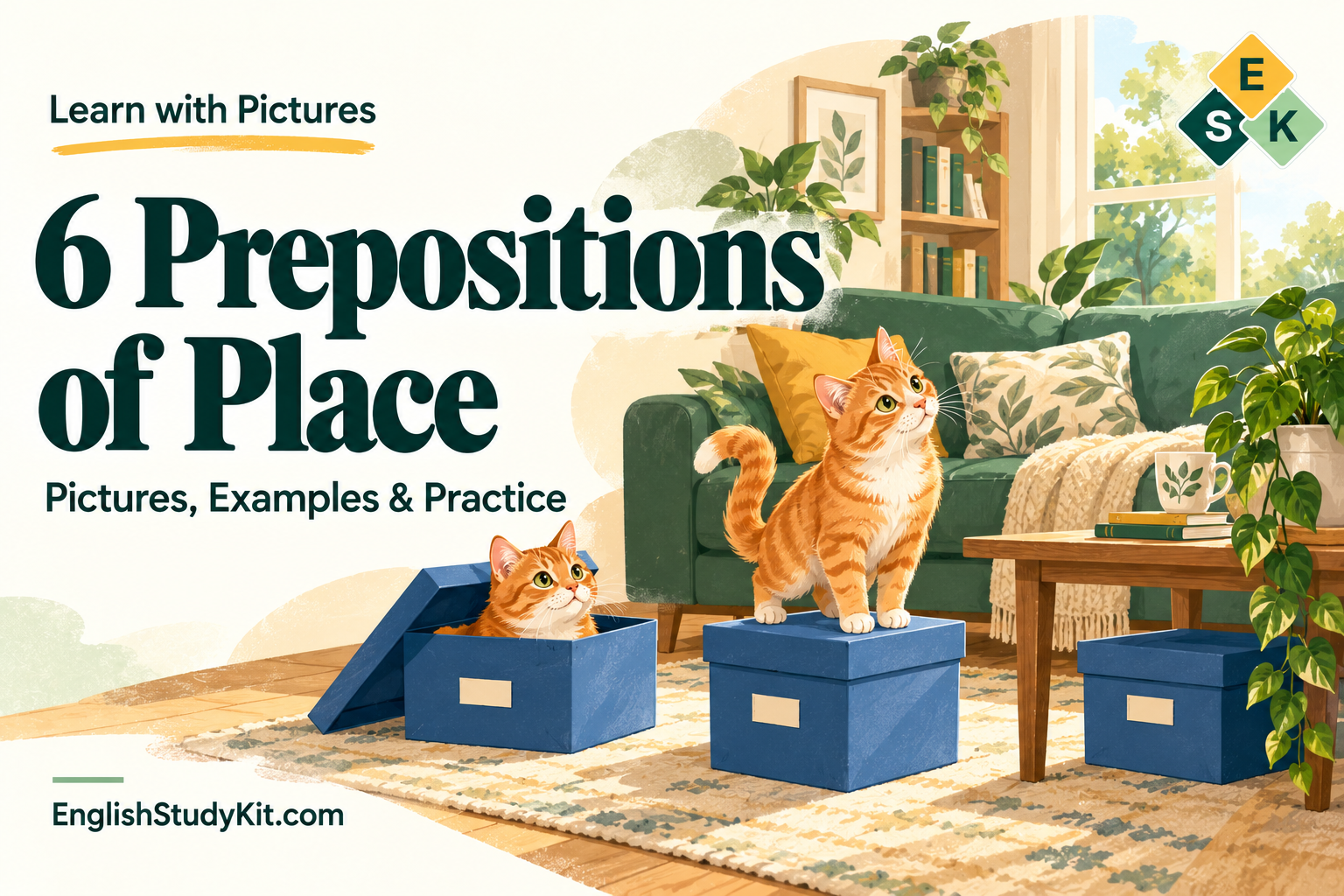
Where is the cat? Six short expressions can tell us a lot: in, on, under, next to, between and behind. This lesson uses the cat-and-box poster to show the differences, then helps you describe objects in a room. Try twelve questions and give clear directions to a partner.
This is part of Learn with Pictures, a series of beginner English lessons. Use the illustration to notice the meaning, then use the written examples and practice to build your own sentences.
Start with the picture poster
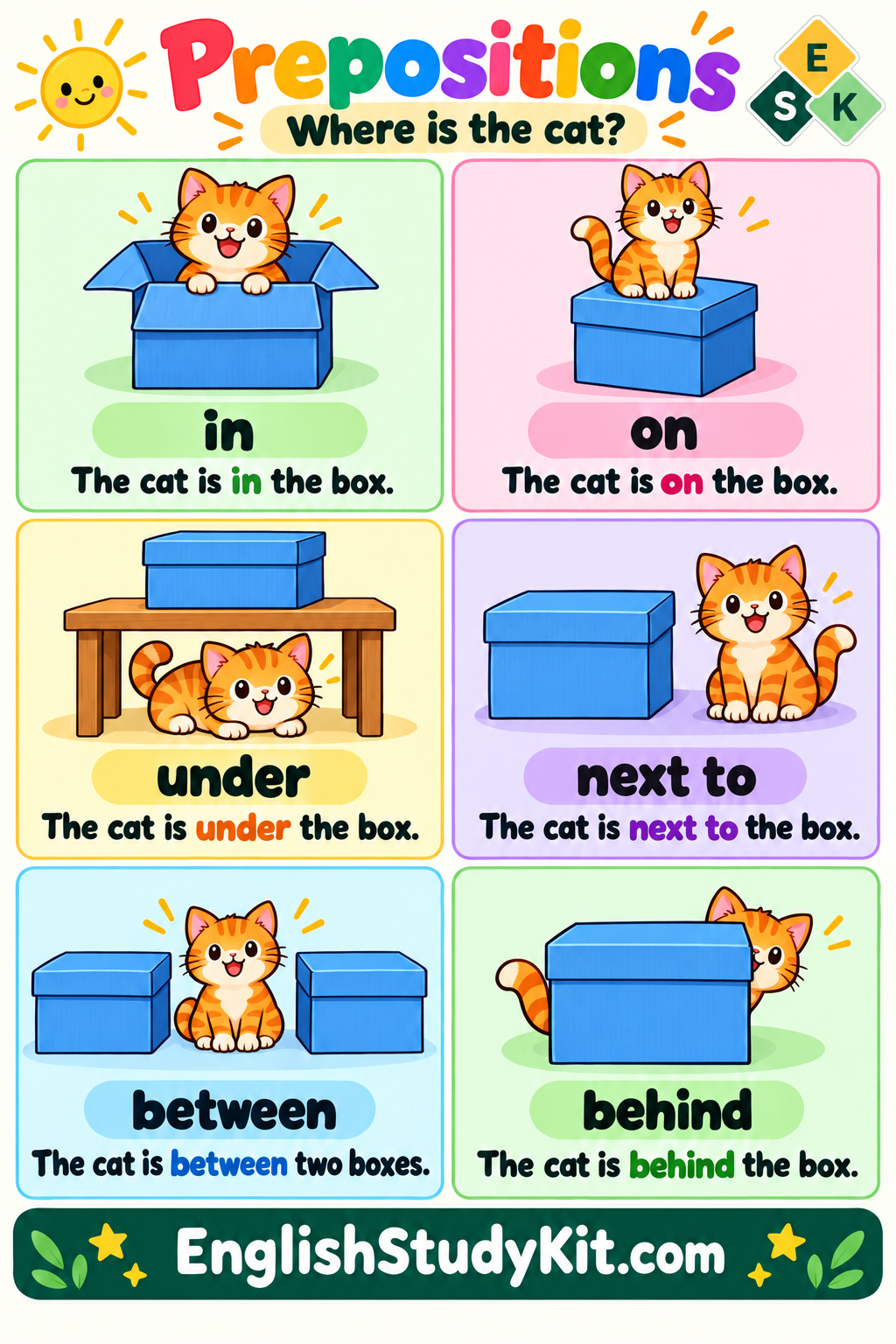
Look at the cat and the blue box or boxes in each panel. Always name the object you are using as a reference. In the under panel, the box is on a table and the cat is below it. Every label and teaching example is also written below, so you can follow the lesson without reading text inside the image.
Find the pictures as you read. You can return to the poster when you need a reminder.
Six prepositions of place
1. in
Inside something, within its sides or boundaries. In the poster, the cat is inside the box.
Example: The cat is in the box.
2. on
On a surface, normally touching and supported by it. In the poster, the cat rests on top of the box.
Example: The cat is on the box.
3. under
Lower than something, usually directly below it in this kind of picture. The cat is below the table and the box on it.
Example: The cat is under the box.
4. next to
Beside something, with a small distance between them. The cat is beside the box.
Example: The cat is next to the box.
5. between
In the space separating the things you name. Here the cat is in the middle of two boxes.
Example: The cat is between the two boxes.
6. behind
At the back of something. The box is in front of the cat from the viewer’s position.
Example: The cat is behind the box.
Build a clear location sentence
Use the person or thing + is/are + place expression + reference object: “The book is on the desk.” “The pencils are in the bag.” The reference object tells your listener what the location is relative to.
One thing: “The cat is under the table.”
More than one thing: “The cats are next to the chair.”
Two named reference objects: “The chair is between the desk and the window.”
“It is behind” may be enough if both people already know the object, but it can be unclear without that context. For beginner practice, name the reference: “The bag is behind the chair.”
In or on? Under or behind?
In means inside: “The pencil is in the box.” On means touching its surface: “The pencil is on the box.” You can put the same pencil in one position, then move it to the other. Changing the preposition changes the meaning.
Under describes a lower position. Behind describes a position at the back. A bag under a chair is below the seat; a bag behind a chair is beyond its back. Something can be hidden in either place, so “I cannot see it” is not enough to choose the preposition.
Next to and between
Next to usually names one nearby reference: “The cat is next to the box.” Between names separate reference points: “The cat is between the two boxes” or “The cat is between the box and the chair”. Use and when naming two different objects.
This poster introduces between with two boxes. In wider English, between can also refer to more than two distinct things; it is not a rule that the word always means exactly two. For today, the two-object pattern is enough.
Ask Where is ...? or Where are ...?
A: Where is my notebook? B: It is on the desk, next to the lamp. A: Where are my pencils? B: They are in the box.
Use where is with one thing and where are with plural things. Answer with it is or they are. If you are not sure, you can say “I think it is in your bag” rather than giving a location as a fact.
A quick picture routine
Choose a small object and a box. Put the object in the box, then on the box, then next to it. Say one complete sentence each time. Next, put the object between two books or behind the box. Use a toy or another safe object; you do not need a real cat to practise.
Practice 1: Choose the best answer
Choose one answer for each question. Check your answers, read the explanations and try again if you need to.
Answer on paper, then open the explanations below. Enable JavaScript to check answers here.
Practice 2: Complete the sentences
Type only the missing word or words. Use the clue in each question. Check the explanations after you finish.
Answer on paper, then open the explanations below. Enable JavaScript to check answers here.
Your turn: help someone find an object
Your turn · self-review
Make a clear room description
Use safe objects around you or invent a room. Your partner should be able to find or place the object from your words.
Practice only. Your writing stays on this page; it is not submitted or saved.
-
Model answer and explanation
My pen is in the pencil case. The pencil case is on the desk. My book is next to the pencil case.
-
Model answer and explanation
A: Where is my bag? B: It is between the chair and the desk.
-
Model answer and explanation
Put the toy cat behind the box. Then put it between the two books.
Check: Did you name the reference object? Did you use is or are correctly? Could under and behind mean different places in your scene?
Keep learning
Choose a small number of new words or patterns to use today. Say your sentences aloud, check one detail and repeat them tomorrow.





