
6 English Question Words: Who, What, Where, When, Why and How
Learn who, what, where, when, why and how with six picture questions, suitable model answers and 12 interactive checks for beginners.
A good question starts with the information you need. Who asks about a person; where asks about a place. This picture lesson introduces six question words through the poster’s everyday situations. Learn what kind of answer fits, then try twelve questions and make a short conversation.
This is part of Learn with Pictures, a series of beginner English lessons. Use the illustration to notice the meaning, then use the written examples and practice to build your own sentences.
Start with the picture poster
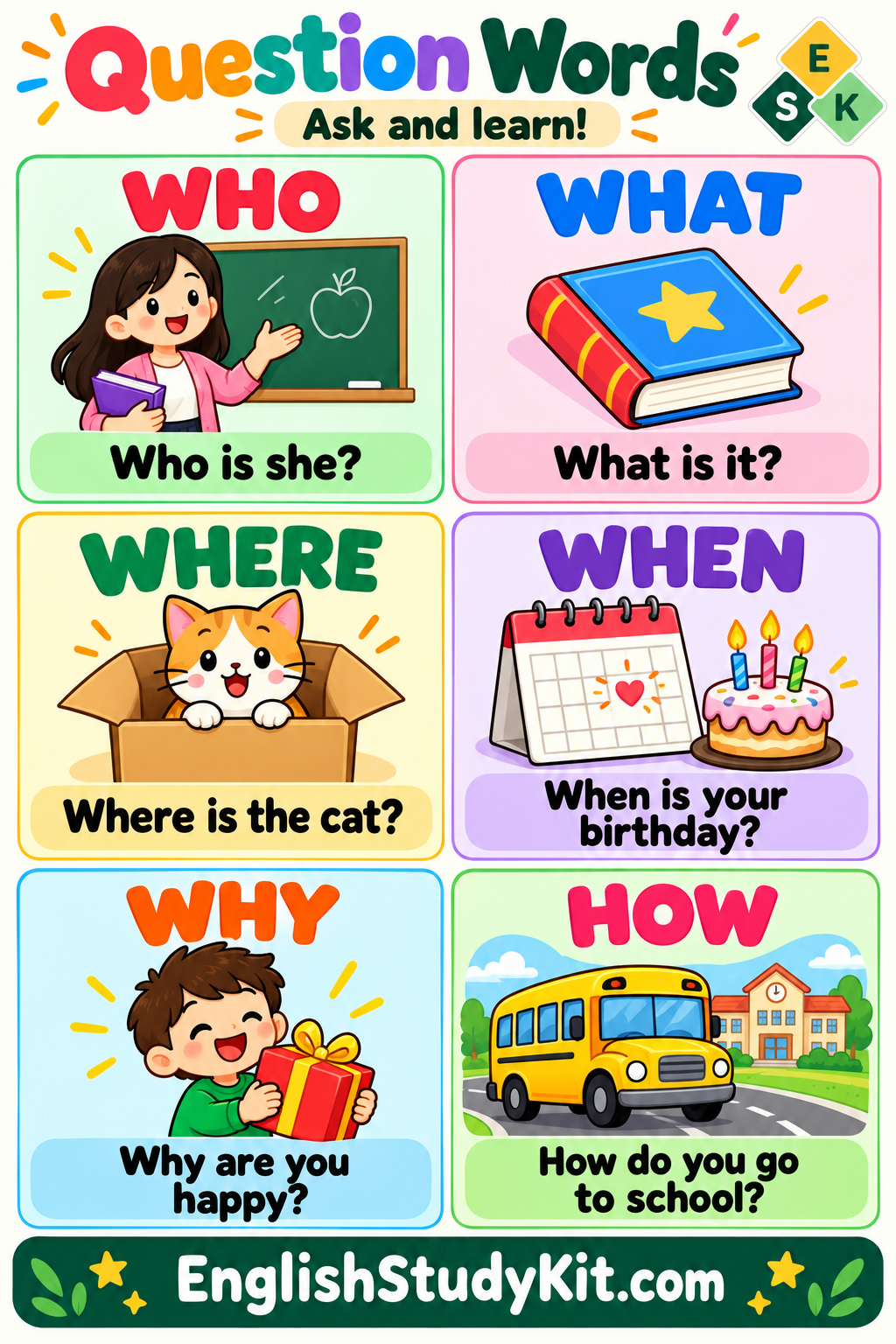
Find the six picture questions: Who is she? What is it? Where is the cat? When is your birthday? Why are you happy? How do you go to school? The model answers below are examples, not personal facts about the people in the illustrations. Every label and teaching example is also written below, so you can follow the lesson without reading text inside the image.
Find the pictures as you read. You can return to the poster when you need a reminder.
Six words and six information types
1. who
Ask about a person or someone’s identity. Poster question: “Who is she?” The teacher picture gives a useful context.
Example: Who is she? She is Ms Lee, our teacher.
2. what
Ask about a thing, an action or other information. In the poster, the question asks you to identify a book: “What is it?”
Example: What is it? It is a book.
3. where
Ask about a place or location. The cat in the poster is inside a box.
Example: Where is the cat? It is in the box.
4. when
Ask about a time or date. The birthday picture includes a cake and calendar, but does not give a specific birthday date.
Example: When is your birthday? It is in May.
5. why
Ask about a reason. The gift picture suggests one possible reason for happiness.
Example: Why are you happy? Because I have a present.
6. how
Ask about a way, method or condition. The bus picture illustrates a way of travelling.
Example: How do you go to school? I go by bus.
Match the question to the information
Before choosing a question word, imagine the answer. A person’s name points towards who. A place points towards where. A date or time points towards when. A reason often starts with because, so why is useful.
A person: “My teacher.” → “Who is she?”
A thing: “A notebook.” → “What is it?”
A place: “In my bag.” → “Where is it?”
A time: “At nine o’clock.” → “When is the lesson?”
A reason: “Because it is my birthday.” → “Why are you excited?”
A method: “By bus.” → “How do you travel?”
These are starting points, not the only possible uses. What can ask about many kinds of information: “What do you like?” How can ask about someone’s condition: “How are you?” It is not only a transport word.
Build a simple question with be
For the poster’s first five questions, notice question word + am/is/are + subject. “She is our teacher” becomes “Who is she?” “The cat is in the box” becomes “Where is the cat?” Keep the small verb in the sentence.
What is it? Not “What it?”
Where are the books? Use are with plural books.
When is your birthday? Use is with singular birthday.
Why are you happy? Use are with you.
This is one useful beginner pattern. Not every question follows it: “Who called?” is a different kind of question. You can study those patterns later in the fuller word-order guide linked below.
One useful action question: How do you ...?
The poster asks “How do you go to school?” It uses do because go is an ordinary present-simple action verb. Learn the whole pattern: How do you + base verb? “How do you travel to work?” “How do you spell your name?”
For transport, “by bus”, “by train” and “by car” are common phrases. For walking, say “on foot”: “I go to school on foot.” These are extra language examples. The poster itself shows a bus.
Short answers can be natural
In conversation, “In the box” can answer “Where is the cat?” A complete sentence is “It is in the box.” Both are useful. When writing a learning exercise, follow the instruction about a word, phrase or full sentence.
For why, a because phrase is a natural spoken reply: “Because I have a present.” You can also use a complete sentence: “I am happy because I have a present.” Do not add because to every answer; it explains a reason, not a place or time.
Read a short conversation
A: Who is your teacher? B: Ms Lee. A: When is your class? B: At nine o’clock. A: Where is it? B: In room two. A: How do you go there? B: By bus.
Each question asks for a different detail. In your own conversations, ask only for information that is appropriate to share. For practice you can invent a class, birthday month or journey.
Practice 1: Choose the question word
Choose the word that asks for the stated information. Check the explanations after you finish.
Answer on paper, then open the explanations below. Enable JavaScript to check answers here.
Practice 2: Match the question to an answer
Choose the answer that gives the kind of information requested. These are model situations, not facts about you.
Answer on paper, then open the explanations below. Enable JavaScript to check answers here.
Your turn: six questions, six useful replies
Your turn · self-review
Build a small conversation
Use imaginary details or information you are comfortable sharing. Write your own questions before revealing the models.
Practice only. Your writing stays on this page; it is not submitted or saved.
-
Model answer and explanation
Who is your friend? Maya. What is in your bag? A book. Where is your class? In room two. When is it? At nine. Why are you happy? Because I like the class. How do you go there? By bus.
-
Model answer and explanation
Where is the lesson? In room two. When is the lesson? At nine o’clock.
Check: Did your answer give a person, thing, place, time, reason or method as needed? Did your be question include is or are? Did you keep do in “How do you go ...?”
Keep learning
Choose a small number of new words or patterns to use today. Say your sentences aloud, check one detail and repeat them tomorrow.
Explore the Learn with Pictures series





