
6 English Opposite Pairs: Pictures, Examples and Practice
Learn six English opposite pairs with pictures, clear examples and 12 interactive questions. Practise size, height, temperature, speed and more.
A big bag and a small bag. A hot drink and cold water. Opposite words help you notice a difference and describe it clearly. Learn six opposite pairs from the poster, use all twelve words in sentences and practise with twelve questions.
This is part of Learn with Pictures, a series of beginner English lessons. Use the illustration to notice the meaning, then use the written examples and practice to build your own sentences.
Start with the picture poster
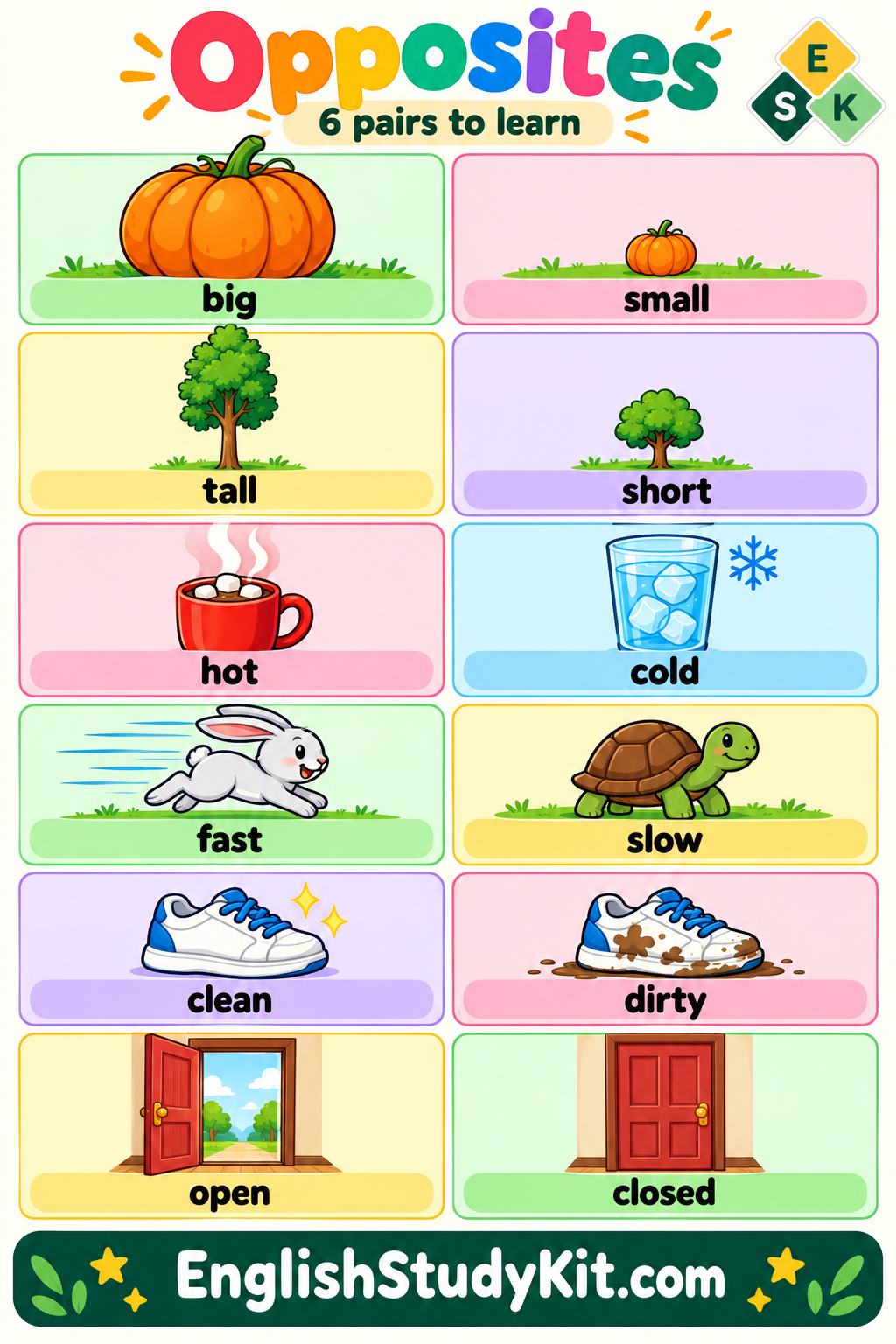
Read the two labels in each pair. Compare the specific feature in the pictures: size, height, temperature, speed, cleanliness or whether something is open. Every label and teaching example is also written below, so you can follow the lesson without reading text inside the image.
Find the pictures as you read. You can return to the poster when you need a reminder.
Six opposite pairs
1. big / small
Big describes a large size. Small describes a little size. These words depend on what you are comparing or what is usual.
Example: The suitcase is big, but the lunchbox is small.
2. tall / short
Tall describes a large height, especially for people, trees and buildings. Short describes a small height in this pair.
Example: The tree is tall. The plant beside it is short.
3. hot / cold
Hot describes a high temperature. Cold describes a low temperature.
Example: The soup is hot, but the water in my glass is cold.
4. fast / slow
Fast means moving or happening at a high speed. Slow means moving or happening at a low speed.
Example: The train is fast. The old lift is slow.
5. clean / dirty
Clean means not dirty. Dirty means having dirt or marks that need cleaning.
Example: My hands are clean, but my shoes are dirty.
6. open / closed
Open means not shut. Closed means shut. In this pair, the words describe a state.
Example: The window is open. The door is closed.
Use the words before a noun or after be
An adjective can come before the thing it describes: “a big bag”, “a small box”, “a clean shirt”. You can also put it after am, is or are: “The bag is big.” “The shoes are dirty.”
One thing: “The door is closed.”
More than one thing: “The doors are closed.”
Before a noun: “They are small boxes.” Do not add -s to small.
Use but to show a contrast: “The plate is clean, but the cup is dirty.” Both parts describe a different condition. And is useful when the descriptions go together: “The room is small and clean.”
Choose the feature you mean
Big and tall are not identical. A box can be big because it is wide and deep, but not very tall. A person is usually tall or short when you describe their height. Use long or short for length, such as a long road. Long is a useful extra word, not one of this poster’s labels.
Fast and slow describe speed here. When you describe an action, “The train moves fast” is natural. A useful partner is slowly: “The train moves slowly.” For this lesson, practise the simpler pattern “The train is fast” or “The train is slow”.
Not big does not always mean small
Opposites are useful, but real objects can be in the middle. A drink can be warm, not hot or cold. A bag can be medium-sized, not big or small. Choose the word that fits the situation rather than forcing every object into one of two groups.
Read a short description
The classroom has a big board and a small clock. The windows are open, but the cupboard is closed. The desks are clean. One bag on the floor is dirty. Notice that the description tells you what each adjective refers to; it does not just list opposite words.
Practice 1: Choose the best answer
Choose one answer for each question. Check your answers, read the explanations and try again if you need to.
Answer on paper, then open the explanations below. Enable JavaScript to check answers here.
Practice 2: Complete the sentences
Type only the missing word or words. Use the clue in each question. Check the explanations after you finish.
Answer on paper, then open the explanations below. Enable JavaScript to check answers here.
Your turn: compare a scene
Your turn · self-review
Describe three contrasts
Choose safe everyday objects around you or invent a scene. You do not need to touch a hot object to describe it.
Practice only. Your writing stays on this page; it is not submitted or saved.
-
Model answer and explanation
My bag is big, but my pencil case is small. The window is open, but the door is closed. My desk is clean, but my shoes are dirty.
-
Model answer and explanation
A: Hot. What is the opposite? B: Cold. The tea is hot, but the juice is cold.
Check: Have you named the object? Does is or are match it? Did you keep adjectives the same for singular and plural things? When these descriptions feel easy, you can learn comparative forms such as bigger and smaller.
Keep learning
Choose a small number of new words or patterns to use today. Say your sentences aloud, check one detail and repeat them tomorrow.
Explore the Learn with Pictures series





