
20 Everyday English Phrasal Verbs You Can Start Using
Learn 20 everyday English phrasal verbs in real situations, with short dialogues, clear word-order notes and a practice exercise with explained answers.
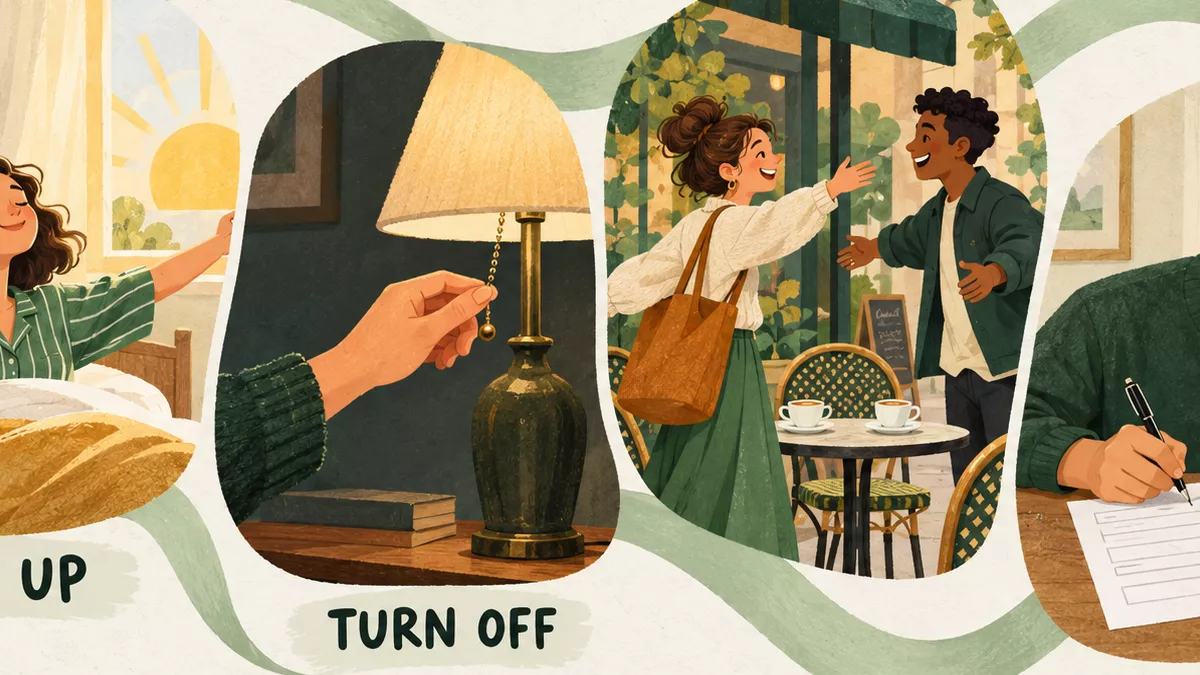
Everyday English phrasal verbs help you describe ordinary actions: get up in the morning, turn off a lamp or meet up with a friend. Learn each expression with its meaning and a full example. The same verb can have several meanings, so this guide teaches one useful everyday meaning for each of exactly 20 expressions.
A phrasal verb combines a verb with one or more small words, often called particles. The meaning may differ from the verb alone. In learner guides, this label is also commonly used for related multi-word verbs. What matters in practice is knowing the meaning and where an object, if there is one, belongs.
How to read the word-order notes
No object here: this example is complete without a direct object.
Separable: a noun object can go between the verb and particle or after the particle. A personal pronoun goes between them.
Together: keep the expression together and place its object afterwards.
For a separable expression, say “turn off the lamp” or “turn the lamp off”, but “turn it off”. With look after, say “look after the dog” and “look after it”. These patterns are explained in the British Council's phrasal-verb guide. The notes below apply to the specific meanings shown.
1–5: Starting and moving through your day
Expression | Meaning and original example | Pattern here |
|---|---|---|
1. Wake up | Stop sleeping. I wake up when my alarm rings. | No object |
2. Get up | Leave your bed. I get up ten minutes later. | No object |
3. Go out | Leave home for a social activity. We go out on Friday evenings. | No object |
4. Come in | Enter. Please come in; the door is open. | No object |
5. Sit down | Move into a sitting position. Let's sit down near the window. | No object |
Scroll sideways to see all columns.
Wake up and get up describe different moments. You might wake up at seven but stay in bed until half past seven. Wake up can also take an object when you cause someone else to stop sleeping; the table shows the meaning without an object.
Leah: What time do you wake up? Arun: At seven, but I don't get up straight away. Leah: Come in and sit down. We have time for breakfast.
6–10: At home
Expression | Meaning and original example | Pattern here |
|---|---|---|
6. Turn on | Start a device or light. Please turn on the fan. | Separable: turn it on |
7. Turn off | Stop a device or light. Turn off the lamp before you leave. | Separable: turn it off |
8. Put on | Dress in an item. Put on your coat; it's cold. | Separable: put it on |
9. Take off | Remove an item of clothing. Take off your wet shoes. | Separable: take them off |
10. Tidy up | Make a place neat. We tidy up the kitchen after dinner. | Separable: tidy it up |
Scroll sideways to see all columns.
Put on describes the action of dressing in something. Wear describes having it on your body afterwards. Take off has other meanings, including what a plane does, but the clothing meaning is the one to practise here.
Maya: Where is my coat? Ben: It's on the chair. Put it on before you go out. Maya: Shall I turn off the fan? Ben: Yes, please turn it off.
11–15: Studying and doing errands
Expression | Meaning and original example | Pattern here |
|---|---|---|
11. Fill in | Complete information on a form. Fill in this form with your name. | Separable: fill it in |
12. Look up | Search for information. I look up new words in a dictionary. | Separable: look them up |
13. Pick up | Collect someone or something. I'll pick up the parcel at five. | Separable: pick it up |
14. Find out | Discover information. We need to find out the opening time. | Separable with a noun: find it out |
15. Write down | Record in writing. Write down the address before you forget it. | Separable: write it down |
Scroll sideways to see all columns.
Find out often introduces a question clause: “I'll find out when the library closes.” In that sentence, keep find out together before the clause. “I'll find it out” is possible when it refers to information, although repeating the question or saying “I'll find out” is often more natural.
Ivo: I don't know this word. Rosa: Look it up and write down an example. Ivo: And the library form? Rosa: Fill it in before you pick up your card.
16–20: Friends and plans
Expression | Meaning and original example | Pattern here |
|---|---|---|
16. Meet up | Meet socially. We can meet up after class. | No direct object; meet up with someone |
17. Look after | Care for someone or something. Jo looks after our cat on Mondays. | Together: look after her |
18. Run out of | Have no more of something. We've run out of milk. | Together: run out of it |
19. Call off | Cancel an event or plan. They called off the outdoor concert. | Separable: call it off |
20. Look forward to | Feel pleased about a future event. I look forward to our next lesson. | Together: look forward to it |
Scroll sideways to see all columns.
After look forward to, use a noun or an -ing form: “I'm looking forward to meeting you.” Here to is a preposition, so “looking forward to meet you” is not the usual pattern.
Asha: Shall we meet up on Saturday? Tom: Yes. I need to look after my niece in the morning, but I'm free later. Asha: Great. I'm looking forward to it.
Check the meaning and word order
Complete these sentences with an expression from the guide. Keep the tense already shown and use the object position correctly.
Answer on paper, then open the explanations below. Enable JavaScript to check answers here.
Put three expressions into your own day
Choose one group and write a short account of a real situation. Use only three expressions at first, checking the object position as you write. The vocabulary learning path gives you everyday topics, and AI Conversations offers situations where you can practise relevant phrases.
Today, describe a morning, a household task or a plan with a friend. Tomorrow, cover this guide and recreate those sentences. A useful phrase is one you can select for the right situation, rather than simply recognise in a list.





