20 Everyday Action Verbs in English: Pictures, Examples and Practice
Learn 20 everyday English action verbs with pictures, simple meanings, example sentences and ten interactive practice questions with answer explanations.

Learn 20 everyday English verbs with the Action Words picture poster, simple meanings and useful example sentences. Then check your understanding with ten interactive questions and use the words to talk about your own day. This beginner-friendly lesson is suitable for A1 learners and for anyone reviewing basic vocabulary.
A verb tells us about an action or a situation. Run, read and cook describe activities. Wear describes having clothes on your body, rather than the movement of putting them on. Here, “action words” is a friendly starting point for learning these useful everyday verbs.
Start with the picture poster
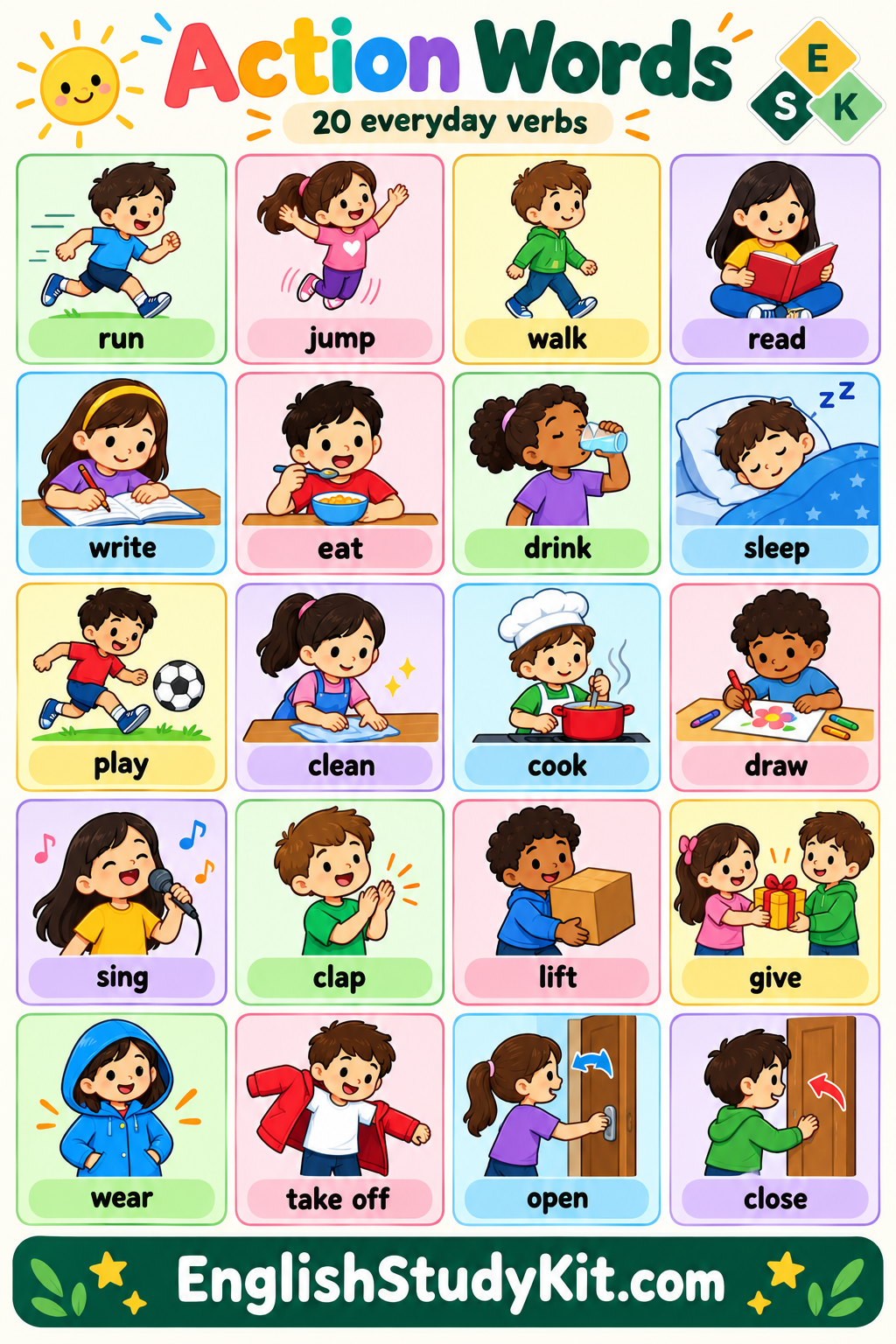
Look across each row from left to right. Say the word, find the action in the picture and try to make a short sentence. All twenty labels, meanings and examples are written below too, so you do not need to read text inside the image to follow the lesson.
1–4: Moving and reading
1. run Move quickly on your feet.
Example: I run in the park on Saturdays.
2. jump Push your body up off the ground with your feet.
Example: The children jump over a small puddle.
3. walk Move on your feet at a regular pace, without running.
Example: We walk to school together.
4. read Look at written words and understand them.
Example: Maya reads a story before bed.
5–8: Writing, meals and rest
5. write Make letters or words on paper or a screen.
Example: I write my name at the top of the page.
6. eat Put food in your mouth and swallow it.
Example: We eat lunch at twelve.
7. drink Take water or another liquid into your mouth and swallow it.
Example: He drinks water after a game.
8. sleep Rest with your eyes closed while you are not awake.
Example: The baby sleeps in a quiet room.
9–12: Games, chores and creativity
9. play Take part in a game or sport, or do something for fun.
Example: They play football after school.
10. clean Remove dirt from a person, place or thing.
Example: I clean the table after dinner.
11. cook Prepare food by heating it.
Example: Dad cooks rice and vegetables.
12. draw Make a picture with a pencil, pen or similar tool.
Example: Nina draws a cat in her notebook.
13–16: Sounds and helping
13. sing Make music with your voice.
Example: We sing a song in class.
14. clap Hit your hands together to make a sound.
Example: The audience claps at the end of the song.
15. lift Move something to a higher position.
Example: He lifts the empty box onto the shelf.
16. give Pass something to another person, or let them have it.
Example: I give my friend a birthday present.
17–20: Clothes and doors
17. wear Have clothes, shoes or an accessory on your body.
Example: Sara wears a blue coat on cold days.
18. take off Remove something you are wearing.
Example: I take off my shoes at the door.
19. open Move something so that it is no longer closed.
Example: Please open the window.
20. close Move something so that it is no longer open.
Example: Please close the door quietly.
Wear, put on and take off: three different meanings
The poster includes wear and take off. Put on is a useful extra expression that helps you understand the difference. It is not one of the poster’s twenty labels.
Put on describes the action of getting an item onto your body: “I put on my coat before I go outside.”
Wear describes having it on: “I wear my coat outside.” For what you can see now, say “I am wearing a blue coat.”
Take off describes removing it: “I take off my coat when I get home.”
With a noun, both “take off your coat” and “take your coat off” are possible. With it, say “take it off”, not “take off it”. The same pattern works with put on: “put it on”. In this lesson, take off has the clothing meaning.
Use the verbs in simple sentences
Start with who does the action, then add the verb and a useful detail: “I read a book.” “We play in the park.” A sentence can be short and still be complete: “The baby sleeps.”
For habits: Use the present simple. Say “I walk to school” and “She walks to school”. With he, she and it, these verbs usually add -s: reads, cooks, wears and takes off.
For an activity happening now: Use am, is or are plus the -ing form: “I am reading.” “She is cooking.” “They are playing.” Keep the small verb: “She cooking” is not a complete standard sentence.
Notice a few spelling changes: write → writing, take → taking, run → running and clap → clapping. You do not need to master every tense today. First learn the meaning, then practise one clear sentence.
Practice 1: Choose the right action
Choose the best answer. Read the explanation after checking, especially if two words seemed similar.
Answer on paper, then open the explanations below. Enable JavaScript to check answers here.
Practice 2: Complete the sentence
Type only the missing word or words. Use the clue in brackets and the time meaning of the sentence.
Answer on paper, then open the explanations below. Enable JavaScript to check answers here.
Try a short speaking or writing task
Choose five verbs from the poster. Write three true sentences about your routine and two sentences describing pictures. If you prefer, invent a character and describe their day instead.
Your turn · self-review
Five verbs in a short example
Make your own attempt first. Then compare it with the model. Many different answers are possible.
Practice only. Your writing stays on this page; it is not submitted or saved.
-
Model answer and explanation
I walk to the library with my friends. They read books there. My sister cooks dinner on Fridays. In one picture, a boy is running. In another picture, a girl is giving a present to a boy. The five poster verbs are walk, read, cook, run and give; their forms change to match the sentences.
Practise in a way that suits you: say the sentences, type them or point to the matching pictures. You can also describe an action without doing it. Cover the labels for one row, name those four words, then check them and try again later.
What to practise next
Use your new words in a longer answer with How to Talk About Your Daily Routine in English.
For more help with habits and activities happening now, try Present Simple vs Present Continuous.
For pronunciation foundations and speaking practice, explore the Speaking learning path. Start with a few familiar words and build up to clear short sentences.