
12 Fruit Names in English: Pictures, Examples and Practice
Learn 12 fruit names in English with pictures, everyday examples, singular and plural forms, and 12 interactive practice questions.
Learn twelve fruit names you can use at home, in a shop or when talking about food you like. This lesson follows the fruit poster, explains each name and helps you practise singular and plural forms. Finish with twelve questions and a short shopping conversation.
This is part of Learn with Pictures, a series of beginner English lessons. Use the illustration to notice the meaning, then use the written examples and practice to build your own sentences.
Start with the picture poster
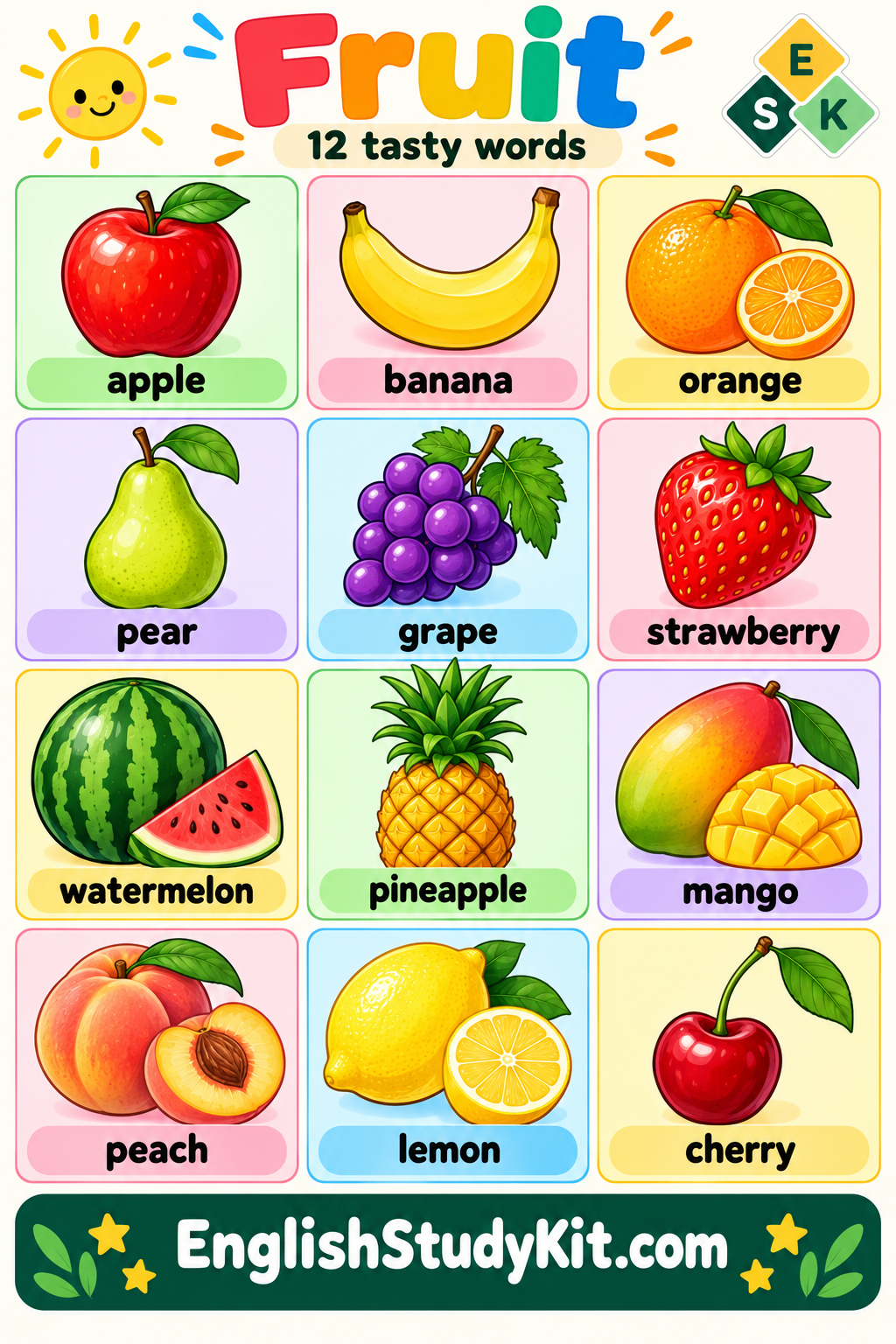
Find each fruit and say its name. The labels give the basic singular word, even when a picture shows more than one fruit, such as the bunch of grapes. Every label and teaching example is also written below, so you can follow the lesson without reading text inside the image.
Find the pictures as you read. You can return to the poster when you need a reminder.
Twelve fruit names
1. apple
A round fruit with a firm inside and skin that can be red, green or yellow.
Example: I put an apple in my bag.
2. banana
A long, curved fruit with a peel, often yellow when ripe.
Example: She eats a banana after lunch.
3. orange
A round citrus fruit with orange skin and juicy pieces inside. Orange is also the name of a colour.
Example: Would you like an orange?
4. pear
A fruit that is often narrow at the top and wider at the bottom.
Example: There is a ripe pear in the bowl.
5. grape
One small, round or oval fruit that grows in a bunch. Grapes can be green, red or dark purple.
Example: I wash the grapes before I eat them.
6. strawberry
A soft red fruit with tiny seeds on the outside.
Example: This strawberry is sweet.
7. watermelon
A large fruit with a thick green skin and a juicy inside, often red or pink.
Example: We share a slice of watermelon.
8. pineapple
A tropical fruit with a rough skin and stiff leaves on top.
Example: I cut the pineapple into small pieces.
9. mango
A tropical fruit with a large flat stone in the middle and flesh that is often yellow or orange.
Example: The mango is ready to eat.
10. peach
A round fruit with a large stone inside and skin that is usually soft and slightly furry.
Example: He buys two peaches.
11. lemon
A yellow citrus fruit with a sour taste.
Example: I add a slice of lemon to the water.
12. cherry
A small, round fruit with a stone inside, often red when ripe.
Example: There are some cherries in the bowl.
One fruit and more than one
Use a or an with one whole countable fruit: a banana, a pear, an apple, an orange. Use an before the vowel sound in apple and orange. With a number greater than one, use the plural: two bananas, three apples, four oranges.
Add -s: apples, bananas, oranges, pears, grapes, watermelons, pineapples and lemons.
Add -es after the final sound in peach: one peach, two peaches.
Change consonant + y to -ies: one strawberry, two strawberries; one cherry, two cherries.
Mango has two accepted plurals: mangoes and mangos.
The poster label grape means one grape. The picture shows a bunch of grapes. You can say “a grape”, “some grapes” or “a bunch of grapes”. A slice of watermelon and a piece of pineapple name a portion rather than a whole fruit.
Talk about what you like
Use the plural for a general preference: “I like apples.” “She likes strawberries.” Add -s to like after he or she, but keep the plural fruit name. “I like this apple” means one particular apple, not apples in general.
A simple question is “Do you like mangoes?” You can answer “Yes, I do” or “No, I don’t”. To compare preferences without a long explanation, say “I like pears, but I don’t like lemons.” These are language examples, not advice about what you should eat.
Ask for fruit in a shop
Customer: Can I have two apples and a banana, please? Seller: Of course. Anything else? Customer: Some grapes, please. Seller: Here you are. Customer: Thank you.
Can I have ... please? is a useful polite request. If you want a specific amount, add it: “a small bunch of grapes” or “three oranges”. Do not guess a price from a picture; ask “How much are they?” when you need that information.
Practice 1: Choose the best answer
Choose one answer for each question. Check your answers, read the explanations and try again if you need to.
Answer on paper, then open the explanations below. Enable JavaScript to check answers here.
Practice 2: Complete the sentences
Type only the missing word or words. Use the clue in each question. Check the explanations after you finish.
Answer on paper, then open the explanations below. Enable JavaScript to check answers here.
Your turn: a fruit bowl and a shopping list
Your turn · self-review
Use the names in real sentences
Try the tasks before revealing the models. Your fruit choices can be different.
Practice only. Your writing stays on this page; it is not submitted or saved.
-
Model answer and explanation
There are two apples, three bananas, some grapes and a pear in the bowl.
-
Model answer and explanation
Can I have two peaches, a pineapple and some cherries, please?
-
Model answer and explanation
I like mangoes, but I don’t like lemons.
Check: Did you use a or an for one whole fruit? Did you use a plural after two or three? Can you point to or describe the fruit without seeing its label?
Keep learning
Choose a small number of new words or patterns to use today. Say your sentences aloud, check one detail and repeat them tomorrow.
Explore the Learn with Pictures series





