
12 Feelings in English: Pictures, Simple Sentences and Practice
Learn 12 feelings in English with a picture poster, simple meanings, everyday examples and 12 interactive practice questions with explanations.
How do you feel today? Learn twelve useful English words for feelings, from happy and sad to proud and shy. This picture lesson gives you a simple meaning, an everyday example and twelve practice questions. Start with the words you recognise, then add two or three new ones.
This is part of Learn with Pictures, a series of beginner English lessons. Use the illustration to notice the meaning, then use the written examples and practice to build your own sentences.
Start with the picture poster
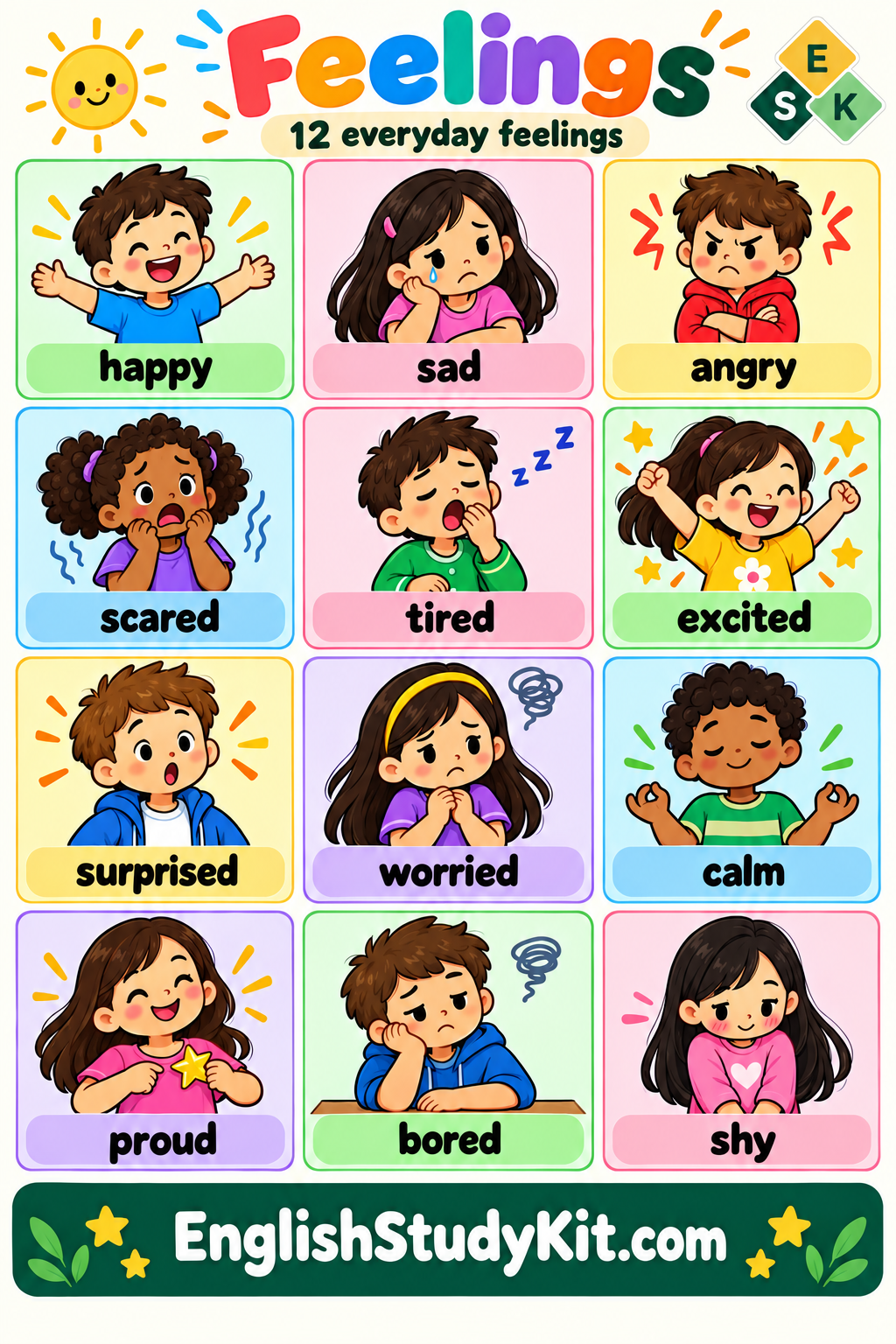
Look at the twelve labelled faces. A face is a useful memory clue, but a real person’s expression does not always tell you exactly how they feel. Every label and teaching example is also written below, so you can follow the lesson without reading text inside the image.
Find the pictures as you read. You can return to the poster when you need a reminder.
Twelve words for feelings
1. happy
Feeling good or pleased about something.
Example: I am happy to see my friend.
2. sad
Feeling unhappy, perhaps because something is wrong or someone is away.
Example: Lena feels sad when her friend leaves.
3. angry
Feeling strongly upset because something seems wrong or unfair.
Example: Ben is angry because someone broke his toy.
4. scared
Feeling afraid of something.
Example: I feel scared when I hear a loud noise at night.
5. tired
Needing rest or sleep.
Example: We are tired after the long walk.
6. excited
Feeling very happy and interested about something happening or coming soon.
Example: The children are excited about the trip.
7. surprised
Feeling that something is unexpected. It can be a pleasant or an unpleasant surprise.
Example: I am surprised to see my teacher at the shop.
8. worried
Thinking about a problem or something bad that might happen.
Example: Sara is worried about her missing bag.
9. calm
Feeling quiet and relaxed, rather than upset or nervous.
Example: I feel calm in the quiet garden.
10. proud
Feeling pleased about something you or another person has done.
Example: Dad is proud of my hard work.
11. bored
Feeling uninterested because an activity is not interesting to you or you have nothing to do.
Example: I feel bored while I wait with nothing to read.
12. shy
Feeling uncomfortable or not confident when speaking to people, especially new people.
Example: Amir is shy when he meets a new class.
Make a sentence: I am happy or I feel happy
These words are adjectives. They describe how someone feels. Start with I am or I feel: “I am tired.” “I feel tired.” Both sentences work. In everyday conversation, I am often becomes I’m: “I’m happy.”
I am calm. You are excited. We are tired.
He is sad. She is worried. They are happy.
I feel proud. She feels proud. Add -s to feel after he, she or it.
Keep the verb in a complete sentence. Say “I am happy” or “I feel happy”, not “I happy”. Do not combine the two patterns as “I am feel happy”.
Add a reason or a useful phrase
Because introduces a reason: “I feel tired because I went to bed late.” Your reason can be very simple: “I am happy because my friend is here.” You can describe a made-up character if you do not want to talk about your own feelings.
excited about a trip: “We are excited about Saturday.”
worried about something: “He is worried about his test.”
proud of someone or something: “She is proud of her picture.”
A short conversation
A: How do you feel about the class trip? B: I’m excited, but I’m a little worried. A: Why are you worried? B: I don’t know the other students yet.
You can have two feelings at the same time. You do not have to choose a single word for a whole day. Ask “How do you feel?” rather than deciding from someone’s face alone.
Practice 1: Choose the best answer
Choose one answer for each question. Check your answers, read the explanations and try again if you need to.
Answer on paper, then open the explanations below. Enable JavaScript to check answers here.
Practice 2: Complete the sentences
Type only the missing word or words. Use the clue in each question. Check the explanations after you finish.
Answer on paper, then open the explanations below. Enable JavaScript to check answers here.
Your turn: notice, say and write
Your turn · self-review
A three-sentence feelings check-in
Write or say your own answer first. The models are examples, not the only correct answers. You may invent a character.
Practice only. Your writing stays on this page; it is not submitted or saved.
-
Model answer and explanation
I feel calm in the garden. I am excited about my English class. I feel proud because I can use three new words.
-
Model answer and explanation
A: How do you feel today? B: I’m tired, but I’m happy to be here.
Check your work: Did you use am, is, are or feel/feels? Did your adjective describe a feeling? If you used proud or excited, did you choose of or about correctly?
Keep learning
Choose a small number of new words or patterns to use today. Say your sentences aloud, check one detail and repeat them tomorrow.





