
12 Classroom Objects in English: Pictures and Practice
Learn 12 classroom objects in English with pictures, useful examples and 12 interactive questions. Practise naming things and polite borrowing requests.
What is in your classroom or study space? Learn twelve useful object names, from a book and a pencil to scissors and glue. You will practise naming things, describing what they are for and asking to borrow an item. The twelve questions help you check vocabulary and simple sentence patterns.
This is part of Learn with Pictures, a series of beginner English lessons. Use the illustration to notice the meaning, then use the written examples and practice to build your own sentences.
Start with the picture poster
Look at each classroom object. Some pictures show things you hold, while others show furniture or a place to write for the whole class. Every label and teaching example is also written below, so you can follow the lesson without reading text inside the image.
Find the pictures as you read. You can return to the poster when you need a reminder.
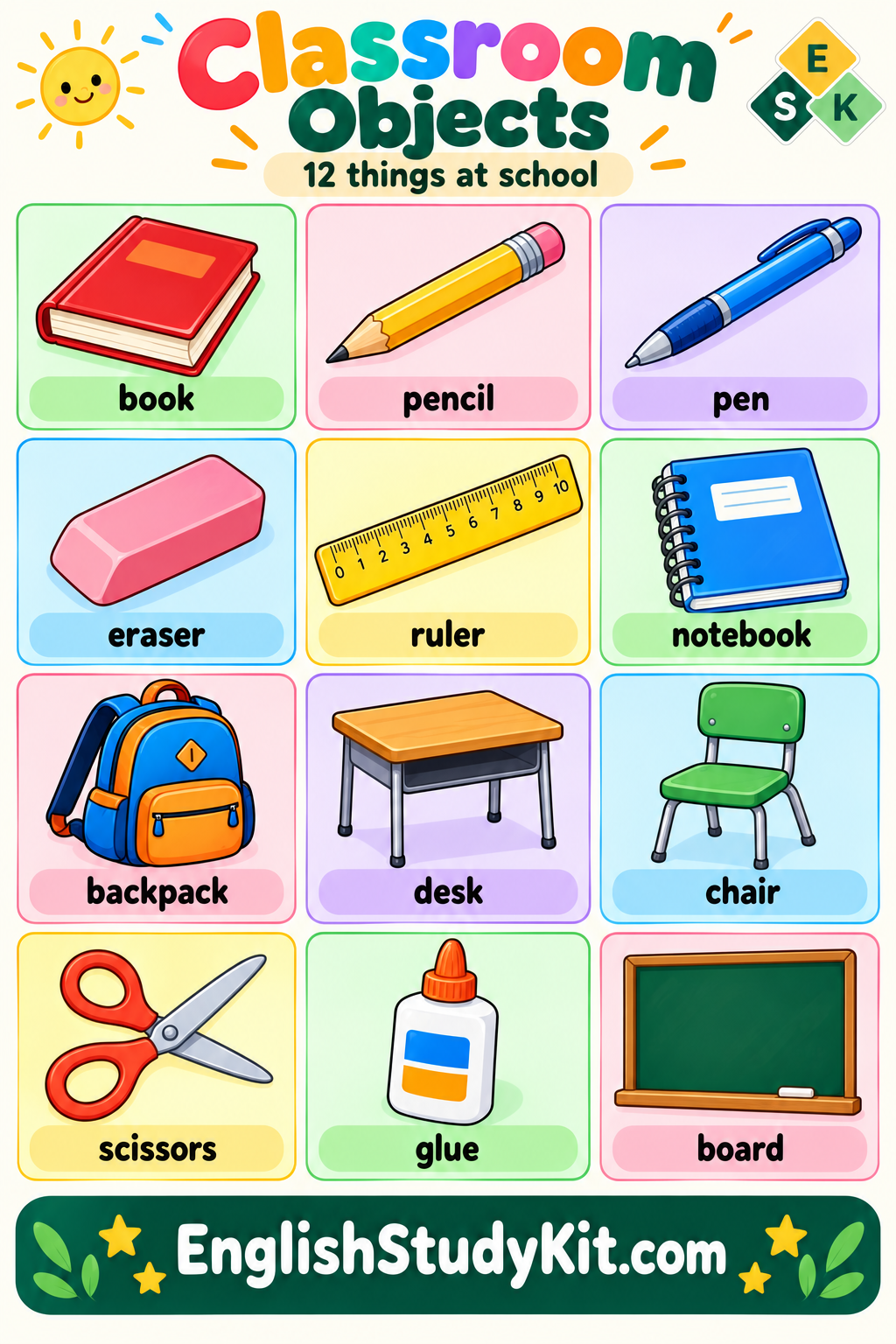
Twelve classroom objects
1. book
Pages joined together in a cover, with words or pictures to read.
Example: Please open your book to page ten.
2. pencil
A tool with a thin writing core, used for writing or drawing. You can usually erase its marks.
Example: I draw a line with my pencil.
3. pen
A tool that writes with ink.
Example: She signs her name with a blue pen.
4. eraser
A small object used to remove pencil marks.
Example: Can I borrow your eraser, please?
5. ruler
A straight tool used to measure or draw a straight line.
Example: Use a ruler to draw the line.
6. notebook
A book of pages for your own writing or notes.
Example: I write new words in my notebook.
7. backpack
A bag carried on your back, usually with two shoulder straps.
Example: My books are in my backpack.
8. desk
A table used for studying, writing or working.
Example: There is a notebook on my desk.
9. chair
A seat for one person, usually with a back.
Example: Please sit on this chair.
10. scissors
A cutting tool with two blades and two handles. The word has a plural form.
Example: These scissors are for cutting paper.
11. glue
A sticky substance used to join things together.
Example: Use a little glue to attach the paper.
12. board
A large surface that a teacher or learner can write on for others to see.
Example: The teacher writes the date on the board.
Name one object: It is a ...
Use “It is a ...” to identify one countable object: “It is a book.” “It is a ruler.” Before the vowel sound in eraser, use an: “It is an eraser.” In speaking, it is often becomes it’s.
One: “This is a pencil.” More than one: “These are pencils.”
One: “The chair is next to the desk.” More than one: “The chairs are next to the desks.”
Ask: “What is it?” Answer: “It’s a notebook.”
Book and notebook are related, but the purpose is different here. You read the lesson in a book; you write your own notes in a notebook. A pen uses ink, while a pencil makes marks that you can usually rub out.
Two special words: scissors and glue
Use scissors with are: “The scissors are on the desk.” Do not say “a scissors”. If you need to count the tool, say “a pair of scissors”. The head word pair is singular, so “This pair of scissors is small” is correct.
Glue is normally uncountable when it means the sticky substance: “some glue”, “a little glue” or “The glue is in the cupboard”. You can count a container or an item: “a bottle of glue” or “a glue stick”. Do not use “two glues” for two ordinary bottles in this beginner pattern.
Borrow something politely
A: Can I borrow your ruler, please? B: Yes, here you are. A: Thank you. B: You’re welcome.
Borrow means use something for a time and then return it. You can replace ruler with pen, pencil or eraser. For a small amount of a substance, ask “Can I have some glue, please?” That is different from borrowing a whole glue stick and giving it back.
Describe a small study space
There is a book and a notebook on my desk. My pencil and pen are in a pencil case. My backpack is under the chair. The board is at the front of the room.
Pencil case is a useful extra phrase, not one of the twelve labels. Start by naming the objects you know. Then add a place such as on my desk or in my backpack. You do not need to describe every object in the room at once.
Practice 1: Choose the best answer
Choose one answer for each question. Check your answers, read the explanations and try again if you need to.
Answer on paper, then open the explanations below. Enable JavaScript to check answers here.
Practice 2: Complete the sentences
Type only the missing word or words. Use the clue in each question. Check the explanations after you finish.
Answer on paper, then open the explanations below. Enable JavaScript to check answers here.
Your turn: prepare your study space
Your turn · self-review
Name it, use it, ask for it
Use your own objects or imagine a classroom. Practise aloud before comparing with the models.
Practice only. Your writing stays on this page; it is not submitted or saved.
-
Model answer and explanation
I have a book, a pencil, a ruler and a notebook. I read the book. I write new words in the notebook.
-
Model answer and explanation
A: Can I borrow your pen, please? B: Yes, here you are. A: Thank you. I’ll give it back after class.
Check: Did you use a or an with one countable item? Did you say scissors are and some glue? Can a partner identify the object from your description?
Keep learning
Choose a small number of new words or patterns to use today. Say your sentences aloud, check one detail and repeat them tomorrow.





