English Capital Letters and Punctuation Made Clear
Use English capital letters and punctuation with clear examples. Practise sentence endings, commas and apostrophes, then correct a short everyday message.
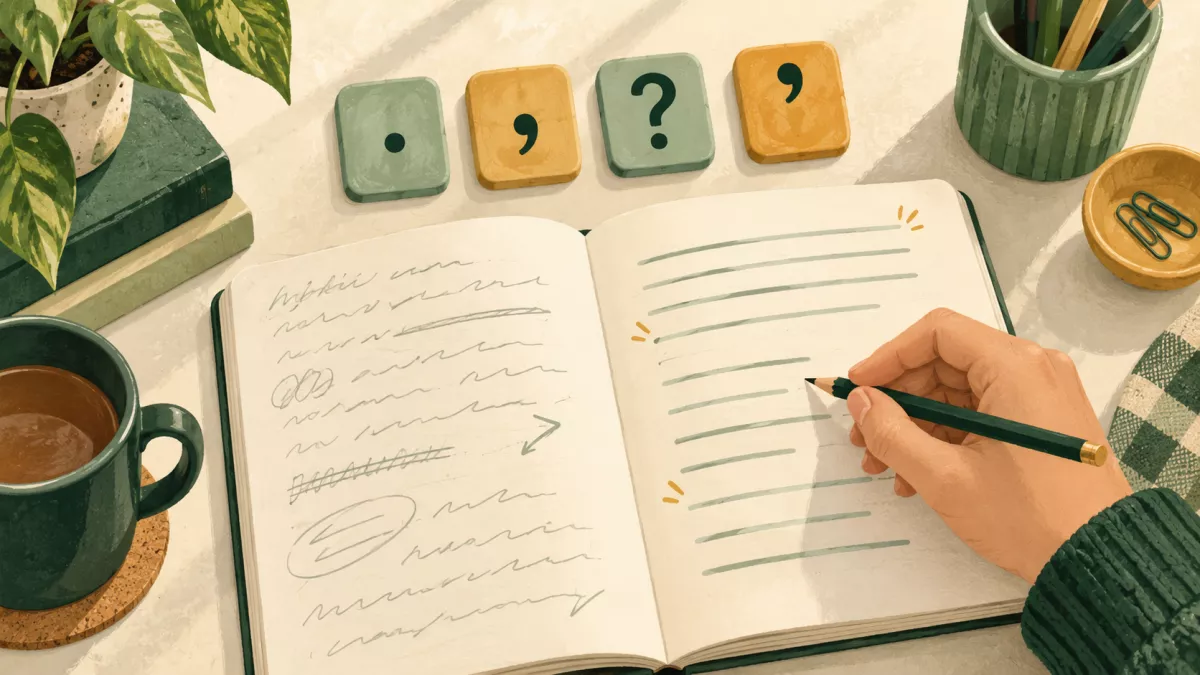
Clear English writing starts sentences with capital letters and uses punctuation to show how ideas fit together. Begin with full stops, question marks, commas and apostrophes. You do not need complicated punctuation to write a useful message, but small marks can change how readers understand it.
Think about the message first, then check one feature at a time. Our proofreading checklist separates meaning, sentence structure and small details so you can give each part your attention.
Use capitals for starts and names
Start a complete sentence with a capital: “The lesson begins at nine.” Capitalise the pronoun I wherever it appears: “Maya and I are ready.” Names of people, places, languages, days and months also take capitals: Ravi, London, English, Tuesday and October.
Ordinary seasons and common nouns normally stay lowercase: “We study English in the library every winter.” A word such as teacher does not become a name simply because the person matters. Compare “my teacher” with “Ms Patel”. Headings can follow different house styles; keep one style consistently.
Finish a sentence according to its purpose
Mark | A useful starting use | Example |
|---|---|---|
Full stop / period | Ends an ordinary statement. | The room is upstairs. |
Question mark | Ends a direct question. | Where is the room? |
Exclamation mark | Adds strong feeling or emphasis. | What a lovely surprise! |
Comma | Separates certain parts within a sentence. | Before we begin, check your notes. |
Scroll sideways to see all columns.
A full stop is called a period in American English. Both names refer to the same basic mark. Avoid filling routine messages with repeated exclamation marks; “Thanks for your help!” can communicate warmth without “Thanks!!!!”.
A reported question is not automatically a direct question: “She asked where the room was.” normally ends with a full stop. Its purpose is to report what she asked rather than ask the reader.
Use commas to organise, not just to pause
A comma can separate items in a list: “Bring paper, a pencil and your notebook.” Some writing styles also place a comma before and in such lists. That choice does not mean you can put a comma before every and in every sentence.
Use a comma after an introductory phrase where it helps the structure: “After the lesson, we went home.” Avoid joining two complete sentences with only a comma. Instead of “The café was closed, we went home”, write “The café was closed, so we went home” or use two sentences.
Give apostrophes a clear job
An apostrophe can show omitted letters in a contraction: do not becomes don’t, and it is becomes it’s. The possessive its has no apostrophe. Compare “It’s a small library” with “The library has changed its opening hours.” The first contracts it is; the second connects the opening hours to the library.
For a simple singular owner, use name plus ’s: “Maya’s notebook.” An ordinary plural does not need an apostrophe: “three notebooks”, not “three notebook’s”. Plural possession has its own patterns, such as “the students’ notebooks”, where the owners are several students.
Revise an everyday message
Original draft: “hi lina are you free on friday i have two ticket’s for the concert its at seven”. A clear revision is: “Hi Lina, are you free on Friday? I have two tickets for the concert. It’s at seven.” Capitals identify the name, day and new sentences; punctuation separates the question from the information.
Tickets is an ordinary plural, so its apostrophe disappears. It’s means it is here. For more message examples and replies, use friendly messages and invitations.
Practise one check before sending
Read your text once for sentence starts and endings, then once for apostrophes. Ask what each mark is doing. A small personal checklist is more useful than adding punctuation wherever you take a breath. After correcting a sentence, write another example so the pattern becomes something you can use independently.
Your turn · self-review
Edit and explain
Write your answer first. Reveal the models, compare the reasons and try a fresh example.
Practice only. Your writing stays on this page; it is not submitted or saved.
-
Model answer and explanation
“Can I borrow your pen on Monday? It’s for my English lesson.” The direct question needs a question mark; I, Monday and English take capitals; It’s means it is.
-
Model answer and explanation
“We bought three apples. They were delicious.” Apples is a plural, so it has no apostrophe. A full stop separates the two complete sentences instead of joining them with only a comma.